
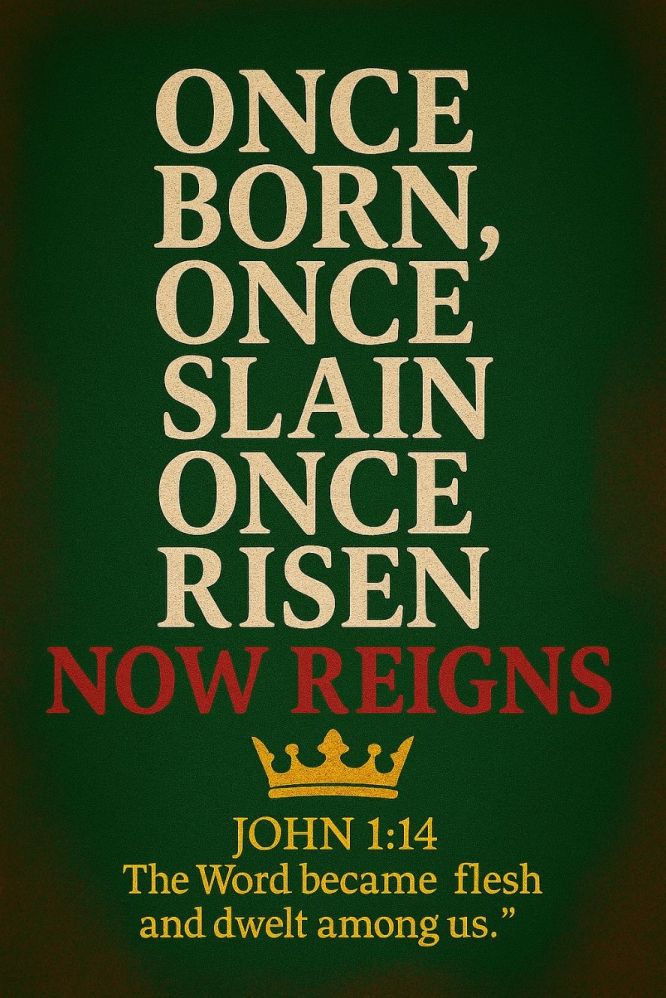
Once Born, Once Slain, Once Risen, Now Reigns


The church has been lulled into cycles of repetition, borrowing pagan customs and sentimental traditions that obscure the gospel. But the Word of God cuts sharper than any ritual. Here are four truths that stand immovable, each one a pillar of the greatest story ever told.

Christ was born once.

The incarnation was not a seasonal myth or a cycle to be replayed every December. “The Word became flesh and dwelt among us” (John 1:14). That moment in Bethlehem was the opening act of redemption, the eternal God stepping into human frailty. He came once, and that was enough. To rehearse His birth as if it were an annual event is to reduce the incarnation to pagan repetition.

Christ died once.

The cross was not symbolic theater—it was the decisive sacrifice. “Christ died for sins once for all, the righteous for the unrighteous, to bring you to God” (1 Peter 3:18). Pagan gods die endlessly in cycles, but Christ’s death was final. It satisfied the wrath of God, fulfilled prophecy, and broke the curse. There is no need for repetition; the penalty has been paid in full.

Christ rose once.

The resurrection is the hinge of history. “He was raised on the third day according to the Scriptures” (1 Corinthians 15:4). Unlike Baal or Sol Invictus, Christ does not rise each year with the sun. He rose once, never to die again. His empty tomb is the triumph that validates our faith and secures eternal life. This is not seasonal hope—it is eternal reality.

Christ forever reign.

The story does not end at the tomb. “He must reign until He has put all His enemies under His feet” (1 Corinthians 15:25). His ascension enthroned Him, and His reign is ongoing. He is not a Babe to be revisited each December—He is the King who rules now and will return in glory. The finale is not nostalgia but the appearing of Christ in power.

Admonition

Stop rehearsing pagan cycles. Stop lighting candles for what has already been fulfilled. Preach the gospel: once born, once slain, once risen, now reigns—soon to return.
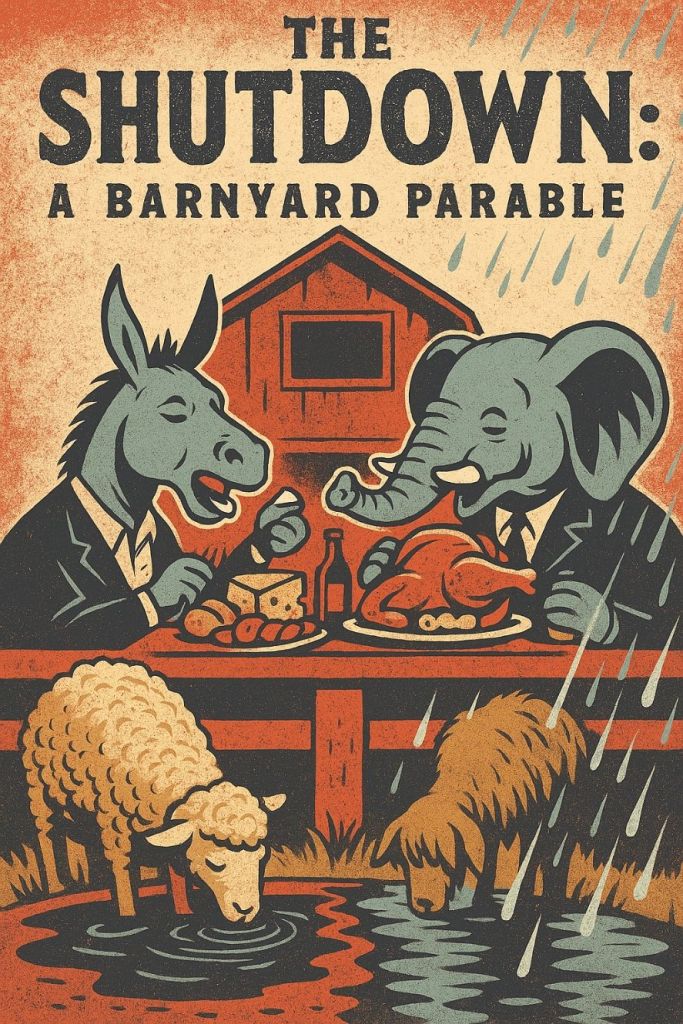
The Shutdown: A Barnyard Parable


Muddy Waters and Judging Between Sheep and Sheep

“Is it not enough for you to feed on the good pasture? Must you also muddy the rest of the water with your feet?” — Ezekiel 34:18


“As for you, my flock, this is what the Sovereign LORD says: I will judge between one sheep and another, and between rams and goats.” — Ezekiel 34:17

The farm’s gates swing shut. “Emergency measures,” trumpet the Elephants. “Necessary sacrifice,” bray the Donkeys. But inside the Big House, both species feast together on grain that was meant for winter storage.

Out in the barnyard, the animals take sides. “The Donkeys caused this!” cry the mice who follow the Elephants. “The Elephants are starving us!” bleat the sheep who trust the Donkeys. They fight over muddied water troughs while neither notices the pipeline running straight from the well to the Big House.

The exhausted horses, working three shifts to buy the same oats that used to cost half, don’t have energy to question why the “opposition” parties keep meeting for midnight suppers. The cows, confused by conflicting reports about which field has grass, give up and chew whatever’s in front of them—usually each other.

Old Major’s dream of “All Animals Are Equal” still hangs painted on the barn, but smaller print keeps appearing underneath: “During Shutdowns, Some Exceptions Apply.” “Temporary Emergency Measures May Extend Indefinitely.” “Your Sacrifice Ensures Our—I Mean YOUR—Security.”

The pigs—now “consultants” who work for both Elephants and Donkeys—explain that the muddy water is actually better for you. “Minerals,” they oink. “Probiotics. Trust the science we funded.”

But one ancient ram remembers Ezekiel’s prophecy: The Judge sees through barn walls. He knows which hooves muddied the water. He’s coming to separate those who got fat on others’ grain from those who starved believing the performance.

The question echoes across the barnyard: When you see them muddying the trough, do you help clear it? Or do you kick in more dirt because your side told you it helps?

The Judge is taking notes. And He’s particularly interested in why the Elephants and Donkeys keep accidentally ordering the same catering service.

But then—the first drops fall.

Rain. Clean, unmuddied, straight from heaven. No pipeline can capture it. No spin can poison it at the source. The animals lift their faces, tongues out, tasting clarity for the first time in years.

Some animals stop fighting over the muddy troughs. They position buckets, barrels, anything that holds water. “Why drink their mud when we can wait for rain?” whispers one lamb to another. Word spreads through the underground—not through official channels the Big House monitors, but farmer to farmer, sheep to sheep: The Judge hasn’t forgotten. He’s sending what they can’t control.

The Elephants and Donkeys panic. They can’t shut down rain. They try: “Unauthorized water collection is dangerous! Only properly filtered water protects you!” But more animals notice—every time it rains, the Big House residents rush to cover their feast tables while the rest of creation drinks freely.

And in the distance, a figure approaches through the storm. Not another politician-shepherd with promises. The Owner Himself, come to judge between sheep and sheep, between those who muddied and those who chose to thirst for truth.

The real revolution isn’t overthrowing the Big House. It’s remembering water doesn’t come from them. It never did.

“I Myself will tend My sheep… I will bind up the injured and strengthen the weak, but the sleek and the strong I will destroy. I will shepherd the flock with justice.” —Ezekiel 34:15-16

Look up. The forecast shows more rain coming.