
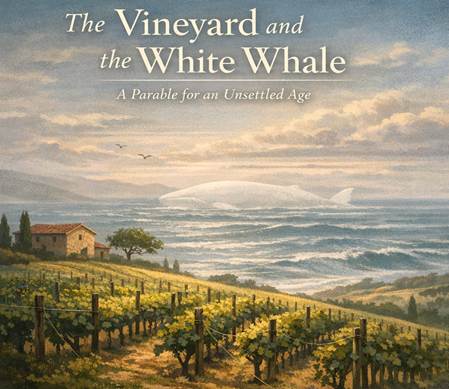
There was a kingdom by the sea where a modest vineyard grew on a quiet rise. It wasn’t impressive, yet it endured every storm. It bore fruit in seasons when other fields failed. It stood as a quiet contradiction to the loud voices of the age.
One man in the kingdom could not bear the sight of it. He was a man of influence, accustomed to shaping the mood of the crowd. But the vineyard unsettled him. It contradicted the story he told about the world. It bore fruit he insisted could not exist. And so, the vineyard became, in his mind, an offense.
He convinced himself that if he could just uproot it, the unease inside him would finally be quiet.
But the vineyard was not his.
And that truth gnawed at him.
He brooded. He rehearsed grievances until they hardened into certainty. Soon the vineyard was no longer a patch of land — it was a symbol of everything he despised. He rallied others to hate it with him. He painted it as a threat to the kingdom’s stability. He insisted that the realm could not stand while that vineyard stood.
Elijah had once confronted a king just like this — a man who wanted what was not his, a man who mistook desire for destiny. The prophet warned him that coveting another man’s inheritance would cost him more than he imagined. But the warning was forgotten, and the pattern repeated.
Across the sea, another man sailed with a similar fire in his bones. Melville would later author his story — a captain who let a single wound become his compass. A white whale had crossed his path, and instead of healing, he fed his injury until it became an obsession. Every sunrise was measured by how close he was to the creature he hated. Every decision bent toward the chase.
Both men believed the same lie:
“If I can destroy the thing that troubles me, the world will finally be set right.”
But the vineyard did not trouble the king. And the whale did not trouble the captain. Their own hearts did.
And while they raged, the world around them trembled.
Borders shifted. Nations armed. Old powers stirred. New powers rose. The tides of history moved like deep waters beneath a sleeping ship.
But neither man noticed. Their eyes were fixed on a single point, and everything outside that point faded into shadow.
The Moral of the Story
And in the days that followed, the kingdom learned what neither Ahab ever could.
When hatred becomes the single bead on the string, it swallows every other color. It dulls the eyes until beauty looks threatening. It numbs the ears until wisdom sounds like deceit. It twists the mind until truth feels dangerous and lies feel safe. It blinds people to what is good, and it blinds them even more to what is right.
The king had sworn the vineyard was poison. The captain had sworn the whale was evil. But the poison was in their own vision, and the evil was in the obsession that hollowed them out.
“The light of the body is the eye,” the Scripture says, “and if the eye is evil, the whole body is full of darkness.” (Matthew 6:22–23)
Their eyes had turned evil — not with violence, but with fixation. And the darkness that followed was of their own making.
The vineyard is still growing. The whale still swam. Nothing the obsessed man did altered either one. His hatred had no power over the thing he despised, so it turned inward and fed him instead.
And any obsession fastened to an unreachable prize will end the same way — consuming the one who clings to it while the prize itself remains untouched.
The prophets had warned of this long before:
“They have eyes, but they see not; ears, but they hear not.” (Psalm 115:5–6)
A blindness chosen, not imposed.
And while the obsessed narrowed their sight to a single target, the world around them shifted. Borders trembled. Nations armed. Old powers stirred. New powers rose. The tides of history moved like deep waters beneath a sleeping ship.
But the obsessed did not see it. They could not. Their hatred had become their compass, and it pointed nowhere but inward.
So, the kingdom learned a hard truth:
A nation fixated on destroying one figure loses the ability to discern the forces shaping its destiny. A people who let hatred guide them will walk straight into the dangers they refuse to see. Obsession does not merely distort reason — it devours it. And when reason is gone, the world can burn unnoticed.
As it is written:
“Be sober, be vigilant; for your adversary the devil walks about as a roaring lion, seeking whom he may devour.” (1 Peter 5:8)
The lion did not devour them through the vineyard. Nor through the whale. He devoured them through the obsession they chose.






You must be logged in to post a comment.