
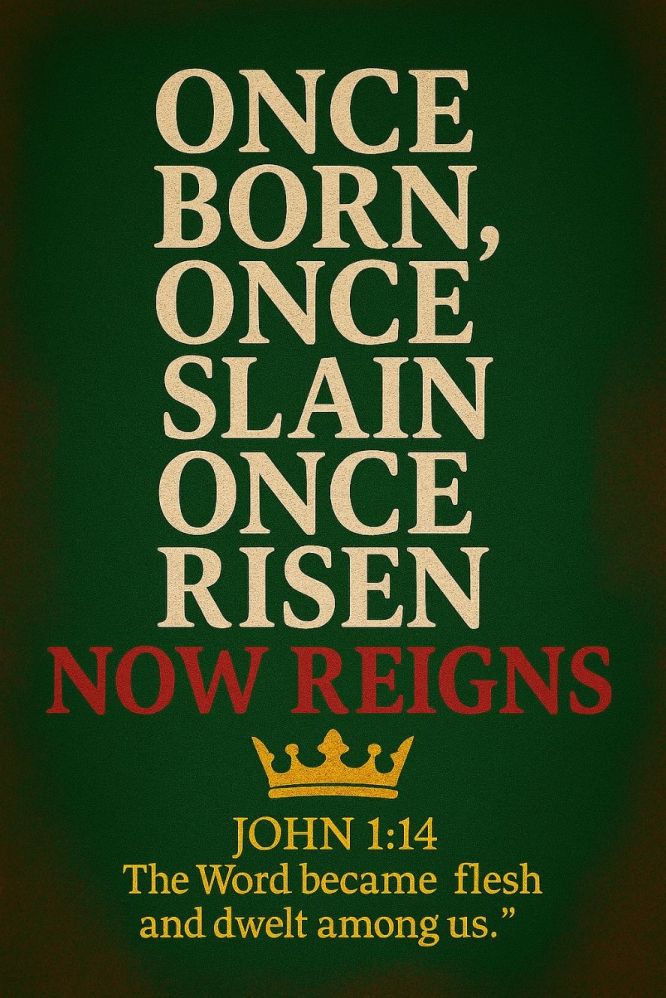
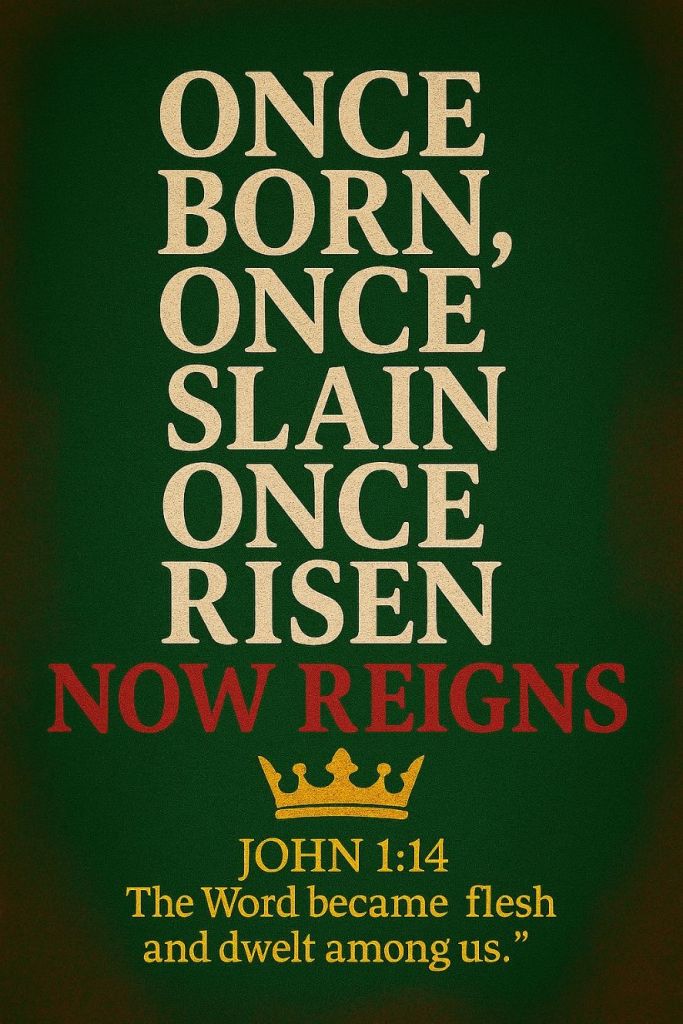
Once Born, Once Slain, Once Risen, Now Reigns


The church has been lulled into cycles of repetition, borrowing pagan customs and sentimental traditions that obscure the gospel. But the Word of God cuts sharper than any ritual. Here are four truths that stand immovable, each one a pillar of the greatest story ever told.

Christ was born once.

The incarnation was not a seasonal myth or a cycle to be replayed every December. “The Word became flesh and dwelt among us” (John 1:14). That moment in Bethlehem was the opening act of redemption, the eternal God stepping into human frailty. He came once, and that was enough. To rehearse His birth as if it were an annual event is to reduce the incarnation to pagan repetition.

Christ died once.

The cross was not symbolic theater—it was the decisive sacrifice. “Christ died for sins once for all, the righteous for the unrighteous, to bring you to God” (1 Peter 3:18). Pagan gods die endlessly in cycles, but Christ’s death was final. It satisfied the wrath of God, fulfilled prophecy, and broke the curse. There is no need for repetition; the penalty has been paid in full.

Christ rose once.

The resurrection is the hinge of history. “He was raised on the third day according to the Scriptures” (1 Corinthians 15:4). Unlike Baal or Sol Invictus, Christ does not rise each year with the sun. He rose once, never to die again. His empty tomb is the triumph that validates our faith and secures eternal life. This is not seasonal hope—it is eternal reality.

Christ forever reign.

The story does not end at the tomb. “He must reign until He has put all His enemies under His feet” (1 Corinthians 15:25). His ascension enthroned Him, and His reign is ongoing. He is not a Babe to be revisited each December—He is the King who rules now and will return in glory. The finale is not nostalgia but the appearing of Christ in power.

Admonition

Stop rehearsing pagan cycles. Stop lighting candles for what has already been fulfilled. Preach the gospel: once born, once slain, once risen, now reigns—soon to return.

‘It Will Be Good for that Servant’


Image by Sergio Cerrato from Pixabay
My Dear Shepherds, It is certainly easier to imagine the Apocalypse now than it was a year ago! Jesus’ commands to have our people ready and waiting for his return seem more urgent. In Luke 12 Jesus told us to “be dressed ready for service … like servants waiting for their master to return from a wedding banquet.” Peter asked, “Lord are you telling this parable to us, or to everyone?”

The Lord answered, “Who then is the faithful and wise manager, whom the master puts in charge of his servants to give them their food allowance at the proper time? It will be good for that servant whom the master finds doing so when he returns. Truly I tell you, he will put him in charge of all his possessions.” (Luke 12:42-44)

(Luke 12:42-44)

There is our job: To be faithful and wise managers, providing food on schedule to those in the household we oversee. Food service doesn’t have the cachet of greatness or prestige but that is our job. We’re quartermasters behind the lines, feeding the troops their rations. The measure of our success is a well-nourished flock, soldiers who don’t wilt in battle. As Dallas Willard wrote, “Instead of counting Christians, we need to weigh them.”

Pastors who love teaching the Bible sometimes assume that as long as they exposit Scripture for their people they’ve fed them well but, frankly, some pastors hide poor shepherding behind good preaching. We must feed our household as Jesus did, with the Word applied, visualized, and embodied by us. Pastors, breathing the Spirit, must incarnate what we preach. Most important is that our people see the love of Christ in us—in the grace we distribute like bread and the ways we wash their feet.

This isn’t the best time to evaluate our work, especially not by the often accepted metrics of pastoral success. Wait till Jesus returns. Feed your people now, day in and day out, meal after meal so that they are healthy, ready, and watching.

Christ’s promised reward is unsettling: “… he will put him in charge of all his possessions.” When I read promises like that (“take charge of ten cities,” is another), I think, You know, I’m tired of being in charge of things. How about if I just sing in the choir. But the work of heaven will be different. We may need a new word for it. “Work” is too weedy and weary. To begin with, our new responsibilities come because of the delighted trust of our Master. “Well done, good and faithful servant! You have been faithful with a few things; I will put you in charge of many things.” Look at that! He’s kept track of those countless small things we did in his name!

Not all our earthly accomplishments will matter then. Our pride-infected, misdirected, faithless work will have been incinerated like wood, hay, and straw. But when we did what the Lord assigned to us, when we built squarely on the foundation of Christ, when we fed, led, and guarded his flock faithfully, our humble work here will be seen there by Jesus as gold, silver, and jewels, the very building blocks of the New Jerusalem.

But there’s more! Our Master will also say, “Come and share your master’s happiness.” Managing God’s possessions in the New Jerusalem will come without weeds, without hassles. No problems to solve. No touchy people to shepherd. Everything to which we put our hand is glorious, every person is beloved, and everything is awash in the bright glory of God.

Lee Eclov Retired Pastor, PT Contributor, leeeclov.com