The Dumbing Down of Christianity


By Dominique Oberling

On March 17, 2008, Oprah hosted her third webnar class with author Eckhart Tolle. Since her endorsement of Tolle’s book, A New Earth, about 3.5 million copies of his spiritual self-help guide have been sent out and more than 2 million people in 139 countries have now signed up for the World Wide Web seminar using a new technology called Skype. (Skype is a free software that allows you to make Internet and videophone calls from all over the world.)

After reading the first two (2) chapters of A New Earth, it is apparent that Tolle does not embrace any one religion over another but instead creates his own, new religion by blending many tenants of Buddhism, Hinduism, Islam, Sufism, Christianity, and other faiths into one. According to a review in the Vancouver Sun by Douglas Todd, Tolle’s “spiritual outlook has become more complex since (his earlier book), The Power of Now, when he dismissed external reality as an illusion and made it sound as if “living in the now” was a panacea for all the world’s problems. In addition, Tolle believes outer realities – including politics, war, poverty, and even the climate – will magically be transformed when individuals change their inner consciousness. This may be true, but only to an extent.”

In essence, Tolle’s approach to his spiritual quest is basically to dumb down all faiths including, and in particular, Christianity. By reducing Christianity to a watered down version, Tolle supplies a Christianity that is more appealing to the masses. According to Chuck Norris in his article, Oprah’s New Easter, “Tolle only quotes relatively benign sayings of Jesus, avoiding the more difficult ones. For example, Tolle notes that Jesus taught that the kingdom of heaven is already present on earth and can be experienced right now, but Tolle overlooks Jesus’ teaching that one must be born again (by believing in Him as the Son of God and Savior) to see that kingdom in the future” (Norris 1). Additionally, Tolle makes no mention that Jesus was making reference to the kingdom of heaven that will take place on earth after Jesus’ pending return in which He will set up his new kingdom here on earth.

Needless to say, Tolle incorrectly interprets this passage on page 43 of his book when he writes, “‘Blessed are the poor in spirit,’ Jesus said, ‘for theirs will be the kingdom of heaven’. What does ‘poor in spirit’ mean? No inner baggage, no identifications. Not with things, not with any mental concepts that have a sense of self in them. And what is the ‘kingdom of heaven’? The simple profound joy of Being that is there when you let go of identifications and so become ‘poor in spirit'” (New).

As Norris noted, Tolle does indeed dumb down Matthew 5:3 by declaring the poor in spirit is here and now and all one needs to do is live in the present as well as do away with all your earthly possessions. While controlling our insatiable need for material possessions – as Americans – would most definitely be a worthy goal for each and every one of us, Tolle misinterpreted this scripture by taking it out of context. Whether intentional or not, he misconstrued what this passage is really about.

What Tolle leaves out of his dumbed-down version of Jesus’ Sermon on the Mount is that in this particular passage, the word poor is linked to in spirit. If Jesus had used the word poor by itself, than Eckhart’s interpretation would be valid. However, Jesus links poor to spirit to clarify His intention. “To be poor in spirit is to acknowledge honestly and with understanding our spiritual poverty – indeed our spiritual bankruptcy – before God” (bible 3).

Norris also states that we “need to rebel against low expectations of culture and choose to do hard things” (Norris, 1). In other words, instead of falling at the feet of the current guru and hearkening his dumbed-down version of ‘Christianity,” we need to take a stand and follow the road that is less traveled. Although a much harder road to travel, it is one that will ultimately lead us to the eternal One who has all the answers, not just for our own personal lives, but for the society we live in.

Ultimately it is our own personal decision to make. We can choose to accept the dumbed-down version of Christianity that is being espoused by the Tolle-Oprah church, or we can take the harder route and the less traveled road and follow Jesus Christ. In order to do so, however, we must accept all of Him, not the dumb-down version offered up in A New Earth.

Dominique Oberling

http://www.wnd.com/index.php?pageId=57827

http://www.oprah.com/obc_classic/webcast/ane_marketing.html

http://anunlikelyperspective2.squarespace.com

Article Source: http://EzineArticles.com/?expert=Dominique_Oberling
http://EzineArticles.com/?The-Dumbing-Down-of-Christianity&id=1091070

Related articles

Author Chopra creates new Jesus


Crucifixion, Diego Velázquez, 17th c. Abrahamic religions believe in the idea that God can prescribe a means of atonement for sin; in Judaism, by spilling the blood of animals or in Christianity, by the atonement of Jesus.Image via Wikipedia

Number three on the New York Times best seller list does not surprise me. People would much rather believe all these convoluted offerings rather than the truth that a loving God actually cared enough about our pitiful selfs that He sent His only Son to die so that we might live.Now I do not know about you but my best intentions has never led me anywhere but to despair. No matter how hard I tried I could never measure up to be GOOD enough by the so called enlightened crowd so I guess I would be doomed to forever live in despair save for the Lord Jesus Christ who came into my life and rescued me from my despair. Now I know who I belong to and therefore I am no longer looking to the enlightened crowd for my self worth.

Perhaps Chopra and all his adherents would be better served to read the ‘Good Book’.

clipped from www.townhall.com
In the book, released in February by Harmony, Chopra states, “I have written what I think the New Testament means…” And what it means to Chopra, the author of more than 40 books, is quite different from the way orthodox Christians have understood it through the centuries.
Chopra believes that the “real” Jesus — the third Jesus — is much less than the New Testament makes him out to be.
According to Chopra, Jesus was nothing more than an adherent to what we now call New Age philosophy.
“Jesus did not physically descend from God’s dwelling place … nor did he return to sit at the right hand of a literal throne,” writes Chopra. “What made Jesus the Son of God was the fact that he had achieved God-consciousness.”
We shouldn’t discount Chopra’s book and assume no one is reading it. Sadly, the opposite true. “The Third Jesus” — full of New Age, heretical pabulum — was ranked third March 30 on The New York Times’ list for hardcover advice books.

Not So Good Friday


By Patrick Oden

goodfri 4546cToday is Good Friday. A curious name because in reality it was a pretty bad Friday.

Imagine if you were a disciple. You had spent three years following a man who more and more seemed like he was the Messiah. He did miracles. He spoke wisdom. He had a power you had never seen in anyone.

Then, on the day in which his power was tested he failed the test. You had given up everything, all that you were, to follow this man and on this Friday he left. He was killed. And this is just the perspective of Jesus‘ followers. Don’t get me started on how bad Jesus’ day was.

“Take this cup from me,” he prayed the night before. God didn’t. It wasn’t his will that Jesus be saved at this point.

On that Friday it was anything but good. Maybe it should be called Miserable Friday, or Awful Friday, or The Worst Friday Ever. Lives were lost on that day, and not just those crucified. Souls were seemingly lost. Everything went wrong. Nothing worked right.

Oh, yeah, Joseph of Arimathea… he was able to get a tomb and bury Jesus before nightfall. At least Jesus wasn’t thrown to the dogs. Thank God for the little blessings, eh?

Yes, the prophets said something about suffering, and disfigurement and the like. But, what is that on such a day? Everything goes wrong. But God does not do wrong things. What are the prophets when one’s own perception sees the troubles bubbling over? They are forgotten words of a past era unable to speak to the present. Jesus is dead. Jesus is buried. Turns out he wasn’t the Messiah after all. We were wrong. He couldn’t even save himself.

Good Friday? There was nothing good about it.

So why call it this? Why is it Good Friday?

Because of Easter. Because two days later he rose from the dead. Friday is only good because we are able to observe the future of the events. We are able to see that Jesus died, but he died for a reason, a reason only seen on Easter morning. We reinterpret the past events based on the later events. All was wrong on that first Friday… except that it was all right because of what would happen two days afterwards.

Continue reading “Not So Good Friday”

A Message for Saint Patrick’s Day


Insight for your “Journey across the Sky” A View from the Nest www.eagleviews.org

You observe days and months and seasons and years! Gal 4:10 (ESV)

Saint PatrickThis year Saint Patrick’s day falls on the Monday of Holy week, the week leading up to the crucifixion of Jesus. It is ironic, in a sense, that this year the day that was set aside to honor the death of one man, Saint Patrick, sets off a week that ends in the death of one man, Jesus. The week starts on a celebration and ends on one as well. Granted the latter being more significant then the former but none-the-less two celebrations indeed bookend this week.

To the Christians, Resurrection Sunday is the grandest of all celebrations for it was on this day that Jesus arose from the dead, to release all those who where held captive by sin. To a true Irishman, Saint Patrick’s day is a day to celebrate being freed from paganism. The one celebrates a death while the other celebrates a life. Saint Patrick, although credited with Christianizing Ireland over his 30 year ministry, can not compare to Jesus who brought Christianity to the whole world during his 3 and a half year ministry.

Posthumously both received acclaim as being men of God, but only Jesus can rightfully claim the title King of Kings and Lord of Lords.

Similarities and contrasts exist for both celebrations. On the one hand we have a nation, Ireland, celebrating the liberation from moral depravity through the influence of the Catholic church and it’s missionary Patrick. On the other hand we see the celebration of life from death, experienced in the life of a born again believer through the influence of the death and resurrection of Jesus Christ. Both were persecuted by those who hated them. For Saint Patrick it was the imprisonment at the hands of Irish Marauders, and later hatred by Celtic Druids, who resented his effective work at converting their followers to Christianity. Jesus too was sought after by the Scribes and Pharisees of his day who plotted to arrest him.
Continue reading “A Message for Saint Patrick’s Day”

Fighting Temptation


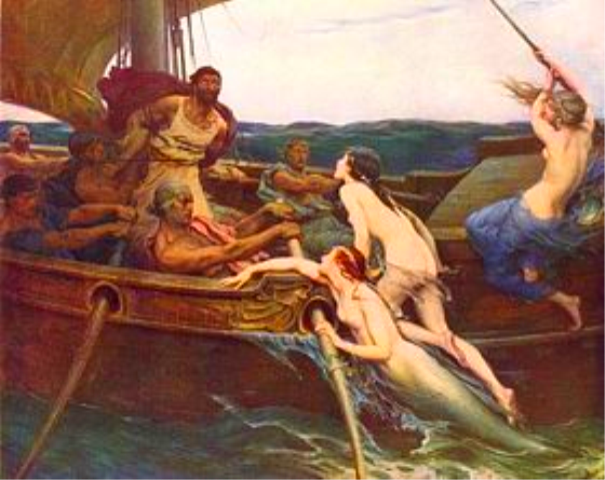
’Odysseus and the Sirens’. Herbert James Draper, 1909. Ferens Art Gallery, Hull.
'Odysseus and the Sirens'. Herbert James Draper, 1909. Ferens Art Gallery, Hull.

In the story of Ulysses, from Homer’s Odyssey, he is on his ship, trying to make his way home? He knows he will pass by the Isle of the Sirens, those voices sing out across the sea in such enticing tones that many sailors are led to their deaths on the jagged, rocky shores, never to see home or their destination. Ulysses commanded that his men put wax in their ears so they could not hear those voices and so be led to their destruction. But for himself, he was tied to the mast so that he could hear their singing. He commanded that none of his orders while hearing them were to be obeyed. The voices almost drive him mad until finally the ship passes by, the voices are stilled, and once more his ears are filled with the voices of his wife and son, with home, with his true destination. So many voices crying out to us on our journey,

Temptation has that effect on everyone. When we set sail towards temptation we are fighting a battle that is far greater than our human capacity to endure. Had Ulysses not had himself tied to the mast and told his sailors to ignore his desire to set off after the tempting allures of the forbidden island he too would have made shipwreck along the shores of life’s many temptations.
Continue reading “Fighting Temptation”