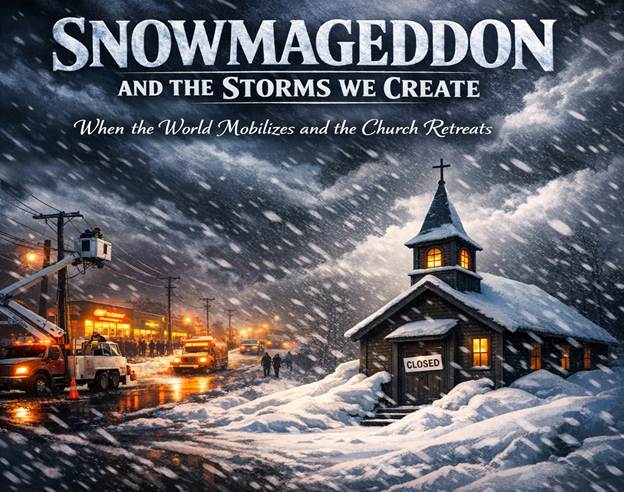
Snowmageddon and the Storms We Create: When the World Mobilizes and the Church Retreats


The forecasts grow louder. The graphics turn dramatic. The region braces for what the news has christened Snowmageddon. This is a storm wrapped in apocalyptic language. It comes complete with countdown clocks, urgent tickers, and warnings that feel more cinematic than meteorological. The world prepares with a kind of frantic determination. Meanwhile, something else unfolds quietly in the background. It is almost unnoticed unless you are paying attention.

Electric linemen are already staged in their trucks, engines idling, ready to restore power the moment the first line snaps. Road crews sit in warm garages beside mountains of salt, waiting for the call to roll out into the night. Grocery stores are stripped bare as shoppers fill carts with enough food to survive a siege. Everyone is mobilizing. Everyone is preparing. Everyone is stepping into their role with a sense of duty and resolve.

And then, amid all this activity, comes the announcement from the one place that claims to carry the unshakable Kingdom:

“All services are canceled due to inclement weather.”

The contrast is hard to ignore. The world gears up. The church shuts down.

This is not about recklessness or ignoring safety. It is about the symbolism—the quiet confession embedded in the decision. When the world anticipates hardship, it mobilizes. When the church anticipates hardship, it retreats. And that retreat reveals something deeper than a scheduling adjustment. It reveals a posture.

Scripture never once suggests that worship is a Sunday-only activity, nor does it tie devotion to favorable weather. The command is simple and ancient: “Six days you shall labor and do all your work, but the seventh is a Sabbath to the LORD your God.” (Exodus 20:9–10) The rhythm is work and rest, not convenience and cancellation. If the work of the Kingdom is the saving of souls, it also includes the strengthening of the saints. It involves the breaking of bread and the prayers of the people. Then that work is not suspended by snowflakes.

The early church understood this instinctively. They gathered in homes, courtyards, borrowed rooms, and hidden places. They met in caves and catacombs. They prayed in prison cells. They broke bread wherever they could find a table. They did not have buildings to close, so they could not close the church. Their worship was not weather-permitting. Their devotion was not seasonal. Their gatherings were not fragile.

Jesus Himself warned us about the danger of a faith that collapses under pressure. “Everyone who hears these words of Mine and does them is like a wise man who built his house on the rock.” (Matthew 7:24) The storm came, the winds blew, the floods rose—and the house stood because its foundation was not circumstantial. But the house built on sand fell, “and great was its fall.” (Matthew 7:27)

A storm does not create weakness. A storm reveals it.

And perhaps that is what Snowmageddon exposes—not the fragility of our infrastructure, but the fragility of our ecclesiology. A church that closes at the first sign of difficulty has confused the building with the body. A church that cancels worship because the weather is inconvenient has forgotten. It has forgotten that worship is not an event but a life. A church that retreats while the world mobilizes is a church that has lost sight of its calling.

Jesus said, “The harvest is plentiful, but the laborers are few.” (Matthew 9:37) He did not add, “unless it snows.” He did not say, “unless the roads are slick.” He did not suggest that the work of the Kingdom pauses when the forecast is unfavorable. Souls do not stop needing salvation because the temperature drops. Hearts do not stop needing hope because the wind picks up. Darkness does not delay its work because the roads are icy.

If anything, storms heighten the need for light.

The world prepares for the storm because it knows what storms can do. The church should prepare for the storm because it knows what storms reveal.

And maybe that is the quiet message hidden inside this winter’s theatrics. If a snowstorm can cancel our worship, perhaps what we call worship was never the thing God asked for. If a weather system can scatter the saints, perhaps the gathering was never rooted in the Spirit. If the church retreats while the world mobilizes, maybe we have forgotten that the Kingdom work is still work. The One who called us did not limit His commission to clear skies.

“Be steadfast, immovable, always abounding in the work of the Lord.” (1 Corinthians 15:58)

Storm or no storm, the Kingdom does not close. Storm or no storm, the mission does not pause. Storm or no storm, the church is still the church.

And maybe Snowmageddon is not the storm we should fear. Maybe the greater storm is the quiet one. It shows how easily we retreat when the world needs us most.
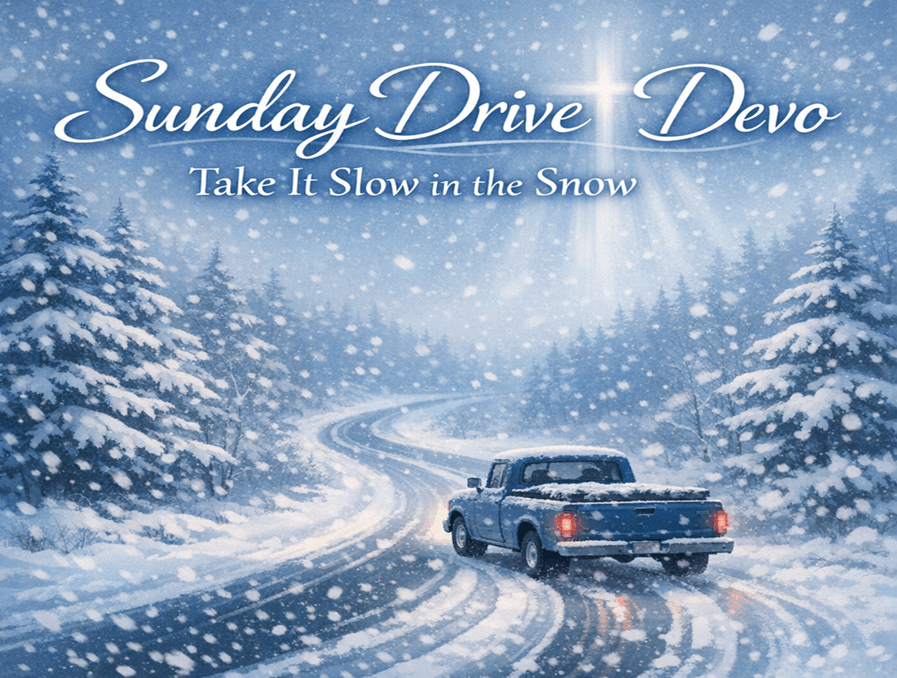
Take It Slow in the Snow


A Winter Road. A Spiritual Lesson. A Faithful Captain.

Opening

The weather outside may be frightful, and the roads may be anything but delightful. Snow piles up, visibility drops, and ice hides beneath the surface waiting to surprise the unprepared. On days like this, the wise stay home. But if you must venture out, safety is job one.

Take it slow in the snow.
Because where there is snow… there is almost always ice.

1. The Four‑Wheel Drive Myth

A lot of folks hit the winter roads thinking four‑wheel drive makes them invincible. But every seasoned driver knows the truth:

All tires slide on ice.
Four‑wheel drive helps you get moving — it does nothing to help you stop.

And sometimes?
Four‑wheel drive just gets you into trouble faster.

Spiritually, pride works the same way.

1 Corinthians 10:12 — “Let him who thinks he stands take heed lest he fall.”

Overconfidence is black ice for the soul.

2. Weight: The Hidden Stability

Years behind the wheel taught me something most people don’t understand:

An empty truck bed is unstable.
A loaded truck settles down.

Weight increases traction.
Weight presses the tires into the road.
Weight gives you control.

Spiritually, the same is true.

Psalm 119:11 — “Your word I have hidden in my heart, that I might not sin against You.”

A believer with Scripture inside them has spiritual downforce.
An empty soul slides.
A weighted soul stands.

3. Traction: Obedience Under Pressure

Dualies give you more rubber on the road — but only when there’s weight pressing them down.

Empty dualies?
They float on snow.
They lose grip.
They slide sideways.

But load that truck…
and those dualies bite into the surface and hold steady.

Obedience works the same way.

James 1:22 — “Be doers of the word, and not hearers only.”

Traction isn’t about speed — it’s about grip.
It’s about consistency.
It’s about doing what God said even when conditions are slick.

4. Modern Parables from the Road

Parable 1 — The Invisible Ice

Black ice looks like pavement.
Temptation looks like opportunity.

Proverbs 14:12 — “There is a way that seems right to a man, but its end is the way of death.”

Parable 2 — The Slow Driver Who Arrives

The one who slows down in the storm is the one who makes it home.

Isaiah 30:15 — “In returning and rest you shall be saved; in quietness and confidence shall be your strength.”

5. The Road as an Altar — First Person Revelation

I’ve spent a lot of years behind the wheel.
Long roads. Long nights. Long storms.
And if there’s one thing driving has taught me, it’s this:

Experience helps… but experience alone won’t save you.

I’ve learned to feel the road through the steering wheel.
I’ve learned how a truck talks when the bed is empty,
and how it settles down when it’s carrying weight.
I’ve learned the difference between snow and ice,
between a slide I can correct
and a slide that’s already decided for me.

But even with all that experience,
I’ve had moments where the road reminded me:
You don’t know what you don’t know.

And that’s exactly what happened on the Sea of Galilee.

The disciples weren’t rookies.
They were experienced fishermen — men who grew up on that water.
They knew the winds.
They knew the currents.
They knew the storms that came out of nowhere.

But one night, a storm hit that was bigger than their experience.

Mark 4:37 — “And a great windstorm arose, and the waves beat into the boat…”

These seasoned men panicked.
Why?
Because experience can teach you a lot —
but it can’t teach you everything.

Experience can make you skilled —
but it can’t make you sovereign.

Experience can help you navigate storms —
but it can’t calm them.

Only Jesus can do that.

Mark 4:39 — “Then He arose and rebuked the wind, and said to the sea, ‘Peace, be still!’”

And someone always brings up Paul’s shipwreck as a rebuttal —
“See? Even a man of God can go down in a storm.”

But look closer.

The ship wrecked…
but the people didn’t.

Acts 27:22 — “There will be no loss of life among you, but only of the ship.”

Why?
Because a man of God was on board.
Because God had a purpose for Paul that no storm could cancel.
Because Jesus wasn’t just along for the ride —
He was the Captain of the outcome.

And that’s the lesson I’ve learned on the road:

I can have experience.
I can have skill.
I can have traction and weight and wisdom.
But if I try to navigate a storm on experience alone,
I’m headed for a wreck.

But if Jesus is in the cab with me —
better yet, if He’s the One holding the wheel —
then even if the truck slides,
even if the road gets rough,
even if the storm gets violent…

I’m going to make it.

Not because I’m a great driver.
But because He’s a faithful Captain.

Psalm 121:8 — “The LORD shall preserve your going out and your coming in…”

Final Reflection

And before I close this out, let me say one more thing — something personal, something true, something I carry with gratitude every single day:

I’ve survived over three million miles behind the wheel.
Accident‑free.
Incident‑free.
Storms, snow, ice, long nights, empty roads, and crowded highways —
and I’m still here.

Not because I’m the best driver.
Not because I always made the right call.
Not because experience never failed me.

I’m here because Jesus piloted my ship.

Three million miles…
and not one of them driven alone.

Thank You, Jesus.

Closing

If you have nowhere to go today, let it snow.
Rest. Be still.

But if God calls you forward, take it slow in the snow.
Move with wisdom.
Move with awareness.
Move with Him.

Because the One who guides you through the storm
is the same One who clears the road ahead.

Proverbs 3:6 — “In all your ways acknowledge Him, and He shall direct your paths”

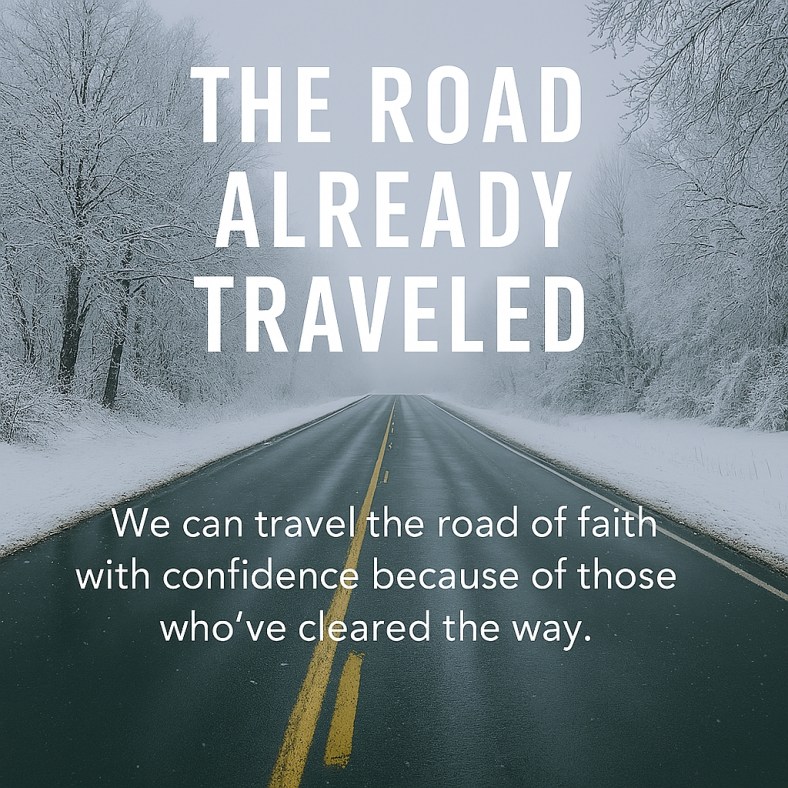
The Road Already Traveled


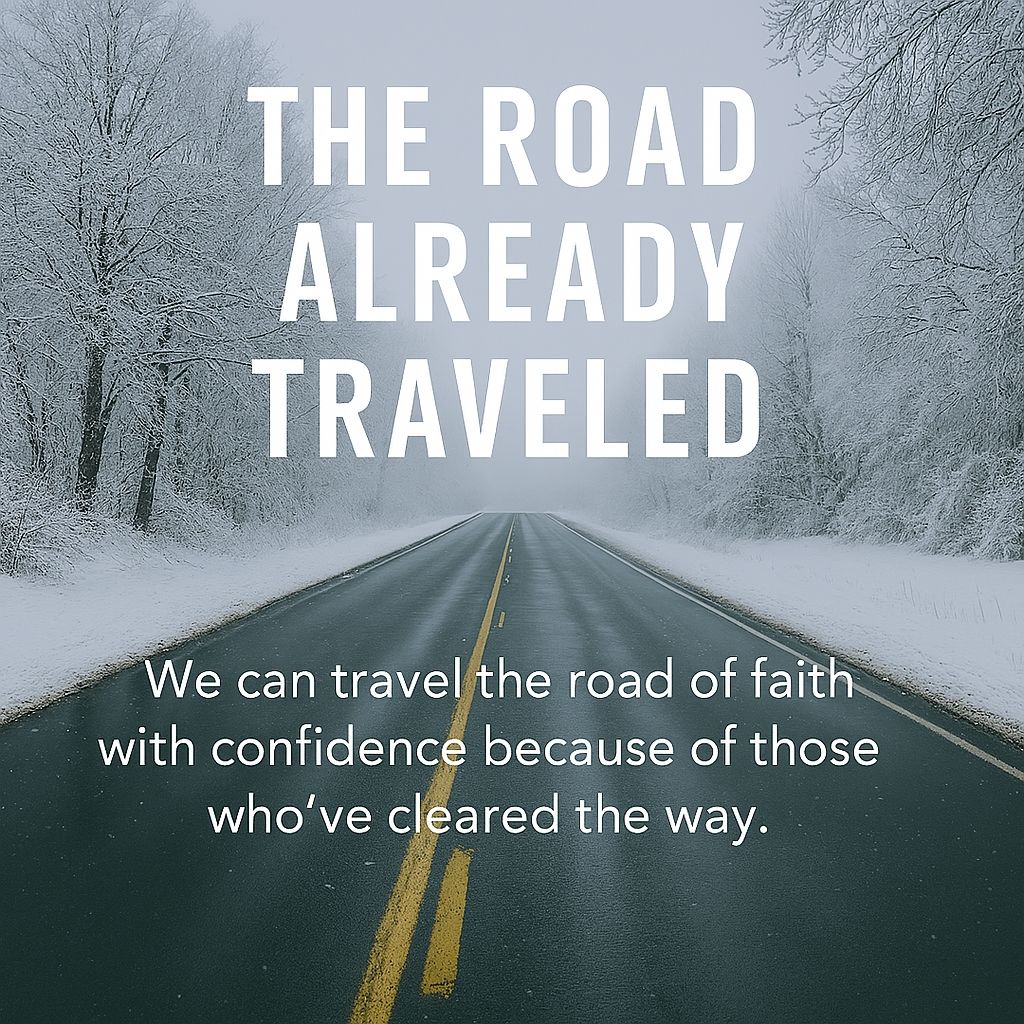
The snow had fallen heavy across the fields, a white blanket covering everything in sight. Yet as I drove my route, the roads beneath my tires were clear. Someone had gone before me. Road crews had braved the cold, plowed the snow, and laid down salt so I could travel safely. I didn’t see their labor, but I reaped its benefit.

That picture stayed with me: the unseen work of those who prepare the way. And I realized—it’s not just true of winter roads. It’s true of the life of faith.

Scripture tells us we are “surrounded by so great a cloud of witnesses” (Hebrews 12:1). Men and women of faith who endured hardship, persecution, and trials have gone before us. They cleared the path, leaving behind testimonies of endurance and courage. Their footprints mark the way, showing us it can be done.

Paul could say at the end of his journey, “I have fought the good fight, I have finished the race, I have kept the faith” (2 Timothy 4:7). His words are like mile markers on the road, encouraging us to press on. The prophets, apostles, martyrs, reformers, and even faithful family members who walked with Christ—they all labored so we could travel confidently along the pathway they laid.

And here’s where the “comfort angel” comes in. Paul also writes that God comforts us in our affliction “so that we may be able to comfort those who are in any affliction, with the comfort with which we ourselves are comforted by God” (2 Corinthians 1:3–4). That’s the ministry of comfort: what once was frightening becomes manageable because someone else has already walked it, received God’s mercy, and left behind encouragement. Their testimony is like salt on icy roads, turning danger into safe passage.

Just as I thanked the road crews for their unseen work, I thank God for those who prepared the way of faith before me. Their endurance clears my doubts. Their testimony salts the icy patches of fear. Their example plows through the drifts of discouragement.

And now, the responsibility is ours. We are not only travelers—we are road crews for those who will come after. Our faithfulness today prepares tomorrow’s pathway. Our endurance becomes encouragement for the next generation.

So drive forward with confidence. The road is not uncharted. It has been traveled, tested, and proven. And as we follow Christ, we prepare the way for others to follow Him too—comforting them with the same comfort we ourselves have received.

We can travel the road of faith with confidence because of those who’ve cleared the way.