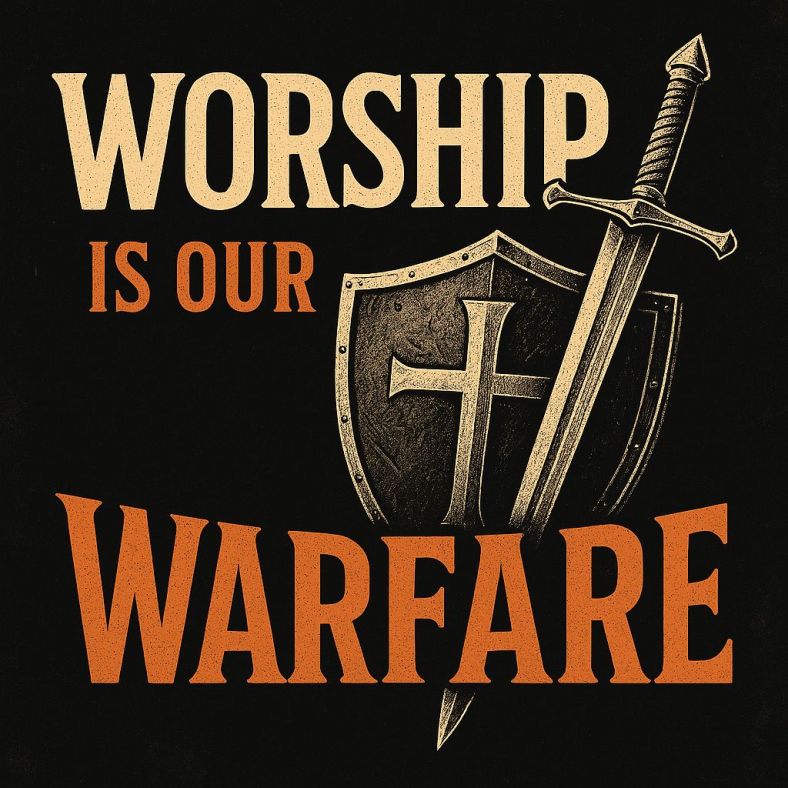

Worship Is Our Warfare: Reclaiming Praise with Purpose


Worship is more than a song. It is a weapon we wield.


In a world noisy with distraction and heavy with unseen battles, worship remains one of the most powerful weapons God has placed in our hands. Not a soundtrack for Sunday. Not an emotional indulgence. But a deliberate, Spirit-anchored declaration that God is God — and we are His.

📖 More Than a Melody — A Battle Cry

Throughout Scripture, we see worship wielded like a sword:

King Jehoshaphat sent singers ahead of soldiers (2 Chronicles 20:21–22), and God Himself set ambushes.

Paul and Silas sang in chains (Acts 16:25–26), and the foundations of the prison trembled.

The psalmist spoke of praises paired with a double-edged sword (Psalm 149:6–9), symbolic of divine authority.

These weren’t acts of passive praise. They were bold movements of faith that invited divine disruption.

🎺 Jericho Jazz & the Wall-Fall Waltz

Now imagine the folks in Jericho watching this parade of priests and trumpeters circle their city. Day after day, they see the same scene: a mariachi band of misfits marching in silence, save for the occasional trumpet blast.

At first, they might have laughed, pointing and jeering from the safety of their walls. But as the days wore on, perhaps their laughter turned to unease. What kind of army fights with music? What kind of strategy is this?

And then, on the seventh day, the music swelled, the people shouted, and the walls that had stood for generations crumbled like sandcastles under a tidal wave.

This wasn’t just a battle won; it was a divine declaration. Worship wasn’t their weapon — it was their witness.

🌊 Noah and the Ark: A Parallel of Faith

The story of Jericho harkens back to Noah, who built the Ark of safety while his neighbors mocked him, believing he had lost his mind. Just as Noah’s neighbors trusted in their own understanding and dismissed the warnings, the people of Jericho trusted in their man-made fortress, believing their walls were impenetrable.

But when the Shout came, their sense of security crumbled along with their walls. They were unprepared because their trust was misplaced.

Thus is the power of praise. Worship centered on God’s might and not on our own creations is our weapon; it is our warfare.

🙌 Worship with Intent, Not Emotion

Vibrant worship is heartfelt, yes — but it is also directed. It honors God not merely in volume or vibe, but in posture:

A posture of surrender, where we relinquish control.

A posture of dependency, where we declare, “You alone are my shield” (Psalm 3:3).

A posture of remembrance, where we reinforce our identity as conquerors in Christ (Romans 8:37).

Lip service may sound sweet to ears, but it does not shake kingdoms. True worship is not a performance — it’s a positioning.

🕊️ Where Praise Dwells, God Defends

When our praise rises, God defends.

Psalm 22:3 reminds us that God inhabits the praises of His people. This means that when we worship, we invite His presence into our battles.

Consider the walls of Jericho. They didn’t fall because of brute force or military strategy. They fell because God responded to the faith-filled worship of His people.

In the same way, our worship today can dismantle strongholds — not just physical ones, but spiritual ones.

Reflect & Respond

What walls are you facing? Take a moment to identify the barriers in your life that seem insurmountable.

Where is your trust? Are you relying on your own strength, or are you placing your faith in God’s power?

How can you worship intentionally? Consider ways to make your worship more than a melody — a deliberate act of faith.

As you reflect, remember that worship is not just a song; it’s a stance. It’s not just an expression; it’s an invitation for God to move.

So lift your voice, raise your hands, and let your praise rise. The walls won’t stand a chance.

Let’s Hear Your Voice

Testimony of God’s deliverance, shout your praise, sound your trumpet of triumph, and join us in marching together as we worship the King of Kings. Share your thoughts and comments — we’d love to hear from you!

This has been a View From the Nest. Be sure to like and share! Until next time, be blessed!

Timeless Comfort: Embracing Psalm 23’s Wisdom


Experience the timeless comfort as we explore the profound words of “Psalm 23”. Allow this “christian meditation” to bring you “comfort” and guide you into a deeper connection with your “faith”. May these scriptures bring peace and renewal to your soul.

🌅 Wednesday Worship: Great Is Thy Faithfulness – A Hymn of Steadfast Hope


🎵 Intro: The Song That Refuses to Expire

There’s something timeless about a melody that echoes eternity. Great Is Thy Faithfulness isn’t flashy—it’s quietly strong, like the steady sunrise or the whisper of grace when you least expect it. This isn’t a song for the mountaintops. It was born in the valleys.

📖 Historical Backdrop

Thomas Chisholm, the hymn’s author, didn’t write from abundance—he wrote from dependence. His life, marked by frail health and modest means, shines with the truth that God’s faithfulness doesn’t depend on our circumstances. It endures.

Chisholm once said:
“I wanted to write something that would show the faithfulness of God as I had experienced it during my many years.”
And so this hymn became a testimony—not to triumph, but to trust.

Lyrical Meditation: “Morning by morning new mercies I see”

How often do we overlook the miracle of “morning”? Not just the literal dawn, but the daily divine reset. The lyric echoes Lamentations 3:22–23:

“Because of the Lord’s great love we are not consumed, for His compassions never fail. They are new every morning; great is Your faithfulness.”

When Chisholm wrote “new mercies,” he was reflecting on the faithful provisions of God that arrive like clockwork, not because we deserve them, but because He’s faithful.

🛡️ Biblical Anchors

  • James 1:17“Every good and perfect gift is from above…who does not change like shifting shadows.”
  • Psalm 119:90“Your faithfulness continues through all generations.”
  • Hebrews 13:8“Jesus Christ is the same yesterday and today and forever.”

Each of these verses confirms what the hymn proclaims: God doesn’t flinch, falter, or fade.

💬 Personal Reflection Prompt

Think of a moment recently, when God showed up, not dramatically, but dependably—in a steady provision, a quiet comfort, or the grace to make it through a hard morning. That’s the kind of faithfulness this hymn celebrates. Write it down. Sing about it. Tell someone.

🔥 Closing Challenge

This week, look for mercy not in the miraculous—but in the mundane. Let each sunrise be a reminder that God remains. That His love still holds. That faithfulness isn’t an event; it’s His essence.

🪨 Shelter in the Storm: Anchored in the Rock Before the Winds Rise


The winds howl. The headlines scream. Homes are shattered, hearts are heavy, and the world trembles beneath a thousand storms—natural, emotional, spiritual. And in the middle of it all, an old hymn whispers with unwavering faith:

Jesus is a rock in a weary land, a shelter in the time of storm.

This isn’t just poetic comfort—it’s spiritual survival. A Shelter in the Time of Storm, written in the late 1800s by Vernon Charlesworth, was born out of a world worn down by hardship. It became a lifeline sung by fishermen steering into stormy harbors, echoing through orphanages ministering to broken souls, and later reimagined by Ira Sankey to stir congregations across oceans. Its refrain is timeless—because the Rock it speaks of is eternal.

Storms will come. And when they do, it’s not doctrine or dogma that saves us—it’s Christ Himself. Scripture declares:

“The Lord has been our dwelling place in all generations… He is my rock, my fortress, my deliverer.” (Psalm 90:1, 18:2)

But in the middle of the storm—when thunder drowns out reason and lightning blinds perspective—it’s difficult to fix your eyes on anything but the chaos. That’s why it’s vital to know the Rock before the storm hits. Calm seas are the classroom. Quiet days are the training ground. Every peaceful moment spent abiding in Him becomes a spiritual anchor when the winds rise.

When you know Jesus in the stillness, you recognize Him in the storm.
He’s not just refuge; He’s recognition.
Not just shelter; He’s strength.
Not just security; He’s sovereign.

And as the world reels from wildfires, floods, wars, and heartache—this hymn becomes a holy declaration: we are not unmoored. The storm may be raging, but the Rock is not shaking. In Him, we find not just protection—but peace.

So today, as tempests swirl around us, let this truth settle deep into your spirit:
Jesus is sure, sound, safe, and secure. He is your Shelter. He is your Storm-Calmer. He is your Rock—now and forever.
This has been a View From the Nest, please like and share and don’t forget to sign up for our newsletter to stay up-to-date when new posts are added. Thank you for stopping by.

Allen Scott

Title: Stop Wasting Gifts: The Shocking Truth About Church Unity


Random Ramblings from the Resident Raptor

Intro

Is your church – the place you count on for spiritual food and fellowship – unknowingly holding itself back? What if I told you that many congregations, maybe even yours, are unintentionally undermining their own unity and strength? How? By overlooking or downplaying the very gifts God has given them to flourish. It’s a tough pill to swallow, but the truth is, countless spiritual talents are gathering dust – unused, unappreciated, or even dismissed. This leads to a fractured and less effective Body of Christ. Stick with me as we dig into the biblical truth that every spiritual gift is essential, and how truly welcoming this God-given diversity isn’t just a nice idea, but the absolute key to a vibrant, interconnected church.

Section 1: The Problem – Wasting Gifts, Sabotaging Unity

We talk a lot about unity in the church, don’t we? It’s a beautiful idea, even a command from God. Jesus himself prayed passionately for it in John 17 – that his followers would be one, so the world would believe. But what does that unity look like? Is it about everyone thinking, acting, and serving in the exact same way? Not a chance. The Bible shows us a unity that’s born from diversity – like a beautiful harmony of different notes, not just one long, boring hum.

The problem, the “shocking truth,” is that many churches have quietly stumbled into a trap. We’ve, often without meaning to, created a sort of ranking system for spiritual gifts. Some gifts get all the attention, put on a pedestal – you know, the more visible ones like preaching, teaching, or leading worship. Meanwhile, other gifts – often the quieter, less public, or maybe less understood ones – get pushed to the side, seen as less important, or sometimes completely ignored.

Think about it. When was the last time your church got as excited about celebrating the gift of helps, or mercy, or administration as it did for a powerful sermon? When did you last hear a message emphasizing how crucial those with gifts of discernment, hospitality, or giving are to the church’s health and outreach?

Now, this usually doesn’t come from a bad place. Often, it’s just due to misunderstanding, not enough teaching on the subject, or a cultural tendency to value what looks most impressive on the surface or gives the quickest results. But the result? Gifts get wasted. And when gifts are wasted, the One who gave them isn’t fully honored, and His Body, the church, suffers. We’re telling parts of the Body that they’re not needed, or at least, not as much. This flies right in the face of what the Bible teaches and is a surefire way to wreck the very unity we say we want. It doesn’t breed unity; it breeds division, not over big theological debates, but over something as basic as undervaluing God’s diverse gifts.

Section 2: Agitating the Problem – The Shocking Truth & Consequences

So, what really happens when a church devalues or ignores certain spiritual gifts? This is where that “shocking truth” lands a punch. It’s not just a small hiccup; it’s a major blow to the church’s energy and its mission.

First off, disunity and division start to grow. The Apostle Paul, in 1 Corinthians 12, uses the human body as an example. He asks, “If the foot should say, ‘Because I am not a hand, I do not belong to the body,’ that would not make it any less a part of the body.” [1 Corinthians 12:15]. When certain gifts are constantly overlooked or not appreciated, the members with those gifts can feel just like that foot – pushed to the side, believing they don’t truly belong or that what they offer isn’t valued. This can lead to frustration, resentment, and eventually, people just checking out. Folks might pull back, not ’cause they don’t love God, but because they just don’t see where their unique, God-given talents fit in. This creates cliques, an “us vs. them” vibe between the “star players” and the seemingly “less gifted,” which is a sad irony in the Body of Christ. Paul warns us about this, saying “there should be no division in the body, but that its parts should have equal concern for each other.” [1 Corinthians 12:25].

Secondly, the church’s overall effectiveness gets crippled. Imagine an army where only the front-line soldiers are valued, and the supply lines, and intelligence, and medical teams are ignored. How well would that army do? It’s the same with the church. We have a mission – to make disciples, to be salt and light, to care for a hurting world. If we’re only using a small slice of the available gifts, we’re essentially fighting with one hand tied behind our back. We miss out on critical insights from those with wisdom, compassionate care from those with mercy, vital organization from those with administration, and essential support from those with the gift of helps. The “common good,” which Paul says is why the Spirit shows up with these gifts, is seriously reduced. [1 Corinthians 12:7]. The church becomes less flexible, less resilient, and less able to meet the many needs both inside its doors and out in the community it’s called to serve.

Thirdly, individual believers get stunted in their spiritual growth and personal fulfillment. Spiritual gifts aren’t just for the church’s benefit; they’re also how we connect with God and grow in our faith. When believers aren’t encouraged or given chances to use their God-given gifts, they miss out on the joy and spiritual development that comes from serving in their own unique way. They might feel unfulfilled, wonder about their purpose, or even start doubting God’s work in their lives. God wants every believer to be an active, contributing player, not just a spectator. Ignoring this leads to a church full of underdeveloped members, instead of a body growing up strong in Christ.

And maybe the biggest shocker? We end up painting a wrong picture of God. The variety of gifts reflects God’s amazing, multifaceted nature – His creativity, His wisdom, His love in all its different expressions. When we limit or rank gifts, we’re showing a small, warped version of who God is. A church that truly honors all gifts, on the other hand, displays the incredible range of God’s genius and His fair, loving heart for all His children.

The truth is, a church that wastes gifts is a church settling for less than what God has in mind. It might look busy, but it’s not truly healthy or unified in the way the Bible describes. This isn’t just some minor theological point; it’s a spiritual wake-up call that needs our attention.

Section 3: The Biblical Solution – Every Gift is Essential

The good news is, the Bible doesn’t just point out the problem; it gives us a clear and powerful solution. That solution is all about understanding and truly embracing the biblical idea that every spiritual gift is vital, given by the same Spirit, for the same goal: to build up the Body of Christ in unity and love.

So, where do we find this in the Bible? Well, 1 Corinthians 12 is a great place to start – it really breaks it all down. Paul kicks off by saying, “Now there are varieties of gifts, but the same Spirit; and there are varieties of service, but the same Lord; and there are varieties of activities, but it is the same God who empowers them all in everyone. To each is given the manifestation of the Spirit for the common good.” (1 Corinthians 12:4-7). Did you catch that? Varieties of gifts, but the same Spirit, the same Lord, the same God. That right there tears down any reason to lift one gift above another because of how “important” it seems. They all come from God Himself.

Paul then lists a whole range of gifts: wisdom, knowledge, faith, healing, miracles, prophecy, discerning spirits, tongues, and interpreting tongues. [1 Corinthians 12:8-10]. And importantly, he doesn’t stop there. Over in Romans 12:6-8, he adds more: serving, teaching, encouraging, contributing (or giving), leadership, and showing mercy. Ephesians 4:11 lists apostle, prophet, evangelist, shepherd (pastor), and teacher, explaining their job is to equip God’s people for ministry. Then you’ve got Peter chiming in, in 1 Peter 4:10-11, saying, “As each has received a gift, use it to serve one another, as good stewards of God’s varied grace.”

The message loud and clear from all these passages is really twofold:

Diversity is God’s Idea: God intentionally hands out a wide variety of gifts. This isn’t some cosmic oopsie or a design flaw; it’s His perfect plan. This variety is meant to show off His own incredible nature and to make sure the church is ready for every good thing He wants it to do.

We Absolutely Need Each Other: Paul’s body analogy is key here. “The eye cannot say to the hand, ‘I have no need of you,’ nor again the head to the feet, ‘I have no need of you.’ On the contrary, the parts of the body that seem to be weaker are indispensable.” (1 Corinthians 12:21-22). That’s a pretty radical idea, isn’t it? The parts that ‘seem weaker’ are actually essential! Every single gift, every single member, has a critical role. Nobody is self-sufficient. We need each other. This interdependence is how God builds humility and genuine care within the church.

Getting this biblical picture totally changes how we see things. It’s not about which gifts are “better” or “more spiritual.” It’s about realizing that all gifts are from God, all are necessary, and all should be honored and used to build up the church and bring glory to God. A gift’s value isn’t about how flashy or public it is, but how faithfully it’s used to serve others in love.

Section 4: Embracing Diversity – The Key to a Thriving Church

So, what happens when a church stops just nodding at the idea of spiritual gifts and really starts to nurture all of them? Something amazing. It blossoms into a thriving, vibrant community that truly reflects God’s design.

What does this actually look like day-to-day?
A thriving church that embraces gift diversity is one where:

Everyone gets equal honor: Just like Paul said, “God has so composed the body, giving greater honor to the part that lacked it, that there may be no division in the body, but that the members may have the same care for one another.” (1 Corinthians 12:24-25). This means making a real effort to recognize and appreciate those gifts that often fly under the radar. It means leaders go out of their way to affirm the value of every contribution – from the person setting up chairs (service/helps) to the one offering a quiet word of comfort (mercy/exhortation) – with the same genuineness they affirm the preacher.

Interdependence isn’t just tolerated, it’s celebrated: Instead of creating an atmosphere of “superstar” Christians or leaning too heavily on a few staff members, the church actively builds a culture where people see how much they need each other’s gifts. Teaching highlights how different gifts work together. Opportunities are intentionally created for ministries where diverse gifts can team up and make an even bigger impact.

Every member is an active minister: That old line between “clergy” and “laity,” at least in terms of who does ministry, starts to fade. Every believer is understood to be a minister, equipped by the Spirit with gifts to serve. The church becomes a hub for equipping and sending people out, not just a place for passive listening.

The mission becomes more effective: With a fuller toolbox of gifts in play, the church can engage in a wider variety of ministries and outreach. It can meet a broader range of needs, both within its own family and in the wider community. That “common good” Paul talked about expands, and the church’s witness becomes more powerful and believable.

But let’s be real, there are some common myths that can get in the way:

“My gift is too small or insignificant.” Friend, the Bible says even the “seemingly weaker” parts are essential. There are no small gifts in God’s eyes, just different functions.

“Only certain people have ‘real’ spiritual gifts.” Nope! Scripture is clear that each believer is given a manifestation of the Spirit. [1 Cor 12:7, 1 Peter 4:10]. The adventure is in discovering and developing them.

“Gifts are only for ‘super-spiritual’ people.” Gifts are grace-gifts (the word “charismata” literally means that!). They’re not rewards for being spiritually awesome, but tools God gives for growth and service, as His Spirit decides.

Embracing the whole spectrum of spiritual gifts isn’t about perfectly checking off a list of talents. It’s about building a culture where every single person feels valued, every God-given ability is seen as a vital piece of the puzzle, and every member is empowered to play their unique part in the beautiful, complex, and divinely orchestrated Body of Christ.

Section 5: Practical Steps & Call to Action

Okay, so getting all this is great, but putting it into action? That’s the real challenge, right? So, how can we actively stop wasting gifts and build this culture of unified diversity in our churches?

For Individuals:

Pray and Discover: Not sure what your spiritual gifts are? First off, pray about it. Ask the Holy Spirit to show you how He’s wired you. Look into good resources, maybe try a spiritual gifts assessment – just remember they’re helpful starting points, not the final word. Think about what you’re passionate about, what you seem to do well, and where you see needs that pull at your heart.

Serve and Experiment: Often, the best way to find and grow your gifts is simply by jumping in and serving. Step out in faith and try different areas of ministry. You might just be amazed at what God stirs up in you.

Value Others’ Gifts: Make it a point to notice and affirm the gifts you see in others, especially those different from your own. Thank the person who quietly serves behind the scenes, encourage the one who shows deep compassion, support the one who keeps things organized.

Resist Comparison: Don’t get caught in the trap of comparing your gifts to someone else’s. As Paul warned, that just leads to feeling down on yourself or getting puffed up with pride. Focus on faithfully using what God has given you.

For Churches (Leadership & Congregation):

Teach Comprehensively on Gifts: Make it a regular thing to teach about the full range of spiritual gifts – their purpose, and why every-member ministry is so important. Don’t just highlight the up-front gifts. Share stories of how diverse gifts are building up your church.

Create Diverse Opportunities: Make sure there are plenty of different ways for people to use their gifts. This might mean taking a fresh look at current ministries or even starting new ones that let different talents shine. Think outside the usual church program box.

Equip and Empower: Actively help members find and use their gifts. Offer training, mentoring, and resources. Trust people and empower them to take the lead in areas where their gifts are.

Model Humility and Interdependence: Leaders, this one’s big for you. Show that you rely on the gifts of others, both in your leadership team and in the wider church family. Publicly affirm and make use of diverse gifts.

Foster a Culture of Affirmation, Not Competition: Work hard to create an atmosphere where every contribution is genuinely valued and celebrated, and where there’s no feeling of competition between different ministries or gifted people.

Pray for Unity and Wisdom: Keep praying for the Holy Spirit to bring unity to your church and to give you all wisdom on how to best use the gifts He’s so generously given.

CTA

What’s one step you can take this week to either discover your own spiritual gift, or to affirm and encourage someone else in theirs? Share your thoughts or experiences in the comments below – let’s learn from each other! And if this message hits home, think about sharing it with your church leaders or small group.

Conclusion

So, let’s be honest: when we ignore or devalue the diverse spiritual gifts God has poured into His church, we unintentionally help create disunity, we slow down our growth, and we limit our impact. But the biblical truth is even more powerful: every gift is vital, every member is essential, and embracing this God-given diversity is the road to a truly unified, thriving, and effective Body of Christ.

Just picture it for a moment: a church where every single person knows they are valued, equipped, and necessary. Imagine the creative solutions, the deep compassion, the dynamic outreach, the profound unity that would flow from a community like that. This isn’t just some pie-in-the-sky dream; it’s God’s actual design.

It’s time to stop letting these precious gifts go to waste. Let’s commit, together, to recognizing, honoring, and unleashing the full spectrum of spiritual talents within our congregations. Because when every part of the Body is working properly, built up in love, the church becomes an unstoppable force for God’s glory and the world’s good. The unity Christ prayed for isn’t found in being all the same, but in the beautiful, interdependent mosaic of His gifted people.

This has been a View From the Nest: And that is the way I see it! What say you?