
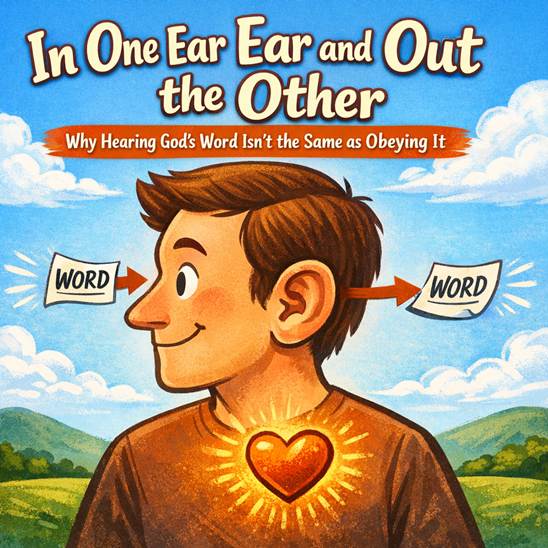
In One Ear and Out the Other: When the Word Never Reaches the Heart


A Funny Story With a Not‑So‑Funny Truth

Three men went deer hunting, and as they crossed a field on their way to the woods, a massive buck jumped up right in front of them. All three fired at the same moment. The buck dropped instantly, and the men hurried over—only to realize they had a problem. Who actually shot the deer?

As they stood there debating, a game warden approached to check licenses. Hearing the dilemma, he knelt down, examined the buck, and said, “One of you is a preacher, right?” Sure enough, one of them was. The warden nodded and said, “Well, the preacher’s the one who got him.” The men stared at him in disbelief. “How can you know that?” The warden shrugged. “Simple. The bullet went in one ear and out the other.”

It’s a humorous story, but beneath the laughter lies a sobering truth—one James warned the church about with prophetic clarity when he wrote, “Be doers of the word, and not hearers only, deceiving yourselves” (James 1:22).


When Hearing Becomes Self‑Deception

Hearing is not the problem. Hearing without obeying is. A message that goes in one ear and out the other never reaches the heart, and the heart is the only place where real transformation takes place. Jesus Himself said the greatest commandment is to “love the Lord your God with all your heart, with all your soul, with all your mind, and with all your strength” (Mark 12:30). The mind matters. The mind is essential. But the mind is not the destination. It is the doorway. The heart is the target.

The preacher in the story fired a shot that passed through the deer’s head but never touched the heart. It produced death, not life. It left a carcass, not a conversion. And that is exactly what happens when the Word of God is received only at the level of intellect. It may pass through the mind, but if it never penetrates the heart, it cannot produce obedience, repentance, or new life. It becomes information without transformation.


A Wound That Never Heals Becomes Fatal

Here is the deeper truth: a bullet that never reaches the heart can still kill you. It can wound you. It can tear flesh, rupture arteries, and leave you bleeding out. A wound is not harmless simply because it missed the center.

And the same is true of the Word when it is only received intellectually. A sermon aimed at the mind alone may not transform you, but it can still wound you. It can leave you convicted but unchanged, aware of truth but still resisting it. You can feel the sting of conviction without ever surrendering to it. And that kind of wound, left unattended, becomes spiritually fatal.

The writer of Hebrews says, “The word of God is living and active, sharper than any two‑edged sword, piercing to the division of soul and spirit, of joints and marrow, and discerning the thoughts and intentions of the heart” (Hebrews 4:12). The Word is designed to pierce. It is meant to cut deep enough to expose motives, confront sin, and bring healing through repentance. But when the Word is only admired, analyzed, or agreed with—when it is heard but not obeyed—it becomes a cut that never closes. Over time, the soul begins to hemorrhage. Not because the Word failed, but because the heart never yielded.


When the Lips Say “Amen” but the Heart Stays Distant

Jesus described this condition when He said, “This people honors Me with their lips, but their heart is far from Me” (Matthew 15:8). The mind can say “Amen” while the heart remains untouched. The intellect can applaud truth while the will refuses to bow to it.

James continues this warning by saying, “For if anyone is a hearer of the word and not a doer, he is like a man who looks intently at his natural face in a mirror… and goes away and at once forgets what he was like” (James 1:23–24). The problem is not the hearing. The problem is the forgetting. The problem is the lack of response. The problem is the absence of obedience.

Truth that only grazes the mind can still leave a person spiritually dying. Truth that never reaches the heart cannot save. Truth that never produces obedience becomes a slow bleed. Eternal death does not always come from outright rebellion. Sometimes it comes from a lifetime of sermons that never penetrated deeper than the intellect.


The Word Must Be Received With Surrender, Not Just Agreement

This is why preaching must aim for the heart. This is why hearing must lead to doing. This is why the Word must be received with surrender, not merely agreement. Jesus said, “Everyone then who hears these words of Mine and does them will be like a wise man who built his house on the rock” (Matthew 7:24). Hearing is the beginning. Doing is the evidence. Obedience is the fruit. Transformation is the result.

Do not let God’s Word pass through you without penetrating you. Do not let it skim the surface of your mind without sinking into the soil of your heart. Do not let it go in one ear and out the other. Slow down. Meditate. Respond. Obey. Let the Word reach the place where life is changed. Let it pierce, not to destroy, but to heal. Let it cut, not to wound, but to free. Let it strike the heart, for only there does the Word bring life. It isn’t about how much Bible you know or can quote but how much you actually put into practice.

Don’t let His Word go in one ear

and right out the other!
The Indwelling Christ: A Test of True Faith


A Call to Honest Examination

Paul’s command in 2 Corinthians 13:5 is not gentle counsel but a summons: “Examine yourselves to see whether you are in the faith; test yourselves.” He does not ask us to recall a moment of sincerity or to lean on a memory of spiritual awakening. He calls us to look honestly at the present reality of our inner life. The question is not whether we once believed, but whether Christ is truly dwelling within us now. Paul presses the point further: “Do you not realize that Christ Jesus is in you—unless, of course, you fail the test?” The test is not about religious activity. It is about indwelling. It is about whether the life of Christ is actually present and active within the believer.

Christ Within: The Only True Evidence

Scripture makes this standard unmistakably clear. Paul writes, “Christ in you, the hope of glory” (Colossians 1:27). If Christ is in us, there is hope. If Christ is not in us, there is no glory at all. John echoes this reality when he says, “He who has the Son has life; he who does not have the Son of God does not have life” (1 John 5:12). Life is not found in religious familiarity but in union with Christ Himself. Paul goes even further in Romans 8:9: “If anyone does not have the Spirit of Christ, he does not belong to Christ.” The dividing line is not church attendance, doctrinal agreement, or moral behavior. The dividing line is the presence or absence of Christ within.

The Danger of Overestimating Ourselves

This is why Paul warns us not to overestimate our spiritual condition. “Do not think of yourself more highly than you ought” (Romans 12:3). We are prone to assume devotion because we participate in religious environments. We sit in church, we sing the songs, we nod at the sermons, and we assume these things testify on our behalf. Yet Jesus confronted the most religious people of His day with devastating clarity: “This people honors Me with their lips, but their heart is far from Me” (Matthew 15:8). External proximity is not internal reality. The Pharisees prayed, fasted, tithed, taught Scripture, and yet Jesus said, “You are like whitewashed tombs… outwardly you appear righteous to men, but within you are full of dead men’s bones” (Matthew 23:27). They failed the test not because they lacked religious activity, but because they lacked the indwelling Christ.

The Voice That Reveals Our Allegiance

Jesus Himself defined the test of true discipleship with piercing simplicity: “My sheep hear My voice, and I know them, and they follow Me” (John 10:27). The evidence of belonging to Christ is not merely hearing Christian voices but hearing His. It is not following Christian culture but following Him. The modern church has trained many believers to outsource their spiritual discernment to pastors, authors, influencers, and institutions. Yet Jesus did not say, “My sheep hear their pastor’s voice.” He said they hear His. And He warned that many who assume they belong to Him will discover otherwise: “Not everyone who says to Me, ‘Lord, Lord,’ will enter the kingdom of heaven, but only he who does the will of My Father” (Matthew 7:21). Words are not proof. Obedience is.

The First Commandment as the True Measure

This is why the first commandment is the true measure of the heart. Jesus said, “You shall love the Lord your God with all your heart, and with all your soul, and with all your mind, and with all your strength” (Mark 12:30). That word all dismantles every rival authority. To love God with all your mind means His Word outranks the voices of media, academia, science, politics, and even our own understanding. Proverbs speaks directly to this: “Trust in the LORD with all your heart and lean not on your own understanding” (Proverbs 3:5). To love Him with all your heart means no affection competes with His. To love Him with all your strength means obedience is not occasional but the natural outflow of devotion. Jesus tied love and obedience together when He said, “If you love Me, you will keep My commandments” (John 14:15). Love without obedience is sentiment. Obedience without love is religion. True discipleship holds both.

Adam, Eve, and Abraham: Two Portraits of the Test

Scripture gives us two vivid portraits of this test. Adam and Eve failed it because they trusted another voice above God’s. The serpent questioned God’s character, and they embraced the lie. The text says, “When the woman saw that the tree was good for food… she took of its fruit and ate” (Genesis 3:6). They trusted their eyes over God’s Word. They leaned on their own understanding instead of His command. Their failure was not about fruit; it was about allegiance. Abraham, by contrast, passed the test because he trusted God’s character even when the command made no sense. When God said, “Take your son, your only son Isaac, whom you love… and offer him there” (Genesis 22:2), Abraham obeyed. Hebrews explains why: “He considered that God was able even to raise him from the dead” (Hebrews 11:19). Abraham trusted God’s voice above his own logic, above his emotions, above the visible circumstances. That is what passing the test looks like.

The Inner Witness of the Spirit

When Paul tells us to examine ourselves, he is calling us into that same clarity. He is asking whether Christ is truly the center of our affections, the anchor of our decisions, the voice that shapes our convictions, and the Lord who governs our steps. John gives us a simple diagnostic: “By this we know that we have come to know Him, if we keep His commandments” (1 John 2:3). Not perfectly, but sincerely. Not flawlessly, but faithfully. The presence of Christ produces repentance, humility, endurance, holiness, and a growing love for truth. The absence of Christ produces apathy, compromise, self‑rule, and selective obedience. Paul’s command is not meant to create fear but honesty. It is not meant to condemn but to reveal. And when Christ truly dwells within us, His Spirit bears witness with our spirit that we are children of God (Romans 8:16).

Christ in You: The Only Hope of Glory

For if Christ is in us, His presence will not remain hidden. His life will press outward. His voice will rise above the noise. His truth will confront our excuses. His holiness will shape our conduct. And His glory will begin to take form within us, even in quiet and unseen ways. But if Christ is not in us—if our faith is merely cultural, inherited, intellectual, or performative—then no amount of religious activity can compensate for His absence. Jesus warned of this with sobering clarity: “Apart from Me you can do nothing” (John 15:5). Without Him, we may appear spiritual, but we will lack the life that only He can give.

Returning to the Center

This is why Paul’s command matters. It calls us back to the center. It calls us to the first love. It calls us to the first commandment. It calls us to the living Christ who does not merely inspire from a distance but dwells within those who belong to Him. The hope of glory is not found in our performance, our knowledge, our traditions, or our religious habits. The hope of glory is Christ in us. And nothing less will do.


Take It Slow in the Snow


A Winter Road. A Spiritual Lesson. A Faithful Captain.

Opening

The weather outside may be frightful, and the roads may be anything but delightful. Snow piles up, visibility drops, and ice hides beneath the surface waiting to surprise the unprepared. On days like this, the wise stay home. But if you must venture out, safety is job one.

Take it slow in the snow.
Because where there is snow… there is almost always ice.

1. The Four‑Wheel Drive Myth

A lot of folks hit the winter roads thinking four‑wheel drive makes them invincible. But every seasoned driver knows the truth:

All tires slide on ice.
Four‑wheel drive helps you get moving — it does nothing to help you stop.

And sometimes?
Four‑wheel drive just gets you into trouble faster.

Spiritually, pride works the same way.

1 Corinthians 10:12 — “Let him who thinks he stands take heed lest he fall.”

Overconfidence is black ice for the soul.

2. Weight: The Hidden Stability

Years behind the wheel taught me something most people don’t understand:

An empty truck bed is unstable.
A loaded truck settles down.

Weight increases traction.
Weight presses the tires into the road.
Weight gives you control.

Spiritually, the same is true.

Psalm 119:11 — “Your word I have hidden in my heart, that I might not sin against You.”

A believer with Scripture inside them has spiritual downforce.
An empty soul slides.
A weighted soul stands.

3. Traction: Obedience Under Pressure

Dualies give you more rubber on the road — but only when there’s weight pressing them down.

Empty dualies?
They float on snow.
They lose grip.
They slide sideways.

But load that truck…
and those dualies bite into the surface and hold steady.

Obedience works the same way.

James 1:22 — “Be doers of the word, and not hearers only.”

Traction isn’t about speed — it’s about grip.
It’s about consistency.
It’s about doing what God said even when conditions are slick.

4. Modern Parables from the Road

Parable 1 — The Invisible Ice

Black ice looks like pavement.
Temptation looks like opportunity.

Proverbs 14:12 — “There is a way that seems right to a man, but its end is the way of death.”

Parable 2 — The Slow Driver Who Arrives

The one who slows down in the storm is the one who makes it home.

Isaiah 30:15 — “In returning and rest you shall be saved; in quietness and confidence shall be your strength.”

5. The Road as an Altar — First Person Revelation

I’ve spent a lot of years behind the wheel.
Long roads. Long nights. Long storms.
And if there’s one thing driving has taught me, it’s this:

Experience helps… but experience alone won’t save you.

I’ve learned to feel the road through the steering wheel.
I’ve learned how a truck talks when the bed is empty,
and how it settles down when it’s carrying weight.
I’ve learned the difference between snow and ice,
between a slide I can correct
and a slide that’s already decided for me.

But even with all that experience,
I’ve had moments where the road reminded me:
You don’t know what you don’t know.

And that’s exactly what happened on the Sea of Galilee.

The disciples weren’t rookies.
They were experienced fishermen — men who grew up on that water.
They knew the winds.
They knew the currents.
They knew the storms that came out of nowhere.

But one night, a storm hit that was bigger than their experience.

Mark 4:37 — “And a great windstorm arose, and the waves beat into the boat…”

These seasoned men panicked.
Why?
Because experience can teach you a lot —
but it can’t teach you everything.

Experience can make you skilled —
but it can’t make you sovereign.

Experience can help you navigate storms —
but it can’t calm them.

Only Jesus can do that.

Mark 4:39 — “Then He arose and rebuked the wind, and said to the sea, ‘Peace, be still!’”

And someone always brings up Paul’s shipwreck as a rebuttal —
“See? Even a man of God can go down in a storm.”

But look closer.

The ship wrecked…
but the people didn’t.

Acts 27:22 — “There will be no loss of life among you, but only of the ship.”

Why?
Because a man of God was on board.
Because God had a purpose for Paul that no storm could cancel.
Because Jesus wasn’t just along for the ride —
He was the Captain of the outcome.

And that’s the lesson I’ve learned on the road:

I can have experience.
I can have skill.
I can have traction and weight and wisdom.
But if I try to navigate a storm on experience alone,
I’m headed for a wreck.

But if Jesus is in the cab with me —
better yet, if He’s the One holding the wheel —
then even if the truck slides,
even if the road gets rough,
even if the storm gets violent…

I’m going to make it.

Not because I’m a great driver.
But because He’s a faithful Captain.

Psalm 121:8 — “The LORD shall preserve your going out and your coming in…”

Final Reflection

And before I close this out, let me say one more thing — something personal, something true, something I carry with gratitude every single day:

I’ve survived over three million miles behind the wheel.
Accident‑free.
Incident‑free.
Storms, snow, ice, long nights, empty roads, and crowded highways —
and I’m still here.

Not because I’m the best driver.
Not because I always made the right call.
Not because experience never failed me.

I’m here because Jesus piloted my ship.

Three million miles…
and not one of them driven alone.

Thank You, Jesus.

Closing

If you have nowhere to go today, let it snow.
Rest. Be still.

But if God calls you forward, take it slow in the snow.
Move with wisdom.
Move with awareness.
Move with Him.

Because the One who guides you through the storm
is the same One who clears the road ahead.

Proverbs 3:6 — “In all your ways acknowledge Him, and He shall direct your paths”

Modern Towers of Babble: Broadcasting Confusion in the Name of Clarity


🌀 Modern Towers of Babble: Broadcasting Confusion in the Name of Clarity

We are living in an age of amplified voices and diminished discernment. Platforms promise clarity, but deliver confusion. Ministries chase relevance while forfeiting reverence. Like the builders of Babel, we construct towers of talk — lofty, impressive, and tragically misaligned. In our quest to be heard, we’ve forgotten how to listen. Modern Towers of Babble isn’t just a critique of culture. It’s a call to return to Spirit-led silence and sacred speech. It’s also about the clarity that only comes from communion, not commentary.

“Remember this, my dear brothers and sisters: Everyone should be quick to listen, slow to speak, and should not get angry easily.”James 1:19 (GW)

I don’t know about you. I’m growing weary of all the talk. It’s the endless chatter that fills our screens, our feeds, and our minds. The 24-hour news cycle has become a relentless echo chamber. Multiple cable channels now exist solely to broadcast commentary, speculation, and opinion around the clock. Each one features its own cadre of talking heads, dissecting the day’s hot topic with surgical precision and emotional fervor.

You’d think with all this talking, something good might come of it. But let’s be honest: most of it is negative, divisive, and draining. If you consume too much of this “news speak,” it doesn’t inform—it infects. It doesn’t enlighten—it exhausts.

“When there are many words, sin is unavoidable, but the one who controls his lips is wise.”Proverbs 10:19 (HCSB)

Scripture doesn’t mince words here. Proverbs warns us that when speech multiplies, error is inevitable. As believers, we’re called to steward our words—not just to speak truth, but to speak it in love. Our speech should build up, not break down. It should heal, not harm.

“Finally, brothers and sisters, keep your thoughts on whatever is right or deserves praise: things that are true, honorable, fair, pure, acceptable, or commendable.”Philippians 4:8 (GW)

This isn’t just a call to positive thinking—it’s a call to spiritual discipline. In a world saturated with noise, we must be intentional about what we dwell on and what we declare. Not every opinion deserves a platform. Not every headline deserves our attention. And not every voice deserves our agreement.

“Let no corrupt communication proceed from your mouth, but that which is good to the use of edifying, that it may minister grace unto the hearers.”Ephesians 4:29 (KJV)

What is corrupt communication? It is not just profanity. It also includes lies, misleading statements, biased commentary, slander, false accusations, and half-truths. Additionally, it involves twisting scripture or reality to suit a narrative.

There’s an old saying: “Let your words be sweet, for you never know how many you may have to eat.” Or even better: “If you don’t have anything good to say, say nothing at all.”

So here’s my challenge: Let’s be slow to speak, quick to listen, and even quicker to discern. Let’s resist the echo chamber and return to the still, small voice of truth. Because in a world addicted to noise, silence—when Spirit-led—can be revolutionary.

And that’s the way I see it. What say you?

This has been a View From the Nest be sure to comment, like and share.

A Simple Formula For Success: Guarenteed to Work


Christian wallpaper John 15:5
No seminars to attend, no films and audio tapes to buy, simply abide in Christ and allow His word to abide in you and you will achieve a level of success you could only dream of before.

Powered by ScribeFire.