Insight for your “Journey across the Sky”
Jesus was getting closer to Jerusalem, and the people thought that the kingdom of God would appear suddenly. While Jesus had the people’s attention, he used this illustration.
He said, “A prince went to a distant country to be appointed king, and then he returned. {Before he left,} he called ten of his servants and gave them ten coins. He said to his servants, ‘Invest this money until I come back.’
“The citizens of his own country hated him. They sent representatives to follow him and say {to the person who was going to appoint him}, ‘We don’t want this man to be our king.’
“After he was appointed king, he came back. Then he said, ‘Call those servants to whom I gave money. I want to know how much each one has made by investing.’
“The first servant said, ‘Sir, the coin you gave me has earned ten times as much.’ “The king said to him, ‘Good job! You’re a good servant. You proved that you could be trusted with a little money. Take charge of ten cities.’
“The second servant said, ‘The coin you gave me, sir, has made five times as much.’ “The king said to this servant, ‘You take charge of five cities.’
“Then the other servant said, ‘Sir, look! Here’s your coin. I’ve kept it in a cloth for safekeeping because I was afraid of you. You’re a tough person to get along with. You take what isn’t yours and harvest grain you haven’t planted.’
“The king said to him, ‘I’ll judge you by what you’ve said, you evil servant! You knew that I was a tough person to get along with. You knew that I take what isn’t mine and harvest grain I haven’t planted. Then why didn’t you put my money in the bank? When I came back, I could have collected it with interest.’
The king told his men, ‘Take his coin away, and give it to the man who has ten.’ “They replied, ‘Sir, he already has ten coins.’ “‘I can guarantee that everyone who has something will be given more. But everything will be taken away from those who don’t have much.
Bring my enemies, who didn’t want me to be their king. Kill them in front of me.’” Luke 19:11-27 (GW)
Life lessons gleaned from a checker game

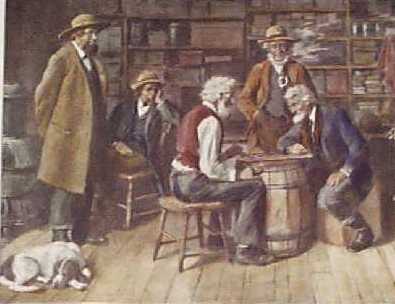
A Quiet Game of Checkers
Checkers is played on a board made up of 64 Â squares. They are laid out in eight columns and eight rows with alternating light and dark squares.
Checkers is a game for two players. Each player receives twelve, flat, disk-like pieces which are placed on the dark squares making sure that a light colored square appears in the lower right hand corner of the board. The darker colored checkers are usually designated black, and the lighter color is designated white. Black always moves first and play proceeds alternately.
Initially, individual checkers may only move forward. There are two types of moves that can be made, capturing moves and non-capturing moves. Non-capturing moves are simply a diagonal move forward from one square to an adjacent square. (Note that the lighter squares are never used.) Capturing moves occur when a player “jumps” an opposing piece. This is also done on the diagonal and can only happen when the square behind (on the same diagonal) is also open. This means that you may not jump an opposing piece around a corner.
On a capturing move, a piece may make multiple jumps. If, after a jump, a player is in a position to make another jump then he may do so. This means that a player may make several jumps in succession, capturing several pieces on a single turn.
Forced Captures: When a player is in a position to make a capturing move, he must make the capturing move. When he has more than one capturing move to choose from, he may take whichever move suits him.
When a checker reaches the opponent’s edge of the board (called the “king’s row”) it is crowned with another checker. This signifies that the checker has been made a king. The king now gains an added ability to move backward. The king may now also jump in either direction or even in both directions, in one turn (if he makes multiple jumps). This makes capturing opponents pieces easier and adds significantly to your ability to win the game.
The object of the game is to eliminate all opposing checkers or to create a situation in which it is impossible for your opponent to make any move. Normally, the victory will be due to complete elimination.
Today the game is as healthy as ever, with people all around the world playing at least a version of it. It can be good training in thought, logic and strategy.
Jesus told a parable one day when the disciples were wondering when he was going to set up his kingdom. In this parable, he told the story of an ambitious prince who came from a foreign country, all the way across the board to be kinged. He hired servants to go to work on his campaign, invested money in them from which he expected to get a favorable return on his investment. He hoped that the servants would be able to garner interest on his behalf. When the one servant failed to show any return on the investment, he was stripped of what little he had and it was handed over to the one who had the most.
A valuable lesson can be learned from this. When someone gives you something, expecting  a return, it is never in your best interest to accept such a “strings attached proposition”. As with most government programs, there is that “hidden string” attached, that will take what little you may have and give it to someone who has much. Thusly it is rightly stated ‘I can guarantee that everyone who has something will be given more. But everything will be taken away from those who don’t have much.’
To this day government handouts work much the same way. When money is dispensed, certain requirements are placed on that money. Those who fail to meet the requirements will have the money taken from them and it will be given to someone who has a great deal because they are producing the results the rulers wish to receive back.
Those who knew this man best, did not wish to be ruled by him because they hated him and sent a delegation after him to ask the people to not “king” Â this man. These, who opposed the king, were later killed in his presence.
The game of checkers is much like a political campaign, in that a player strategizes over each move to ascertain the best possible way to achieve success- being kinged. Jumping over opponents, stepping over people, removing any and all opposition, is in the best interest of the player who wants to be king.
In checkers no one gets hurt, but in real life that is not the case. When a politician resorts to doing whatever it takes to get elected (kinged) they sometimes will stop at nothing when opposed. Such was the case of this prince who desired to be king. All those who opposed his reign where ordered to be killed in his presence. He stood there and presided over the executions. Even his own workers were chastened if they failed to produce the desired results-gain interest for the candidate. Those who pleased the king were given choice seats in his government, they were rewarded with political favor and power. They were able to EARN their seat. They went from being ruled, to ruling, from enslavement to empowerment, from serving to being served.
Of course Jesus was using this parable to teach about the Kingdom of Heaven, and that those who oppose making Jesus, King of their lives, will suffer the punishment of being banned from his presence for eternity. Those who hated Him sought to have him killed in attempts to end his influence amongst the people. That plan failed because they failed to understand that He would indeed die, but three days later He would rise again from the grave and ascend into heaven to rule and reign forever. His kingdom has no end.
Unlike the ambitious prince who killed those who opposed him, Jesus forgave them. Instead of handing the opposition over to death, Â He chose to die in their place. I can get behind someone who sacrifices himself for the sake of others, I have a very hard time supporting one, who will do whatever it takes to get ahead, even the total destruction of those who oppose him.
I can work for a campaign which seeks the best interest of those whom they are seeking to rule, I can not get behind anyone who only seeks to serve himself  by enslaving those whom he seeks to rule over.
I can support a ruler who gives gifts to men for the sole purpose of enriching their lives and giving power to the powerless, so they can overcome their problems. I have a real problem supporting one who uses power and influence in order to buy votes and support, and then rewarding those who do their bidding with seats of power and control.
And Jesus called them to him and said to them, “You know that those who are considered rulers of the Gentiles lord it over them, and their great ones exercise authority over them. 43But it shall not be so among you. But whoever would be great among you must be your servant, 44and whoever would be first among you must be slave of all. 45For even the Son of Man came not to be served but to serve, and to give his life as a ransom for many.” Mark 10:42-45 (ESV)
I do not know about you, but as far as I am concerned, I think I like the way Jesus ran his campaign for kingship far better than the way we see others running their campaigns. What say you?
But those who are waiting for the Lord will have new strength; they will get wings like eagles: running, they will not be tired, and walking, they will have no weariness. Isaiah 40:31 (BBE)