In One Ear and Out the Other: When the Word Never Reaches the Heart


A Funny Story With a Not‑So‑Funny Truth

Three men went deer hunting, and as they crossed a field on their way to the woods, a massive buck jumped up right in front of them. All three fired at the same moment. The buck dropped instantly, and the men hurried over—only to realize they had a problem. Who actually shot the deer?

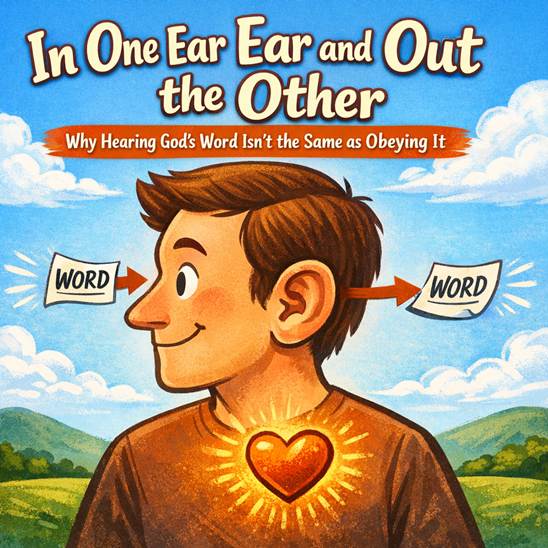
As they stood there debating, a game warden approached to check licenses. Hearing the dilemma, he knelt down, examined the buck, and said, “One of you is a preacher, right?” Sure enough, one of them was. The warden nodded and said, “Well, the preacher’s the one who got him.” The men stared at him in disbelief. “How can you know that?” The warden shrugged. “Simple. The bullet went in one ear and out the other.”

It’s a humorous story, but beneath the laughter lies a sobering truth—one James warned the church about with prophetic clarity when he wrote, “Be doers of the word, and not hearers only, deceiving yourselves” (James 1:22).


When Hearing Becomes Self‑Deception

Hearing is not the problem. Hearing without obeying is. A message that goes in one ear and out the other never reaches the heart, and the heart is the only place where real transformation takes place. Jesus Himself said the greatest commandment is to “love the Lord your God with all your heart, with all your soul, with all your mind, and with all your strength” (Mark 12:30). The mind matters. The mind is essential. But the mind is not the destination. It is the doorway. The heart is the target.

The preacher in the story fired a shot that passed through the deer’s head but never touched the heart. It produced death, not life. It left a carcass, not a conversion. And that is exactly what happens when the Word of God is received only at the level of intellect. It may pass through the mind, but if it never penetrates the heart, it cannot produce obedience, repentance, or new life. It becomes information without transformation.


A Wound That Never Heals Becomes Fatal

Here is the deeper truth: a bullet that never reaches the heart can still kill you. It can wound you. It can tear flesh, rupture arteries, and leave you bleeding out. A wound is not harmless simply because it missed the center.

And the same is true of the Word when it is only received intellectually. A sermon aimed at the mind alone may not transform you, but it can still wound you. It can leave you convicted but unchanged, aware of truth but still resisting it. You can feel the sting of conviction without ever surrendering to it. And that kind of wound, left unattended, becomes spiritually fatal.

The writer of Hebrews says, “The word of God is living and active, sharper than any two‑edged sword, piercing to the division of soul and spirit, of joints and marrow, and discerning the thoughts and intentions of the heart” (Hebrews 4:12). The Word is designed to pierce. It is meant to cut deep enough to expose motives, confront sin, and bring healing through repentance. But when the Word is only admired, analyzed, or agreed with—when it is heard but not obeyed—it becomes a cut that never closes. Over time, the soul begins to hemorrhage. Not because the Word failed, but because the heart never yielded.


When the Lips Say “Amen” but the Heart Stays Distant

Jesus described this condition when He said, “This people honors Me with their lips, but their heart is far from Me” (Matthew 15:8). The mind can say “Amen” while the heart remains untouched. The intellect can applaud truth while the will refuses to bow to it.

James continues this warning by saying, “For if anyone is a hearer of the word and not a doer, he is like a man who looks intently at his natural face in a mirror… and goes away and at once forgets what he was like” (James 1:23–24). The problem is not the hearing. The problem is the forgetting. The problem is the lack of response. The problem is the absence of obedience.

Truth that only grazes the mind can still leave a person spiritually dying. Truth that never reaches the heart cannot save. Truth that never produces obedience becomes a slow bleed. Eternal death does not always come from outright rebellion. Sometimes it comes from a lifetime of sermons that never penetrated deeper than the intellect.


The Word Must Be Received With Surrender, Not Just Agreement

This is why preaching must aim for the heart. This is why hearing must lead to doing. This is why the Word must be received with surrender, not merely agreement. Jesus said, “Everyone then who hears these words of Mine and does them will be like a wise man who built his house on the rock” (Matthew 7:24). Hearing is the beginning. Doing is the evidence. Obedience is the fruit. Transformation is the result.

Do not let God’s Word pass through you without penetrating you. Do not let it skim the surface of your mind without sinking into the soil of your heart. Do not let it go in one ear and out the other. Slow down. Meditate. Respond. Obey. Let the Word reach the place where life is changed. Let it pierce, not to destroy, but to heal. Let it cut, not to wound, but to free. Let it strike the heart, for only there does the Word bring life. It isn’t about how much Bible you know or can quote but how much you actually put into practice.

Don’t let His Word go in one ear

and right out the other!
Snowmageddon and the Storms We Create: When the World Mobilizes and the Church Retreats


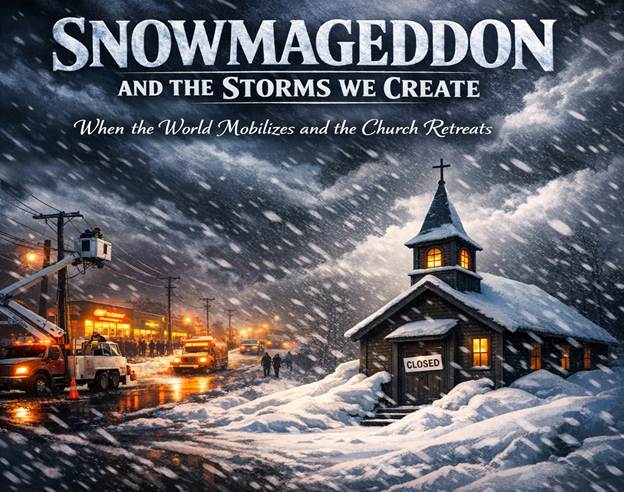
The forecasts grow louder. The graphics turn dramatic. The region braces for what the news has christened Snowmageddon. This is a storm wrapped in apocalyptic language. It comes complete with countdown clocks, urgent tickers, and warnings that feel more cinematic than meteorological. The world prepares with a kind of frantic determination. Meanwhile, something else unfolds quietly in the background. It is almost unnoticed unless you are paying attention.

Electric linemen are already staged in their trucks, engines idling, ready to restore power the moment the first line snaps. Road crews sit in warm garages beside mountains of salt, waiting for the call to roll out into the night. Grocery stores are stripped bare as shoppers fill carts with enough food to survive a siege. Everyone is mobilizing. Everyone is preparing. Everyone is stepping into their role with a sense of duty and resolve.

And then, amid all this activity, comes the announcement from the one place that claims to carry the unshakable Kingdom:

“All services are canceled due to inclement weather.”

The contrast is hard to ignore. The world gears up. The church shuts down.

This is not about recklessness or ignoring safety. It is about the symbolism—the quiet confession embedded in the decision. When the world anticipates hardship, it mobilizes. When the church anticipates hardship, it retreats. And that retreat reveals something deeper than a scheduling adjustment. It reveals a posture.

Scripture never once suggests that worship is a Sunday-only activity, nor does it tie devotion to favorable weather. The command is simple and ancient: “Six days you shall labor and do all your work, but the seventh is a Sabbath to the LORD your God.” (Exodus 20:9–10) The rhythm is work and rest, not convenience and cancellation. If the work of the Kingdom is the saving of souls, it also includes the strengthening of the saints. It involves the breaking of bread and the prayers of the people. Then that work is not suspended by snowflakes.

The early church understood this instinctively. They gathered in homes, courtyards, borrowed rooms, and hidden places. They met in caves and catacombs. They prayed in prison cells. They broke bread wherever they could find a table. They did not have buildings to close, so they could not close the church. Their worship was not weather-permitting. Their devotion was not seasonal. Their gatherings were not fragile.

Jesus Himself warned us about the danger of a faith that collapses under pressure. “Everyone who hears these words of Mine and does them is like a wise man who built his house on the rock.” (Matthew 7:24) The storm came, the winds blew, the floods rose—and the house stood because its foundation was not circumstantial. But the house built on sand fell, “and great was its fall.” (Matthew 7:27)

A storm does not create weakness. A storm reveals it.

And perhaps that is what Snowmageddon exposes—not the fragility of our infrastructure, but the fragility of our ecclesiology. A church that closes at the first sign of difficulty has confused the building with the body. A church that cancels worship because the weather is inconvenient has forgotten. It has forgotten that worship is not an event but a life. A church that retreats while the world mobilizes is a church that has lost sight of its calling.

Jesus said, “The harvest is plentiful, but the laborers are few.” (Matthew 9:37) He did not add, “unless it snows.” He did not say, “unless the roads are slick.” He did not suggest that the work of the Kingdom pauses when the forecast is unfavorable. Souls do not stop needing salvation because the temperature drops. Hearts do not stop needing hope because the wind picks up. Darkness does not delay its work because the roads are icy.

If anything, storms heighten the need for light.

The world prepares for the storm because it knows what storms can do. The church should prepare for the storm because it knows what storms reveal.

And maybe that is the quiet message hidden inside this winter’s theatrics. If a snowstorm can cancel our worship, perhaps what we call worship was never the thing God asked for. If a weather system can scatter the saints, perhaps the gathering was never rooted in the Spirit. If the church retreats while the world mobilizes, maybe we have forgotten that the Kingdom work is still work. The One who called us did not limit His commission to clear skies.

“Be steadfast, immovable, always abounding in the work of the Lord.” (1 Corinthians 15:58)

Storm or no storm, the Kingdom does not close. Storm or no storm, the mission does not pause. Storm or no storm, the church is still the church.

And maybe Snowmageddon is not the storm we should fear. Maybe the greater storm is the quiet one. It shows how easily we retreat when the world needs us most.

I Surrender All: A Devotional for Easter


The words of the hymn I Surrender All resonate deeply with the journey of faith. Written in 1896 by Judson W. Van DeVenter, this hymn emerged from a pivotal moment in his life. Van DeVenter, an accomplished artist, found himself torn between pursuing a career in the arts or stepping into full-time ministry. After wrestling with God’s call, he finally surrendered, choosing to dedicate his life entirely to serving Christ. This heartfelt act of yielding birthed one of the most beloved hymns in Christian worship—a timeless reminder of what it means to fully trust and submit to God.

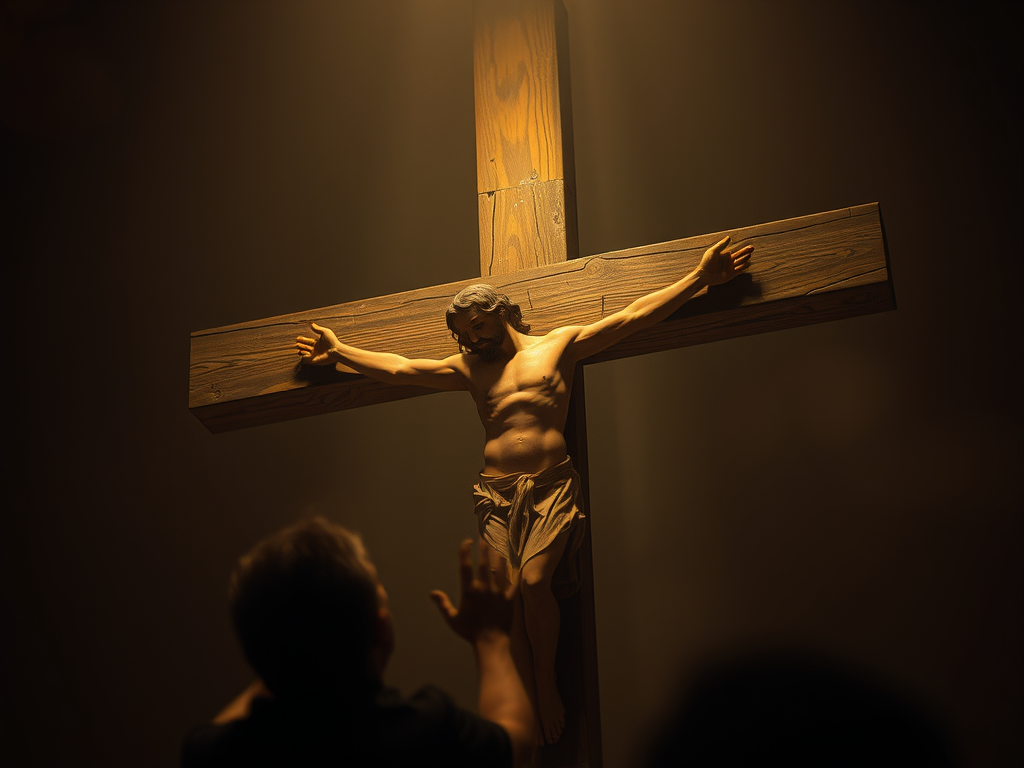
As we approach the heart of the Easter season, I Surrender All takes on an even deeper meaning. It reminds us of the ultimate act of surrender—Jesus Christ offering Himself on the cross for the redemption of humanity. The Son of God gave everything, holding nothing back, for the sake of love. His sacrifice invites us to examine our own lives and to ask: what might God be calling us to surrender in this season?

Surrender is not an easy concept. It challenges our desire for control, tests our faith, and often stretches us in uncomfortable ways. For some, surrender might mean letting go of fear or anxiety, trusting God to provide and guide. For others, it could involve reconciling broken relationships, relinquishing bitterness or pride, and choosing humility and love. Perhaps God is asking you to trust Him with your future, your career, or a dream you’ve been holding tightly to.

Easter is a time of reflection, renewal, and hope. Just as the empty tomb represents victory and new life, surrendering our hearts to God leads to transformation and peace. When we let go of our own plans and fully trust in Him, we find that His ways are higher, and His plans are greater than anything we could imagine.

Closing Prayer

Lord, as we reflect on the profound sacrifice of Jesus on the cross, may we open our hearts to fully surrender to You. Teach us to trust You with our fears, dreams, and burdens, knowing that in You, we find true peace and joy. Transform our hearts this Easter season and help us walk in the light of Your love. In Jesus’ name, Amen.