
A neighborhood finally sees the end of a long‑standing wooden menace
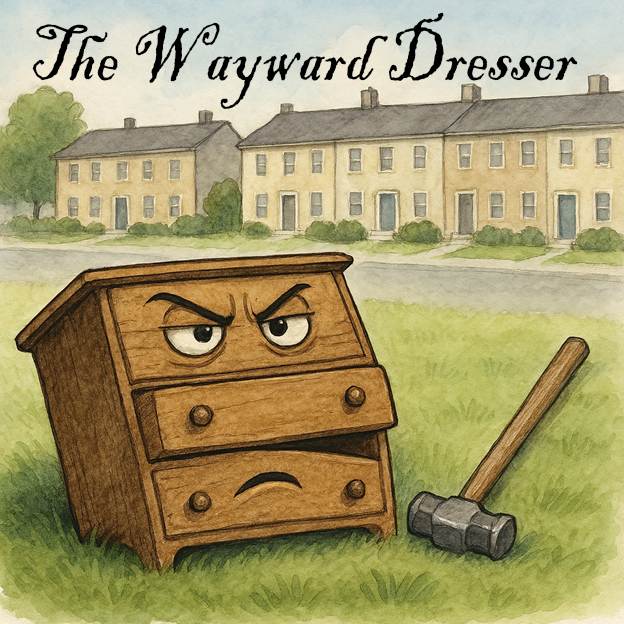
Somewhere in a small town in Pennsylvania — For months, a battered dresser stayed on a narrow strip of land. The township maintained this land. It lay sprawled there, unattended. Its warped frame and swollen drawers formed an eyesore. Residents could not ignore it, yet somehow never addressed it. It started as discarded furniture. Slowly, it evolved into a fixture of quiet defiance. The wooden intruder seemed to grow bolder with each passing week.
The dresser did not move or speak, but its presence carried a strange authority. It reclined on its side. It seemed to intentionally pose. Its puffed‑out drawers gave the impression of a chest lifted in pride. Neighbors walked past it with the same uneasy tolerance. It was akin to how one responds to a stray dog refusing to leave the porch. Drivers slowed down to stare. Children pointed out from car windows. Yet no one touched it. Not the landlord. Not the maintenance crew. Not even the township, responsible for mowing the very ground on which it rested.
Like Goliath standing in the Valley of Elah, the dresser’s power came not from action but from endurance. It simply remained, day after day, mocking the neighborhood with its refusal to budge. And like the armies of Israel, an entire community of capable adults adjusted their routines around it. They waited for someone else to take responsibility.
A Giant in the Grass
Residents described the dresser as if it possessed a personality. It seemed to smirk at passersby, daring anyone to challenge its claim to the land. Rain bloated its panels. Sun bleached its finish. Frost cracked its edges. Yet the dresser held its ground with the stubbornness of a giant that believed no one would ever confront it.
The longer it stayed, the more impossible it seemed to remove. What should have been a simple task gradually became a symbol of collective hesitation. The dresser was not strong, but it was unchallenged, and that was enough.
The Arrival of a David
The stalemate ended on an ordinary afternoon. A resident decided that the dresser’s reign had lasted long enough. There was no announcement, no committee meeting, and no official directive. A neighbor quietly offered a tool — a sledgehammer. This gesture was reminiscent of Jonathan placing his sword and shield into David’s hands before the battle.
With this borrowed weapon in hand, the resident approached the dresser. The resident had the calm resolve of someone who had reached the end of patience. The dresser, for the first time in months, appeared vulnerable.
The First Strike
The first swing landed with a sharp crack that echoed across the yard. A drawer burst open, releasing a puff of dust as if the dresser had been holding its breath. A second blow splintered a leg. A third sent fragments scattering across the grass. The giant that had lounged in smug defiance for months was suddenly reduced to a trembling heap of particle board.
As in the biblical account, once the first strike was delivered, help arrived from an unexpected source. A passing neighbor stepped out of her vehicle, surveyed the scene, and gladly joined the effort. Without hesitation, she gathered the fallen pieces. She carried them to the dumpster. She worked with the efficiency of someone who understood the importance of finishing what had begun.
Within minutes, the dresser was gone. The patch of ground it had occupied for so long stood empty. It was now restored to the quiet normality it had been denied.
The Moral of the Story
In the biblical account, Goliath stood in the valley for forty days, taunting Israel with his presence. He did not need to swing a sword or launch an attack. His mere existence, unchallenged, was enough to paralyze an entire army of trained, armored fighting men.
The dresser played the same role. It did not move, speak, or strike. It simply sat there, day after day. It occupied a space it was never meant to occupy. It grew comfortable in its defiance. It mocked the neighborhood with its stubborn refusal to leave. And like Israel’s soldiers, the community adjusted their routines around it. They walked past it. They ignored it and pretended it was not their problem.
That is the quiet danger of tolerated nuisances — and of unrepented sin. What begins as a small inconvenience becomes, over time, an obstacle that feels immovable. What starts as a minor irritation grows into a fixture of defeat. What should have been removed immediately becomes something we learn to live with.
Sin often arrives without fanfare. It simply appears, settles in, and occupies ground it was never meant to hold. It lingers. It mocks. It grows comfortable. It dares anyone to confront it. And the longer it remains unchallenged, the more unbeatable it seems.
The day the dresser fell is a reminder. Giants — wooden or spiritual — collapse the moment someone steps up. They take the first swing and refuse to tolerate what should never have been allowed to stay. Sometimes the greatest victories begin with a simple, decisive moment of clarity: enough.
When that moment comes, the giant falls, the nuisance is removed, and the ground it occupied is restored to peace.
THIS HAS BEEN A VIEW FROM THE NEST please LIKE, Subscribe, and Share.

You must be logged in to post a comment.