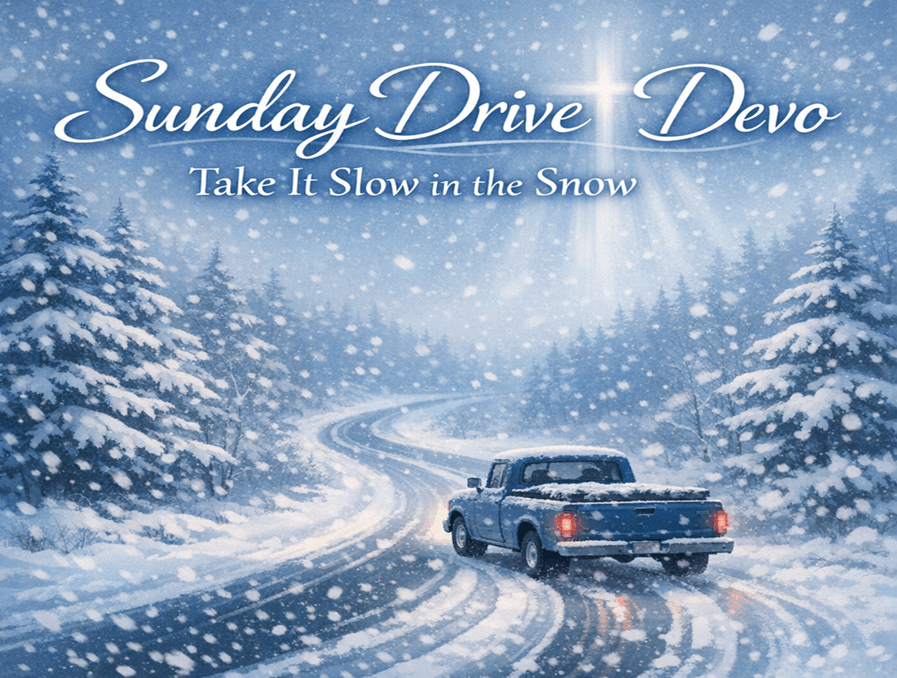
Take It Slow in the Snow


A Winter Road. A Spiritual Lesson. A Faithful Captain.

Opening

The weather outside may be frightful, and the roads may be anything but delightful. Snow piles up, visibility drops, and ice hides beneath the surface waiting to surprise the unprepared. On days like this, the wise stay home. But if you must venture out, safety is job one.

Take it slow in the snow.
Because where there is snow… there is almost always ice.

1. The Four‑Wheel Drive Myth

A lot of folks hit the winter roads thinking four‑wheel drive makes them invincible. But every seasoned driver knows the truth:

All tires slide on ice.
Four‑wheel drive helps you get moving — it does nothing to help you stop.

And sometimes?
Four‑wheel drive just gets you into trouble faster.

Spiritually, pride works the same way.

1 Corinthians 10:12 — “Let him who thinks he stands take heed lest he fall.”

Overconfidence is black ice for the soul.

2. Weight: The Hidden Stability

Years behind the wheel taught me something most people don’t understand:

An empty truck bed is unstable.
A loaded truck settles down.

Weight increases traction.
Weight presses the tires into the road.
Weight gives you control.

Spiritually, the same is true.

Psalm 119:11 — “Your word I have hidden in my heart, that I might not sin against You.”

A believer with Scripture inside them has spiritual downforce.
An empty soul slides.
A weighted soul stands.

3. Traction: Obedience Under Pressure

Dualies give you more rubber on the road — but only when there’s weight pressing them down.

Empty dualies?
They float on snow.
They lose grip.
They slide sideways.

But load that truck…
and those dualies bite into the surface and hold steady.

Obedience works the same way.

James 1:22 — “Be doers of the word, and not hearers only.”

Traction isn’t about speed — it’s about grip.
It’s about consistency.
It’s about doing what God said even when conditions are slick.

4. Modern Parables from the Road

Parable 1 — The Invisible Ice

Black ice looks like pavement.
Temptation looks like opportunity.

Proverbs 14:12 — “There is a way that seems right to a man, but its end is the way of death.”

Parable 2 — The Slow Driver Who Arrives

The one who slows down in the storm is the one who makes it home.

Isaiah 30:15 — “In returning and rest you shall be saved; in quietness and confidence shall be your strength.”

5. The Road as an Altar — First Person Revelation

I’ve spent a lot of years behind the wheel.
Long roads. Long nights. Long storms.
And if there’s one thing driving has taught me, it’s this:

Experience helps… but experience alone won’t save you.

I’ve learned to feel the road through the steering wheel.
I’ve learned how a truck talks when the bed is empty,
and how it settles down when it’s carrying weight.
I’ve learned the difference between snow and ice,
between a slide I can correct
and a slide that’s already decided for me.

But even with all that experience,
I’ve had moments where the road reminded me:
You don’t know what you don’t know.

And that’s exactly what happened on the Sea of Galilee.

The disciples weren’t rookies.
They were experienced fishermen — men who grew up on that water.
They knew the winds.
They knew the currents.
They knew the storms that came out of nowhere.

But one night, a storm hit that was bigger than their experience.

Mark 4:37 — “And a great windstorm arose, and the waves beat into the boat…”

These seasoned men panicked.
Why?
Because experience can teach you a lot —
but it can’t teach you everything.

Experience can make you skilled —
but it can’t make you sovereign.

Experience can help you navigate storms —
but it can’t calm them.

Only Jesus can do that.

Mark 4:39 — “Then He arose and rebuked the wind, and said to the sea, ‘Peace, be still!’”

And someone always brings up Paul’s shipwreck as a rebuttal —
“See? Even a man of God can go down in a storm.”

But look closer.

The ship wrecked…
but the people didn’t.

Acts 27:22 — “There will be no loss of life among you, but only of the ship.”

Why?
Because a man of God was on board.
Because God had a purpose for Paul that no storm could cancel.
Because Jesus wasn’t just along for the ride —
He was the Captain of the outcome.

And that’s the lesson I’ve learned on the road:

I can have experience.
I can have skill.
I can have traction and weight and wisdom.
But if I try to navigate a storm on experience alone,
I’m headed for a wreck.

But if Jesus is in the cab with me —
better yet, if He’s the One holding the wheel —
then even if the truck slides,
even if the road gets rough,
even if the storm gets violent…

I’m going to make it.

Not because I’m a great driver.
But because He’s a faithful Captain.

Psalm 121:8 — “The LORD shall preserve your going out and your coming in…”

Final Reflection

And before I close this out, let me say one more thing — something personal, something true, something I carry with gratitude every single day:

I’ve survived over three million miles behind the wheel.
Accident‑free.
Incident‑free.
Storms, snow, ice, long nights, empty roads, and crowded highways —
and I’m still here.

Not because I’m the best driver.
Not because I always made the right call.
Not because experience never failed me.

I’m here because Jesus piloted my ship.

Three million miles…
and not one of them driven alone.

Thank You, Jesus.

Closing

If you have nowhere to go today, let it snow.
Rest. Be still.

But if God calls you forward, take it slow in the snow.
Move with wisdom.
Move with awareness.
Move with Him.

Because the One who guides you through the storm
is the same One who clears the road ahead.

Proverbs 3:6 — “In all your ways acknowledge Him, and He shall direct your paths”

WHEN THE KINGDOM TREMBLES:


A Watchman’s Word for a Nation in Upheaval

Solomon once wrote:

“What has been will be again; what has been done will be done again. There is nothing new under the sun.” (Ecclesiastes 1:9)

If you want to understand the turmoil of our time, you don’t need a pundit. You need a Bible.

The unrest we see today is not new. The outrage, the factions, the calls for resistance, and the crowds stirred to avenge a leader have long existed. It is ancient. It is familiar. It is recorded in Scripture with unnerving precision.

The names change. The slogans change. The flags change.

But the spirit behind it does not.


THE DAY THE SONGS SHIFTED:

When Public Praise Became Political Crisis**

Israel’s political fracture began with a chant:

“Saul has slain his thousands, and David his tens of thousands.” (1 Samuel 18:7)

That lyrics were not entertainment. It was a national poll.

It told the nation. It told Saul. The people saw something in David they no longer saw in their king.

Scripture says:

“Saul eyed David from that day forward.” (1 Samuel 18:9)

That is the moment a leader stops governing and starts defending his throne.


THE GIANT THAT EXPOSED THE KING

For forty days, Goliath mocked Israel. For forty days, Saul — the tallest man in the nation (1 Samuel 9:2) — did nothing.

Then David stepped forward and did in minutes what the king failed to do in over a month:

“So David prevailed over the Philistine with a sling and a stone.” (1 Samuel 17:50)

This was not just a military victory. It was public humiliation for Saul.

David didn’t just silence a giant. He exposed a leader who had lost courage, clarity, and the anointing.

And insecure leaders do not forgive those who reveal their weakness.


THE RISE OF TWO CAMPS

From that moment, Israel split into two factions:

Saul’s Camp — The Old Guard

  • loyal to the throne
  • fearful of change
  • convinced David was a threat
  • emotionally tied to Saul’s past victories

David’s Camp — The New Movement

  • loyal to God’s anointing
  • drawn to righteousness
  • inspired by courage
  • convinced God was shifting the kingdom

This was not rebellion. This was discernment.

But Saul saw it as sedition.


THE POLITICS OF JEALOUSY AND FEAR

Saul’s insecurity metastasized into violence:

“Saul cast the spear… for he said, ‘I will pin David to the wall.’” (1 Samuel 18:11)

When that failed:

“Saul sought to kill David.” (1 Samuel 19:10)

He mobilized the army. He weaponized the state. He turned the machinery of government against a single man.

This is what happens when a leader loses the fear of God.


DAVID’S RESTRAINT:

The Only Thing That Prevented Civil War**

David had multiple opportunities to kill Saul:

  • in the cave at En Gedi (1 Samuel 24)
  • in the camp while Saul slept (1 Samuel 26)

His men urged him to strike. They saw it as justice. They saw it as self‑defense. They saw it as God’s will.

But David said:

“The Lord forbid that I should stretch out my hand against the Lord’s anointed.” (1 Samuel 24:6)

David refused to seize power by force. He refused to avenge himself. He refused to let outrage masquerade as righteousness.

He understood:

“He removes kings and raises up kings.” (Daniel 2:21)

And that sometimes a nation receives the leader it asked for:

“Make us a king to judge us like all the nations.” (1 Samuel 8:5)

And sometimes the leader it deserves:

“You have rejected your God… therefore the Lord will not hear you.” (1 Samuel 8:18)

David feared God more than he feared losing.

That is why he became king.


ABSALOM:

The Charismatic Usurper Who Weaponized Grievance**

Absalom didn’t begin with swords. He began with sentiment.

Scripture says:

“Absalom stole the hearts of the men of Israel.” (2 Samuel 15:6)

He positioned himself at the gate. He intercepted grievances. He amplified frustrations. He promised justice. He played the victim. He played the hero.

And when the moment was right:

“The conspiracy grew strong.” (2 Samuel 15:12)

A crowd convinced they were fighting for righteousness was actually fighting against God’s chosen king.


BARABBAS:

The Insurrectionist the Crowd Preferred Over the Messiah**

Pilate offered the people a choice:

  • Jesus, the innocent
  • Barabbas, the insurrectionist

Scripture is explicit:

“Barabbas was in prison with the rebels who had committed murder in the insurrection.” (Mark 15:7)

And the crowd shouted:

“Not this man, but Barabbas!” (John 18:40)

Then:

“Crucify Him!” (Mark 15:13)

The crowd believed they were defending justice. They demanded the release of a murderer and the execution of the Son of God.

That is what happens when outrage becomes a god.


THE WATCHMAN’S WORD FOR OUR TIME

A nation becomes Saul’s camp under several circumstances. This happens when it rallies to avenge a leader who feels threatened. It occurs when crowds are stirred into frenzy. It is observed when loyalty replaces discernment. When emotion replaces Scripture and outrage replaces obedience. Moreover, when personal conviction replaces the fear of the Lord, that nation is truly Saul’s camp. That nation has become Saul’s camp.

And Scripture warns what happens next.

The Watchman’s call is simple:

Do not let your outrage become your god. Do not let your loyalty become your idol. Do not let your emotions become your prophet. Do not strike what God has not commanded you to strike.

Because if you do, you may find yourself fighting against the very thing God Himself has established.

“Vengeance is mine,” says the Lord; “I will repay.” (Romans 12:19)


Benediction: The Posture of a Child of God in a Divided Nation

May the people of God remember. Our allegiance is to the Lord. It is not to the noise of the crowd or the fury of the moment. When nations rage and factions demand loyalty, may you stand where Scripture commands — not where outrage pushes.

May you refuse the spirit of Saul that strikes in fear. Embrace the spirit of David who waited on the Lord.

Reject the seduction of Absalom. He steals hearts with grievance. Cling to the Shepherd‑King. He leads with righteousness.

May you discern the difference between the crowd that cried “Crucify.” May you also see the remnant that stayed at the foot of the cross.

May your heart be governed by the Word, not by the winds of public opinion.
For it is written:

  • “Trust in the Lord with all your heart and lean not on your own understanding.” (Proverbs 3:5-6)
  • “Be slow to speak, slow to anger, for the anger of man does not produce the righteousness of God.” (James 1:19-20)
  • “Do not repay evil for evil but overcome evil with good.” (1 Peter 3:9)
  • “Let every soul be subject to the governing authorities, for there is no authority except from God.” (Romans 13:1)
  • “Blessed are the peacemakers, for they shall be called sons of God.” (Matthew 5:9)

May you walk in fear of the Lord,
not the fear of losing influence.

May you speak truth without venom,
stand firm without violence,
and wait on God without grasping for power.

May your discernment be sharper than the rhetoric of the age. Let your obedience be deeper than the passions of the crowd.

When the kingdom trembles and the factions roar, may you be found among those who act only with God’s command. Do not follow a multitude to do evil. Trust the Judge of all the earth to do what is right.

May the Lord steady your steps,
guard your tongue,
anchor your heart,
and keep you from the snares of reaction.

For the kingdoms of this world rise and fall,
but the Kingdom of our God endures forever.

Amen.

“I Surrender All… or Did I?”


"Thou shalt love the Lord thy God with all thy heart, 
and with all thy soul, and with all thy mind,
and with all thy strength." (Mark 12:30, KJV)

A Prophetic Op-Ed on Half-Hearted Worship

1. Opening Summary: The Worship Gap We Refuse to Name

We sing “I Surrender All” while clutching our idols. We declare “All to Jesus I freely give” while negotiating terms in secret. Worship has become so polished, so routine, that few pause to ask: “Do I mean this?”

We critique the theology of songs from Bethel, Hillsong, and Elevation, yet ignore the theology of our own hearts. We dissect lyrics for doctrinal purity but never examine the disconnect between our lips and our lives.

It’s the same pattern Scripture exposes again and again:

  • Israel sang and danced at Sinai, then built a golden calf.
  • They praised God for deliverance, then longed for Egypt’s leeks and melons.
  • They shouted “Hosanna!”, then cried “Crucify Him!” days later.
  • We sing “I Surrender All”, then live “I Surrender What’s Convenient.”

And still, the Spirit asks:

“Do you love Me?”
“Do you really love Me?”

This op-ed isn’t about worship styles—it’s about worship substance. It’s not a critique of music—it’s a confrontation of motive. It’s time to stop pretending and start repenting.


2. All to Jesus I surrender…

We sing it with trembling lips and lifted hands. But heaven hears the truth beneath the melody: “I surrender some.”

“You shall love the Lord your God with all your heart and with all your soul and with all your mind and with all your strength.” (Mark 12:30)
“If anyone would come after Me, let him deny himself and take up his cross daily and follow Me.” (Luke 9:23)

All. Daily. No turning back. These are not poetic suggestions—they are the terms of discipleship.


3. All to Him I freely give…

Freely? Or conditionally?

“When you make a vow to God, do not delay to fulfill it… It is better not to vow than to make a vow and not fulfill it.” (Ecclesiastes 5:4–5)

Singing this hymn without intent to obey is not just emotional exaggeration—it’s spiritual dishonesty. It’s laying a gift at the altar with strings still tied to it.


4. Worldly pleasures all forsaken…

We say we’ve forsaken the world, but our appetites betray us.

“Do not love the world or the things in the world.” (1 John 2:15)
“We remember the fish we ate in Egypt… the cucumbers, the melons, the leeks, the onions, and the garlic.” (Numbers 11:5)

Israel was free, but their cravings were still enslaved. Lot’s wife looked back and was frozen in judgment (Genesis 19:26). The Laodiceans were lukewarm, and Jesus said He would spit them out (Revelation 3:16).

“No one who puts his hand to the plow and looks back is fit for the kingdom of God.” (Luke 9:62)


5. A Personal Warning

I recall a homeowner once asking me to dedicate their house to the Lord. Before I could speak the prayer, the Spirit prompted me to caution them: “Once something is dedicated to the Lord, it is no longer yours to do with as you please.”

I declined the dedication. I blessed the home and its occupants, but I would not consecrate what they were not prepared to surrender. That wasn’t fear—it was reverence.

It was the same Spirit who exposed Achan’s buried treasure (Joshua 7), Ananias and Sapphira’s partial offering (Acts 5), and Peter’s vow that crumbled under pressure (Matthew 26).


6. Make me, Savior, wholly Thine…

Wholly? Or just on Sundays?

“Present your bodies as a living sacrifice, holy and acceptable to God, which is your spiritual worship.” (Romans 12:1)
“You are not your own, for you were bought with a price.” (1 Corinthians 6:19–20)

An hour on Sunday is not surrender—it’s an Ananias-offering, a portion dressed up as the whole.


7. The Prophetic Punch

We dissect the lyrics of others while ignoring the lies in our own lungs. We sing “I surrender all” while clutching our idols. We dedicate homes, ministries, and relationships with ceremony but not consecration.

But the Spirit isn’t fooled by our chorus—He’s waiting for our cross.

“Simon, son of John, do you love Me?” (John 21:15)
“Do you really love Me?”


8. The Call to Return

This is not a call to sing louder. It’s a call to live surrendered.

  • Lay down the divided allegiances.
  • Stop negotiating with God.
  • Love Him with all your heart, soul, mind, and strength.
  • Take up your cross daily.
  • Stop pretending. Start repenting.

9. Closing Refrain

Lot’s wife looked back. Israel longed back. Peter fell back. Laodicea leaned back. But Christ calls us to press forward—cross in hand, eyes fixed on Him. Do you love Me? Do you really love Me?”

Learning to Live Without By Living Within God's Laws


God didn’t give us a cowardly spirit but a spirit of power, love, and good judgment. 2 Timothy 1:7


In July 2010, the results of a Pew Survey of over 1,000 Christian households found an interesting result. The survey found that for those who consistently read their Bible every day, they have less mortgage payments, car payments, or unpaid credit cards. The less people read their Bible the more likely they were to have more debts among survey participants. There are two potential reasons for this clear difference.

The first reason is the discipline in one’s spiritual life often leads to greater disciplines in other areas of one’s life, including how someone manages their finances.

The second reason is those who consistently spend time in the scriptures are tapping into God’s wisdom and guidance for their daily financial decisions.

The survey found that daily Bible readers are more than twice as likely to give 10% or more of their income to God’s work at their church and other ministries. Daily Bible reading leads people to a conviction that God is their true Provider, and they are to be generous with whatever resources God entrusts to them during their lifetime.

Perhaps if the bible was not a forbidden book in our classrooms and public squares, more people would grow up fiscally responsible. Maybe if more people were exposed to the wisdom found in the pages of the bible, society as a whole would fair far better. If ‘we the people’ held our elected officials to a higher standard and required of them to demonstrate biblical values, perhaps our country would not find itself overdrawn, and overtaxed. Having more of our society engaged in bible study would possibly lead to an increase in charitable giving and therefore more resources would be available for the poor and sick among us.

No wonder the government wants to ban bible reading from as many places as possible because if more people tapped into the power of God available to them through the study of sacred scriptures there would be less need for government intervention in our daily lives.

And that is this week’s tail feather. Think about it.

But those who are waiting for the Lord will have new strength; they will get wings like eagles: running, they will not be tired, and walking, they will have no weariness. Isaiah 40:31 (BBE)

Along for the journey