
4 Hymns of Redemption— There Is a Fountain


There is a Fountain

Some hymns comfort the heart, and some cleanse it. There Is a Fountain Filled with Blood does both. William Cowper, a man who knew the depths of despair and the fierce mercy of God, wrote this hymn. It is not polished or ornamental. It is honest. It is vulnerable. It is the cry of a soul. The soul has discovered that the only place to find cleansing is at the foot of the cross. It also finds healing there. Hope is found at the foot of the cross too.

Cowper’s words are not theoretical. They rise from a life marked by suffering, doubt, and repeated battles with darkness. And yet, out of that struggle came a powerful declaration of grace. It stands as one of the most profound in all of hymnody. The blood of Christ is not merely symbolic. It is effective, cleansing, restoring, and sufficient. This hymn does not shy away from the cost of redemption. It invites the believer to step into the stream of mercy that flows from Christ’s sacrifice. In that stream, they find a hope that cannot be shaken.

Zechariah 13:1 gives us the anchor:
“On that day there shall be a fountain opened… to cleanse them from sin and uncleanness.”
Cowper takes this ancient promise to the foot of Calvary. He reminds us that the fountain is not a metaphor. It is the very life of Christ poured out for us.

As you listen to the piano meditation, let this hymn wash over you. Let it remind you that grace is not fragile. Mercy is not scarce. The cleansing love of Christ is deeper than your failures and stronger than your fears. Let this be a moment of renewal.


Hymn Lyrics: There Is A Fountain

(Public Domain)

There is a fountain filled with blood
Drawn from Immanuel’s veins;
And sinners plunged beneath that flood
Lose all their guilty stains.

The dying thief rejoiced to see
That fountain in his day;
And there may I, though vile as he,
Wash all my sins away.

Dear dying Lamb, Thy precious blood
Shall never lose its power
Till all the ransomed Church of God
Be saved, to sin no more.

E’er since by faith I saw the stream
Thy flowing wounds supply,
Redeeming love has been my theme
And shall be till I die.

When this poor lisping, stammering tongue
Lies silent in the grave,
Then in a nobler, sweeter song
I’ll sing Thy power to save.


Audio Meditation


Let the music draw you into the cleansing, renewing mercy of Christ.


About the Hymnwriter

William Cowper (1731-1800) was a poet of extraordinary sensitivity and depth. His life was marked by profound emotional struggle, yet out of that struggle came hymns of remarkable clarity and hope. There Is a Fountain is one of his greatest works. It is a hymn that testifies to the power of Christ’s blood. This power can cleanse, restore, and sustain. Cowper partnered with John Newton, the author of Amazing Grace. They produced the Olney Hymns, a collection. This collection has shaped Christian worship for generations. His words remind us that God often brings the richest truth out of the deepest valleys.


Benedictional Prayer

May the cleansing love of Christ wash over your heart today.
May His mercy quiet every fear and lift every burden.
May His grace renew your hope and strengthen your steps.
And may the fountain of His salvation flow through every part of your life.
Amen.
In One Ear and Out the Other: When the Word Never Reaches the Heart


A Funny Story With a Not‑So‑Funny Truth

Three men went deer hunting, and as they crossed a field on their way to the woods, a massive buck jumped up right in front of them. All three fired at the same moment. The buck dropped instantly, and the men hurried over—only to realize they had a problem. Who actually shot the deer?

As they stood there debating, a game warden approached to check licenses. Hearing the dilemma, he knelt down, examined the buck, and said, “One of you is a preacher, right?” Sure enough, one of them was. The warden nodded and said, “Well, the preacher’s the one who got him.” The men stared at him in disbelief. “How can you know that?” The warden shrugged. “Simple. The bullet went in one ear and out the other.”

It’s a humorous story, but beneath the laughter lies a sobering truth—one James warned the church about with prophetic clarity when he wrote, “Be doers of the word, and not hearers only, deceiving yourselves” (James 1:22).


When Hearing Becomes Self‑Deception

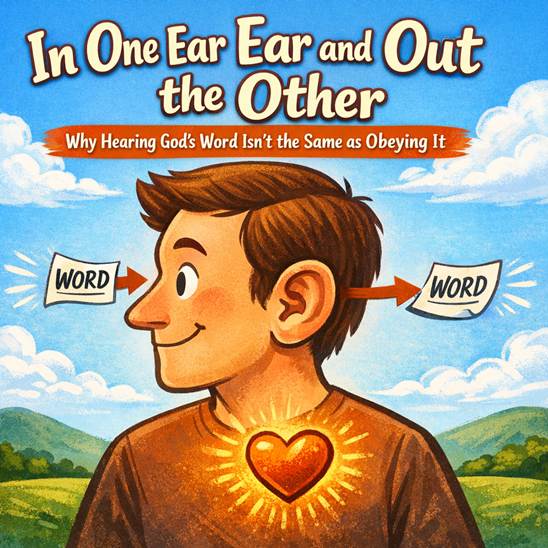
Hearing is not the problem. Hearing without obeying is. A message that goes in one ear and out the other never reaches the heart, and the heart is the only place where real transformation takes place. Jesus Himself said the greatest commandment is to “love the Lord your God with all your heart, with all your soul, with all your mind, and with all your strength” (Mark 12:30). The mind matters. The mind is essential. But the mind is not the destination. It is the doorway. The heart is the target.

The preacher in the story fired a shot that passed through the deer’s head but never touched the heart. It produced death, not life. It left a carcass, not a conversion. And that is exactly what happens when the Word of God is received only at the level of intellect. It may pass through the mind, but if it never penetrates the heart, it cannot produce obedience, repentance, or new life. It becomes information without transformation.


A Wound That Never Heals Becomes Fatal

Here is the deeper truth: a bullet that never reaches the heart can still kill you. It can wound you. It can tear flesh, rupture arteries, and leave you bleeding out. A wound is not harmless simply because it missed the center.

And the same is true of the Word when it is only received intellectually. A sermon aimed at the mind alone may not transform you, but it can still wound you. It can leave you convicted but unchanged, aware of truth but still resisting it. You can feel the sting of conviction without ever surrendering to it. And that kind of wound, left unattended, becomes spiritually fatal.

The writer of Hebrews says, “The word of God is living and active, sharper than any two‑edged sword, piercing to the division of soul and spirit, of joints and marrow, and discerning the thoughts and intentions of the heart” (Hebrews 4:12). The Word is designed to pierce. It is meant to cut deep enough to expose motives, confront sin, and bring healing through repentance. But when the Word is only admired, analyzed, or agreed with—when it is heard but not obeyed—it becomes a cut that never closes. Over time, the soul begins to hemorrhage. Not because the Word failed, but because the heart never yielded.


When the Lips Say “Amen” but the Heart Stays Distant

Jesus described this condition when He said, “This people honors Me with their lips, but their heart is far from Me” (Matthew 15:8). The mind can say “Amen” while the heart remains untouched. The intellect can applaud truth while the will refuses to bow to it.

James continues this warning by saying, “For if anyone is a hearer of the word and not a doer, he is like a man who looks intently at his natural face in a mirror… and goes away and at once forgets what he was like” (James 1:23–24). The problem is not the hearing. The problem is the forgetting. The problem is the lack of response. The problem is the absence of obedience.

Truth that only grazes the mind can still leave a person spiritually dying. Truth that never reaches the heart cannot save. Truth that never produces obedience becomes a slow bleed. Eternal death does not always come from outright rebellion. Sometimes it comes from a lifetime of sermons that never penetrated deeper than the intellect.


The Word Must Be Received With Surrender, Not Just Agreement

This is why preaching must aim for the heart. This is why hearing must lead to doing. This is why the Word must be received with surrender, not merely agreement. Jesus said, “Everyone then who hears these words of Mine and does them will be like a wise man who built his house on the rock” (Matthew 7:24). Hearing is the beginning. Doing is the evidence. Obedience is the fruit. Transformation is the result.

Do not let God’s Word pass through you without penetrating you. Do not let it skim the surface of your mind without sinking into the soil of your heart. Do not let it go in one ear and out the other. Slow down. Meditate. Respond. Obey. Let the Word reach the place where life is changed. Let it pierce, not to destroy, but to heal. Let it cut, not to wound, but to free. Let it strike the heart, for only there does the Word bring life. It isn’t about how much Bible you know or can quote but how much you actually put into practice.

Don’t let His Word go in one ear

and right out the other!