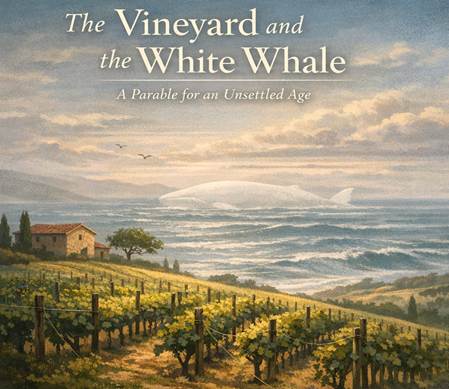
The Vineyard and the White Whale: A Parable for an Unsettled Age


There was a kingdom by the sea where a modest vineyard grew on a quiet rise. It wasn’t impressive, yet it endured every storm. It bore fruit in seasons when other fields failed. It stood as a quiet contradiction to the loud voices of the age.

One man in the kingdom could not bear the sight of it. He was a man of influence, accustomed to shaping the mood of the crowd. But the vineyard unsettled him. It contradicted the story he told about the world. It bore fruit he insisted could not exist. And so, the vineyard became, in his mind, an offense.

He convinced himself that if he could just uproot it, the unease inside him would finally be quiet.

But the vineyard was not his.

And that truth gnawed at him.

He brooded. He rehearsed grievances until they hardened into certainty. Soon the vineyard was no longer a patch of land — it was a symbol of everything he despised. He rallied others to hate it with him. He painted it as a threat to the kingdom’s stability. He insisted that the realm could not stand while that vineyard stood.

Elijah had once confronted a king just like this — a man who wanted what was not his, a man who mistook desire for destiny. The prophet warned him that coveting another man’s inheritance would cost him more than he imagined. But the warning was forgotten, and the pattern repeated.

Across the sea, another man sailed with a similar fire in his bones. Melville would later author his story — a captain who let a single wound become his compass. A white whale had crossed his path, and instead of healing, he fed his injury until it became an obsession. Every sunrise was measured by how close he was to the creature he hated. Every decision bent toward the chase.

Both men believed the same lie:

“If I can destroy the thing that troubles me, the world will finally be set right.”

But the vineyard did not trouble the king. And the whale did not trouble the captain. Their own hearts did.

And while they raged, the world around them trembled.

Borders shifted. Nations armed. Old powers stirred. New powers rose. The tides of history moved like deep waters beneath a sleeping ship.

But neither man noticed. Their eyes were fixed on a single point, and everything outside that point faded into shadow.


The Moral of the Story

And in the days that followed, the kingdom learned what neither Ahab ever could.

When hatred becomes the single bead on the string, it swallows every other color. It dulls the eyes until beauty looks threatening. It numbs the ears until wisdom sounds like deceit. It twists the mind until truth feels dangerous and lies feel safe. It blinds people to what is good, and it blinds them even more to what is right.

The king had sworn the vineyard was poison. The captain had sworn the whale was evil. But the poison was in their own vision, and the evil was in the obsession that hollowed them out.

“The light of the body is the eye,” the Scripture says, “and if the eye is evil, the whole body is full of darkness.” (Matthew 6:22–23)

Their eyes had turned evil — not with violence, but with fixation. And the darkness that followed was of their own making.

The vineyard is still growing. The whale still swam. Nothing the obsessed man did altered either one. His hatred had no power over the thing he despised, so it turned inward and fed him instead.

And any obsession fastened to an unreachable prize will end the same way — consuming the one who clings to it while the prize itself remains untouched.

The prophets had warned of this long before:

“They have eyes, but they see not; ears, but they hear not.” (Psalm 115:5–6)

A blindness chosen, not imposed.

And while the obsessed narrowed their sight to a single target, the world around them shifted. Borders trembled. Nations armed. Old powers stirred. New powers rose. The tides of history moved like deep waters beneath a sleeping ship.

But the obsessed did not see it. They could not. Their hatred had become their compass, and it pointed nowhere but inward.

So, the kingdom learned a hard truth:

A nation fixated on destroying one figure loses the ability to discern the forces shaping its destiny. A people who let hatred guide them will walk straight into the dangers they refuse to see. Obsession does not merely distort reason — it devours it. And when reason is gone, the world can burn unnoticed.

As it is written:

“Be sober, be vigilant; for your adversary the devil walks about as a roaring lion, seeking whom he may devour.” (1 Peter 5:8)

The lion did not devour them through the vineyard. Nor through the whale. He devoured them through the obsession they chose.

A True Story of Man-Made Climate Change


Now Elijah the Tishbite, who was of the settlers of Gilead, said to Ahab, “As the LORD, the God of Israel lives, before whom I stand, surely there shall be neither dew nor rain these years, except by my word.” – 1Kings 17:1

Elijah was a Tishbite. Most Jews and Christians are familiar with Elijah. When Elijah confronted wicked rulers he was a “nobody” from an obscure tribe. But that did not stop him from taking a stand for God. Elijah didn’t have a prophetic blog. He did not hold a degree in theological studies from a major Jewish school of the prophets. He did not boast a large resume nor have thousands of Facebook likes and Twitter followers. For the most part until he took a stand for the Lord he was a nobody. What gave him a place in the annals of biblical history is what he had to say, and for whom he was speaking.

Elijah was facing Ahab, who along with Jezebel was systematically attempting to remove all the spokesmen of God from the land. They were killing the prophets of God. They sought to SILENCE the voice of God from among the people. They wanted to be sure that there was no one to challenge their political position, or political decisions. They in effect wanted to be the final arbiter of all things.

God wasn’t having any of it and thus sent Elijah to confront Ahab about his wicked ways. Ahab had introduced Baal worship into the northern kingdom of Israel. Baal was considered the god of fertility and of rain, so the pronouncement of Elijah that it was not going to rain until Elijah said it would was a direct challenge to Ahab’s worship of the Baal god. Elijah was directly challenging Ahab’s reliance on idol worship. He was there to remind Ahab who really was in charge of the climate.

True to his word the heaven’s withheld rain and dew for three and a half years until God spoke to Elijah again to declare that it was going to rain. During that time a great famine hit the land.

Elijah’s confidence was in God’s character and faithfulness. He spoke with assurance because he knew the voice of the Lord and he knew that God could be counted on to do what He said He would do. Elijah even went as far as confronting all the prophets of Baal, those the government hired to stand before the people and instruct them on the ways of Baal worship. These were government employees whose job was to instruct the people on the religion of environmentalism, and they were given the authority to punish anyone who did not bow down to worship the god of the earth.

Elijah wasn’t having any of it.

1 Kings 18:16-39 (GW)
16 So Obadiah went to tell Ahab. Ahab went to meet Elijah.
17 When he saw Elijah, Ahab said, “Is that you, you troublemaker of Israel?”
18 Elijah answered, “I haven’t troubled Israel. You and your father’s family have done it by disobeying the LORD’S commands and following the various Baal gods.
19 Order all Israel to gather around me on Mount Carmel. And bring the 450 prophets of Baal and 400 prophets of Asherah who eat at Jezebel’s table.”
20 Ahab sent word to all the Israelites and brought the prophets together on Mount Carmel.
21 Elijah stood up in front of all the people and asked them, “How long will you try to have it both ways? If the LORD is God, follow him; if Baal is God, follow him.” The people didn’t say a word.
22 So Elijah told the people, “I’m the only surviving prophet of the LORD, but there are 450 prophets of Baal.
23 Give us two bulls. Let the prophets of Baal choose one for themselves, cut it into pieces, lay it on the wood, but not set it on fire. I’ll do the same with the other bull.
24 “You call on the name of your gods, but I will call on the name of the LORD. The god who answers by fire is the real God.” All the people answered, “That’s fine.”
25 Elijah told the prophets of Baal, “Choose one bull for yourselves. Prepare yours first, because there are more of you. Call on the name of your god, but don’t set the wood on fire.”
26 They took the bull he gave them, prepared it, and called on the name of Baal from morning until noon. They said, “Baal, answer us!” But there wasn’t a sound or an answer. So they danced around the altar they had made.
27 At noon Elijah started to make fun of them. “Shout louder, since he is a god. Maybe he’s thinking, relieving himself, or traveling! Maybe he’s sleeping, and you have to wake him!”
28 So they shouted louder. They also cut themselves with swords and spears until their blood flowed. (This is what their ritual called for.)
29 In the afternoon they continued to rant and rave until the time for the evening sacrifice. But there was no sound, no answer, no attention given to them.
30 Then Elijah said to all the people, “Come over here.” So all the people came to him. He rebuilt the LORD’S altar that had been torn down.
31 Elijah took 12 stones, one for each of the tribes named after Jacob’s sons. (The LORD had spoken his word to Jacob: “Your name will be Israel.”)
32 Elijah built an altar in the LORD’S name with those stones. He also made a trench that could hold 12 quarts of grain around the altar.
33 He arranged the wood, cut up the bull, and put it on the wood.
34 He said, “Fill four jars with water. Pour the water on the offering and on the wood.” Then he said, “Do it again,” and they did it again. Then he said, “Do it a third time,” and they did it a third time.
35 The water flowed around the altar, and even the trench was filled with water.
36 When it was time to offer the sacrifice, the prophet Elijah stepped forward. He said, “LORD God of Abraham, Isaac, and Israel, make known today that you are God in Israel and that I’m your servant and have done all these things by your instructions.
37 Answer me, LORD! Answer me! Then these people will know that you, LORD, are God and that you are winning back their hearts.”
38 So a fire from the LORD fell down and consumed the burnt offering, wood, stones, and dirt. The fire even dried up the water that was in the trench.
39 All the people saw it and immediately bowed down to the ground. “The LORD is God!” they said. “The LORD is God!”

Oh happy day! Someone darned to challenge the prophets of environmentalism and prove once and for all who is actually in charge of the environment. Elijah forced the king and the prophets for hire to prove that the god they worshipped was in charge. This proved to be a fatal error.

Elijah went to the top of Carmel and bowed down on the ground to pray. …Gradually, the sky grew darker with clouds and wind, and there was a heavy rain.   I Kings 18:42 &45

Elijah was not ashamed of his God and was willing to stand against king Ahab to declare his faith. I am afraid there are too many prophets of God hiding in caves from fear than are willing to boldly go and tell the good news of Christ to a lost and dying world. I am afraid that the worship of Baal has crippled too many of God’s people into believing the lies the Baals are selling and not the truth of God’s word. We need a few good men willing to stand up and proclaim to all the prophets of Baal the truth of God’s word.

Or we can start with just one lone voice crying in the wilderness. Repent for the Kingdom of God is at hand. Choose today whom you will serve. If Baal is god then serve him but if God is God then serve Him you really can not have it both ways.

And that is the way I see it. What say you?


Image.gifThis is a view from the nest. What say you?

But those who are waiting for the Lord will have new strength; they will get wings like eagles: running, they will not be tired, and walking, they will have no weariness. Isaiah 40:31 (BBE)

Along for the journey

Image.jpg


This has been A View from the Nest. The statements, comments, or opinions expressed are solely that of the author and do not represent the views or opinions of the host of this site or any affiliates thereof. Any questions or comments should be directed to myself and not to the host or hosts of this site.

Enhanced by Zemanta

God’s Standard Bearers


…When the enemy comes in like a flood, The Spirit of the Lord will lift up a standard against him.Isaiah 59:19 (NKJV)

Tea Party Express at the Minnesota capitol
Image by Fibonacci Blue via Flickr

They have been much maligned by the mainstream press. They are hated and vilified by ‘liberal’ activists and politicians. They are considered illegitimate by some but their presence can be seen and their influence felt none-the-less. To conservatives and people of faith however, the tea-party movement represents nothing less than a mighty move of God upon the hearts of his people.

–“We wait for light, but behold obscurity; for brightness, but we walk in darkness. We grope for the wall like the blind, and we grope as if we had no eyes….For our transgressions are multiplied before Thee, and our sins testify against us….In transgressing and lying against the Lord and departing away from our God, speaking oppression and revolt, conceiving and uttering from the heart words of falsehood. And judgment is turned away backward and justice standeth afar off: for Truth is fallen in the street and equity cannot enter. Yea. Truth faileth; and he that departeth from evil is accounted mad” (Isaiah 59:9-15, see margin of v. 15). Nevertheless when Satan has brought in a flood of lying errors and lawlessness has become ascendant, the Spirit of God intervenes and thwarts Satan’s vile purpose.

The solemn verses quoted above accurately describe the awful conditions in Israel under the reign of Ahab and his heathen consort Jezebel. Because of their multiplied transgressions, God had given up the people to blindness and darkness and a spirit of falsehood and madness possessed their hearts. In consequence, Truth was fallen in the street-ruthlessly trampled underfoot by the masses. Idolatry had become the State religion: the worship of Baal was the order of the day: wickedness was rampant on every side. The Enemy had indeed come in like a flood, and it looked as though there was no barrier left which could stem its devastating effects. Then it was that the Spirit of the Lord lifted up a standard against him, making public demonstration that the God of Israel was highly displeased with the sins of the people, and would now visit their iniquities upon them. That heavenly standard was raised aloft by the hand of Elijah.


God has never left Himself without witnesses on earth. In the very darkest seasons of human history the Lord has raised up and maintained a testimony for Himself. Neither persecution nor corruption could entirely destroy it. In the days of the antediluvians, when the earth was filled with violence and all flesh had corrupted His way, Jehovah had an Enoch and a Noah to act as His mouthpieces. When the Hebrews were reduced to abject slavery in Egypt, the Most High sent forth Moses and Aaron as His ambassadors, and at every subsequent period in their history one Prophet after another was sent to them.

So also has it been throughout the whole course of Christendom: in the days of Nero, in the time of Charlemagne, and even in the dark ages-despite the incessant opposition of the Papacy-the Lamp of Truth was never extinguished. And so it is today the Tea-party has arisen as a standard against this evil tide that has come upon us. Be sure to stand with the tea-party and help reclaim America. Vote for God and country Tuesday Nov 2nd 2010.

And that is this week’s tail feather.

But those who are waiting for the Lord will have new strength; they will get wings like eagles: running, they will not be tired, and walking, they will have no weariness. Isaiah 40:31Open Link in New Window (BBE)


Along for the journey

Enhanced by Zemanta