The True Meaning of Worship: A Reflection on “Here I Am to Worship”


Random Ramblings from the Resident Raptor
Worship is more than a song, more than an act, more than a ritual—it is the heartbeat of a believer’s relationship with God. In today’s world, where distractions pull us in every direction, understanding true worship is vital.

Inspired by the song Here I Am to Worship, let’s explore worship as an offering, a response, and a sacred encounter with God. What does the Lord expect? How should we approach worship? And most importantly, how do we fix our hearts and minds on the One who deserves all praise?

The Heart of Worship

Worship begins in the heart. It is not confined to church walls or Sunday services; rather, it is a daily posture of surrender and adoration. In Romans 12:1, Paul urges us to “offer your bodies as a living sacrifice, holy and pleasing to God—this is your true and proper worship.”

True worship is not about performance or perfection—it is about offering ourselves, flaws and all, to God in reverence and love. It is about responding to His goodness, His mercy, and His presence in our lives.

What the Lord Expects

In John 4:23-24, Jesus speaks to the Samaritan woman and declares, “Yet a time is coming and has now come when the true worshipers will worship the Father in spirit and in truth.” Worship is not empty words or rehearsed motions—it is an honest and heartfelt connection with God.

God desires sincerity, humility, and authenticity in worship. He does not demand grand gestures but seeks a heart that truly acknowledges Him. When we worship, our focus should be on who He is, rather than what we want.

Approaching Worship

How do we prepare our hearts for worship? Psalm 100:4 gives us a simple yet profound answer: “Enter his gates with thanksgiving and his courts with praise.”

Gratitude and awe pave the way for worship. When we approach God with thanksgiving, we shift our attention from ourselves to Him. Preparing for worship can involve quiet reflection, confessing sins, meditating on Scripture, or simply standing in awe of His greatness.

The Object of Our Worship: God Himself

Worship is not about us—it is about God. He is the Light of the World, the King of Kings, the Righteous Judge. Fixing our gaze on His attributes draws us deeper into worship:

  • His Majesty – “The Lord reigns, he is robed in majesty” (Psalm 93:1). He is sovereign and supreme.
  • His Glory – “The heavens declare the glory of God” (Psalm 19:1). All creation reflects His brilliance.
  • His Love – “God is love” (1 John 4:8). His love is boundless, redeeming, and relentless.
  • His Justice – “He is the Rock, his works are perfect, and all his ways are just” (Deuteronomy 32:4). He is fair, righteous, and true.

When we worship, we declare who God is. We shift from focusing on our circumstances to magnifying Him.

Staying Focused in Worship

In an age of endless distractions, staying centered in worship can be challenging. Here are a few ways to keep our hearts fixed on God:

  • Engage with Scripture – Meditating on His Word deepens our understanding of Him.
  • Pray Before Worship – Ask God to quiet distractions and open your heart.
  • Reflect on His Attributes – Recall His faithfulness, power, and promises.
  • Sing with Meaning – Don’t just sing—worship with intentionality.

Conclusion

Worship is an invitation. An invitation to step into His presence, to bow before His holiness, and to lift high the name of Jesus. As Here I Am to Worship so beautifully expresses:

“Here I am to worship, here I am to bow down,
Here I am to say that You’re my God.
You’re altogether lovely, altogether worthy,
Altogether wonderful to me.”

These words encapsulate the essence of true worship—humbling ourselves before Him, acknowledging His majesty, and declaring His worth. Worship is a response—an offering of love, devotion, and praise.

So, here we stand, humbled before Him. Here we are to worship.

This has been a View From the Nest: And that is the way I see it. What say you?

THE LOST KEYS


Random Ramblings from the Resident Raptor

We’ve all been there—stuck, convinced we know exactly where the answer lies. We keep searching, keep striving, keep pushing forward in the direction we believe to be right, only to come up empty.

But what happens when Jesus invites us to look again, take a new approach, and trust His guidance?

The Disciples’ Struggle: Lost Without Jesus

After His crucifixion, Jesus’ disciples felt lost. Though He had risen, they couldn’t see Him, and they assumed He was gone forever.

So, they went back to fishing—back to what they knew. But without Jesus, nothing worked.

All night they toiled, casting their nets, using their experience, their skills—but their nets remained empty.

Jesus Is Always Watching

What they didn’t realize was that Jesus had been watching them the entire time.

He could have stepped in sooner—before their exhaustion, before their discouragement, before they gave up. But He waited.

Then, just as dawn broke, He called out to them:

“Friends, have you caught anything?”

Of course, He knew the answer. But He wanted them to confront it. To pause. To acknowledge their failure, their emptiness, their lack of fruit.

How often do we need to hear that question in our own lives?

Did you catch anything?
Did you find what you were looking for?
Why do you keep chasing after things that do not satisfy?

Until we recognize our own emptiness, we won’t seek the fullness of Christ.

The disciples, worn down by failure, admitted:

“No.”

And only then—only after the confession of their need—Jesus gave them the solution.

“Throw your net on the right side of the boat and you will find some.”

And suddenly, abundance flooded their nets.

The Lost Keys: A Personal Revelation

I recently had my own empty nets moment.

I lost my car keys one Saturday afternoon and was absolutely certain they had fallen out of my pocket and between the couch cushions. I was determined that my assumption had to be right.

Yet no matter how hard I tried—nothing.

Finally, exhausted, I gave up and went to bed.

Then, at 3 a.m., I was awakened with the thought:

“Go look again.”

I returned to the couch, searching the same way, still convinced my assumption had to be right.

Then, a still, small voice whispered:

“Take another look.”

And suddenly, I realized—the keys couldn’t be in the couch because I had placed a full-length cushion over the seat thus sealing the cracks which would have prevented anything from falling between the cushions. Well at least something as big as a KEY FOB.

Then I heard another gentle nudge:

“Go to the kitchen.”

And there, in plain sight, sat my keys—right beneath the sink, waiting to be found. Taunting me without uttering a sound, as if to say, ‘Were you looking for me?’

Jesus Is the Key to Everything

This isn’t just about fishing or car keys. It’s about the reality of life itself.

The disciples tried to navigate life without Jesus, returning to old habits, chasing after success their own way. But their best efforts led to empty nets.

I tried to find my keys by relying on my own understanding. I wasted hours of searching, convinced I knew the answer. But the best I could do was come up empty.

That’s what life looks like without Jesus—we struggle, we strain, we exhaust ourselves, but we never truly succeed.

Because He alone holds the keys to life.

When we chase success without Him, we struggle and come up empty.

But Jesus holds the keys—to peace, fulfillment, joy, direction, and eternal life. Without Him, we will always be searching, always convinced we have the answer but never truly finding it.

But when we stop relying on ourselves and turn to Him—we find full nets. Found keys. Found purpose. Found life.

Random Ramblings from the Resident Raptor

The Sifting Has Begun!


Will You Stand for God or Fall Away?
by Allen Frederick

Introduction: The Urgency of the Hour

The time for playing church is over. The world is shifting, and God is calling His people to wake up. No longer can we afford to walk in lukewarm faith, clinging to comfort while ignoring the voice of God. A choice must be made: Will we surrender fully to the Lord, or continue in stagnant religion that denies His power?

Throughout history, God has always separated the faithful from the faithless before bringing revival or judgment. Today, He is calling His church to make a decision—will we truly serve Him, or remain bound by complacency?

The Biblical Pattern of Sifting

God never moves without refining His people first. Before Elijah called down fire, he confronted Israel’s doublemindedness:

“How long halt ye between two opinions? If the Lord be God, follow him: but if Baal, then follow him.” (1 Kings 18:21)

Before Jesus entrusted His disciples with the gospel, He made it clear that true discipleship requires full surrender:

“Whoever wants to be my disciple must deny themselves and take up their cross daily and follow me.” (Luke 9:23)

Before God brought spiritual renewal, He always purified the hearts of those willing to follow Him:

“I will shake all nations, and the desired of all nations will come, and I will fill this house with glory.” (Haggai 2:7)

God is shaking His church right now, refining those who are truly committed while allowing those who resist His movement to fall away.

Signs That the Church Has Grown Lukewarm

Many churches today resemble the Laodicean church in Revelation—rich in programs, tradition, and self-sufficiency, yet spiritually weak:

“I know thy works, that thou art neither cold nor hot… So then because thou art lukewarm, and neither cold nor hot, I will spue thee out of my mouth.” (Revelation 3:15-16)

A lukewarm church can be identified by:

  • More focus on tradition than transformation—rituals replace true worship.
  • Resistance to fresh revelation—God’s movement is hindered by fear of change.
  • A lack of true repentance and surrender—church becomes a social club rather than a spiritual powerhouse.

If the presence of God is no longer the priority, then everything else is in vain.

The Call to Choose: If God Be God, Serve Him

God is asking His people the same question Elijah asked IsraelHow long will we waver? Either we surrender fully to Him, or we continue in religion that denies His power. But know this—the days of walking the fence are over.

True worship requires:

  • A heart that is fully surrendered to Jesus.
  • A willingness to forsake comfort for obedience.
  • A hunger for revival and the presence of God over personal preferences.

The church cannot survive without the fire of God. The time for lukewarm faith is up—either we are on fire for Jesus, or we will wither away.

Call to Action: Hear What the Spirit Is Saying

The message is clear. The time for compromise is over.

“He that hath an ear, let him hear what the Spirit saith unto the churches.” (Revelation 3:22)

If you feel God stirring your heart, now is the time to listen and act. No more delaying. No more excuses. The church must return to its first love, seek revival, and walk in total surrender.

🔥 Ask Yourself:

  • Am I truly on fire for God, or have I been lukewarm?
  • Is my church embracing God’s movement or resisting it?
  • What will I do today to align my heart with the Lord’s call?

🚨 This is your moment to make a choice:
Will you be part of the remnant that stands for Christ, or will you fade into compromise?

This has been a View From the Nest: And that’s the way I see it, what say you?

Finding Peace in Life’s Storms: A Reflection on “It Is Well with My Soul”


Finding peace in any storm

Life has a way of testing us—through loss, heartache, and moments where hope feels distant. It’s in those very storms that we must search for peace, even when it seems impossible. Few expressions of resilience and faith are as profound as the hymn It Is Well with My Soul, written by Horatio Spafford in the wake of unimaginable tragedy. His story is a powerful testament to how faith can sustain us through the darkest valleys.

A Song Born from Sorrow

Horatio Spafford was no stranger to grief. After losing his young son to illness, financial ruin followed due to the Great Chicago Fire of 1871. But it was in 1873, when his four daughters perished in a shipwreck, that his faith was truly tested. As he traveled across the ocean to reunite with his wife—the only survivor—Spafford penned the words that would become It Is Well with My Soul.

When peace like a river attendeth my way, When sorrows like sea billows roll; Whatever my lot, Thou hast taught me to say, It is well, it is well with my soul.

Imagine writing such words while sailing past the very place where your children were lost. His hymn was not one of resignation, but of trust in something greater. It is a reminder that peace is not found in the absence of hardship, but in the presence of unwavering faith.

Holding on to Faith Through Hardship

The message of the hymn resonates deeply because loss and suffering touch everyone at some point. When life doesn’t go as planned—when we are faced with grief, disappointment, or uncertainty—it can feel like drowning in those very same waves.

Yet, Spafford’s words encourage us to surrender our burdens, to trust that peace can be found even when the storm rages. Faith does not erase sorrow, but it does offer a steady anchor. Whether through prayer, reflection, or simply breathing through the moment, we can find strength that transcends circumstance.

A Call to Find Peace in the Storm

What storm are you facing right now? Are the waves crashing hard against your soul? Perhaps this is the reminder you need—that peace is not dependent on life being perfect, but on trusting that it will all be well in the end.

Take a moment to reflect, to listen to the hymn, and to allow its message to settle into your heart. And if you are struggling, know this: you are not alone. Faith, hope, and resilience are always within reach, even when the sea billows roll.


TRUSTING GOD’S GUIDANCE


The Journey Begins: Trusting God’s Guidance

There’s something undeniably powerful about beginnings. Whether it’s stepping into a new season of life, embracing a fresh opportunity, or simply choosing to move forward despite uncertainty, every journey holds the potential for transformation. But where do we turn when the road ahead seems unclear?

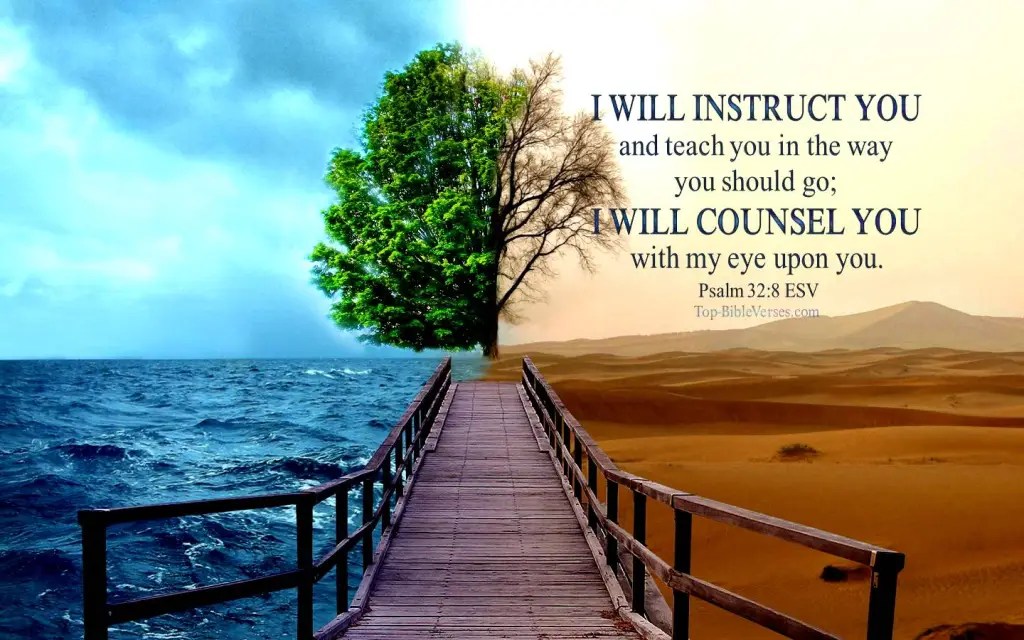
Psalm 32:8 provides an answer steeped in divine assurance:
“I will instruct you and teach you in the way you should go; I will counsel you with My loving eye on you.”

This verse is a reminder that we are never truly lost. God is the ultimate guide, gently leading us down paths we may not fully understand yet. While our own vision may be clouded by doubt or fear, His perspective is infinite, seeing beyond obstacles into the blessings that await.

Walking in Trust

The first steps of any journey can be daunting. Doubts creep in—“Am I making the right choice?” “Will this work out?”—but faith is not about seeing every detail clearly; it’s about trusting the One who does. God promises instruction, wisdom, and care. He doesn’t just direct us—He walks with us.

Like a traveler setting out at dawn, we must embrace the unknown with courage. We may not see the full destination, but we can trust that each step forward is part of a divine plan, designed for our growth and purpose.

Moving Forward with Confidence

So, if you find yourself standing at the threshold of something new—whether it’s a life change, a challenge, or an opportunity—take a deep breath and step forward in faith. God has already gone before you, preparing the way. His guidance is never absent, and His counsel never fails.

Your journey begins now. Walk boldly, knowing that you are led by love, not by fear.

Action Step: Reflect & Write

Take a few minutes to reflect on a moment in your life when you felt uncertain about your path. How did God guide you through it? Write about that experience in a journal or share it with a friend. If you’re in a season of transition now, ask yourself: What is God teaching me in this moment?

This has been a View From the Nest and that’s the way I see it! What say you?