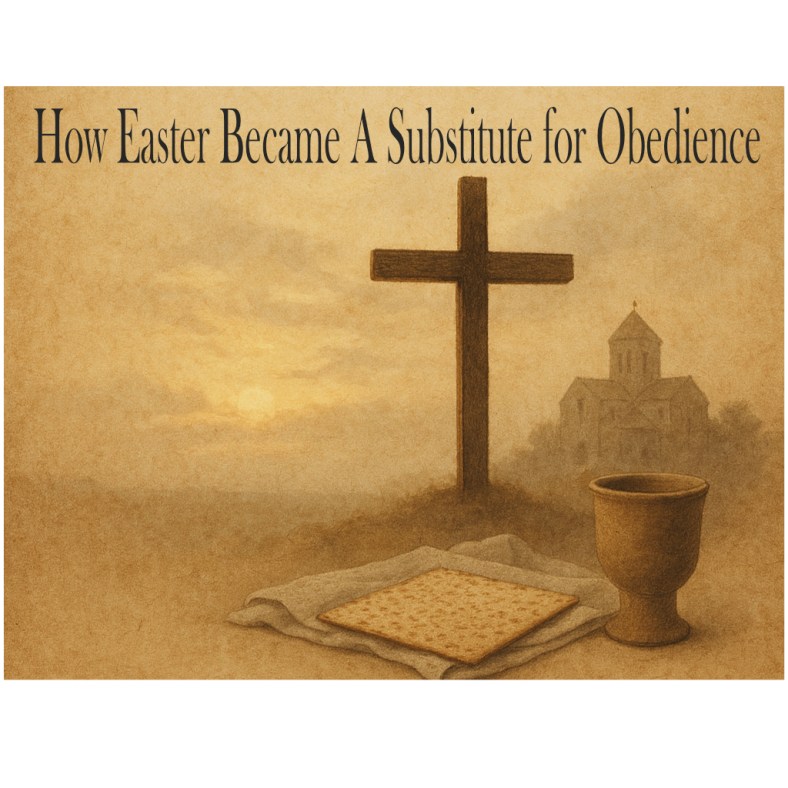
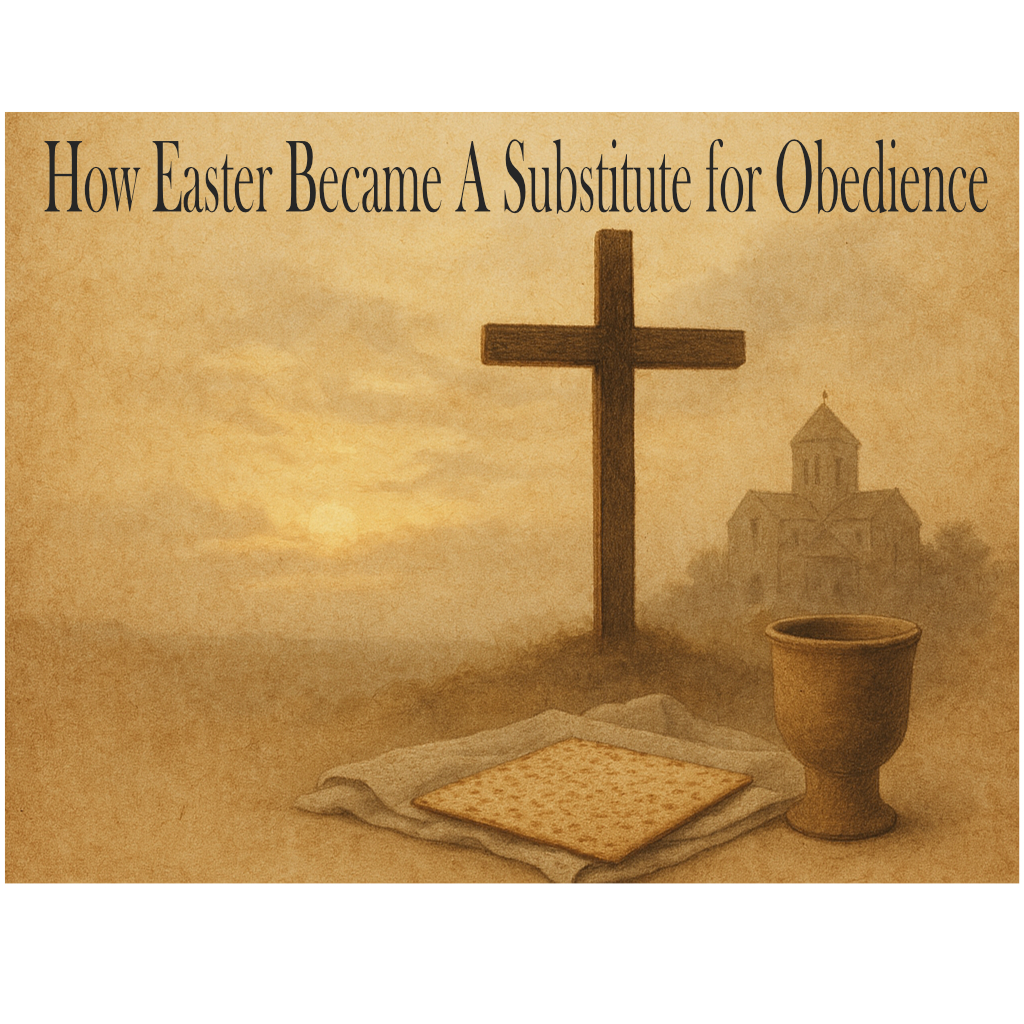
The whole problem with Easter begins with the very word itself. Long before the church ever attached it to the resurrection, Easter was the name of a spring goddess. She was celebrated with fertility rites, offerings, and seasonal rituals. The early church fathers knew this. The bishops at Nicaea knew this. Everyone in the ancient world knew this. The word carried unmistakable pagan overtones. As a result, the church found itself in an awkward position. They wanted a festival to celebrate the resurrection. However, they didn’t want it to fall on the same day as the pagan celebration that shared its name. So instead of abandoning the pagan term, they kept it—and simply moved the date.
But that raises a question no one seems willing to ask: If the name was pagan, the date was pagan, and the season was pagan, why use it at all? Why not simply keep the feast God established—Passover—which is older, biblical, commanded, fulfilled by Christ, and practiced by Jesus Himself? The answer is uncomfortable but historically undeniable: the early Gentile church wanted distance from anything that looked “too Jewish.” They did not embrace the feast God instituted. They adopted a pagan name. They shifted the date to avoid the pagan festival. Then, they declared the whole thing a “high holy day.” In a single action, they departed from the biblical calendar. They left behind the apostolic pattern. They disconnected from the very rhythm of redemption God Himself set in motion.
And this is where the real problem begins. Once the church is willing to replace what God established with what man invented, it becomes extremely easy. It becomes easy to call the invention “holy.” It also becomes easy to call the commandment “optional.” It becomes easy to defend tradition with passion while ignoring Scripture with ease. It becomes easy to forget that Jesus kept Passover, not Easter (Luke 22:15). The apostles preached Christ as our Passover Lamb, not the centerpiece of a spring festival (1 Corinthians 5:7). The early church remembered the resurrection every time they gathered. They did not do it once a year on a date calculated by the moon (Acts 20:7). There is so much wrong with this entire season. The modern church doesn’t need a new argument. It needs repentance. It needs cleansing. It needs to be washed from the layers of tradition, syncretism, and cultural compromise that have accumulated over centuries. The issue is not whether we celebrate the resurrection. The issue is whether we will honor God the way He commanded. Or will we continue to sanctify a festival He never asked for.
When the Created Becomes the Center and the Creator Becomes the Footnote
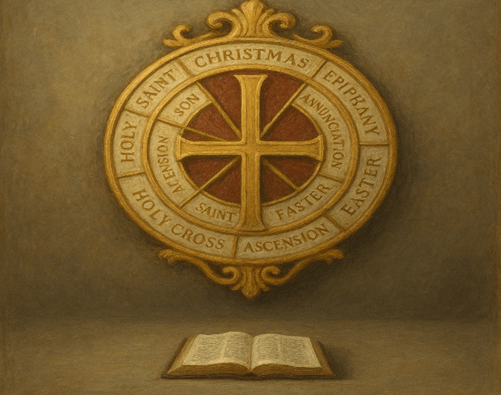
Strip away the two big festivals and the calendar collapses. Strip away the productions, the pageants, the pastel-colored Sundays, and the special offerings. Suddenly, the church is forced to face the emptiness it has been covering with seasonal excitement. The early church didn’t need a holiday to feel alive. They had the Holy Spirit (Acts 2:4). They had fellowship (Acts 2:42). They had the apostles’ teaching (Acts 2:42). They had the breaking of bread (Acts 2:46). They had prayer (Acts 2:42). They had mission (Acts 8:4). They had power (Acts 4:33).
We have Christmas and Easter.
When the created thing becomes the center of our worship, the Creator becomes the footnote. Paul warned us about this mistake. “They exchanged the truth of God for a lie, and worshiped and served the creature rather than the Creator.” (Romans 1:25). We read that verse and think of idols carved from wood and stone. But the modern church has its own idols—sanctified by tradition, polished by sentiment, and defended with passion. Christmas and Easter have become the emotional anchors of the Christian year. God did not command these days. Without them, the church would have to rediscover what it means to be the church. It would need to be more than just doing church.
The Author’s Argument—and the Hole Right Through the Middle of It
The article that sparked this editorial tried to defend Easter. It stated, “Easter is the axis on which the Christian year revolves.” He’s right—but not in the way he thinks. If the axis of the Christian year is a man‑made festival, then the whole thing is already off balance. The resurrection is the axis of our faith. Easter is not the resurrection. Easter is a date chosen by bishops in A.D. 325 using a formula that sounds more like astronomy than theology.
The author continues, “Without resurrection, there is no Christianity.” Amen. Scripture says the same: “If Christ has not been raised, your faith is futile.” (1 Corinthians 15:17); “He was raised for our justification.” (Romans 4:25). But then he makes the leap: therefore, Easter is necessary.
No Scripture. No command. No apostolic example. Just tradition.
This is how deception works—not by denying what God said, but by adding to it.
The New Testament church honored the resurrection every time they gathered. They met on the first day of the week (Acts 20:7). They broke bread in remembrance of Him (Luke 22:19; 1 Corinthians 11:26). They preached the resurrection continually (Acts 4:33). They lived in resurrection power daily (Philippians 3:10). They didn’t need a festival to remind them Jesus was alive. They were living proof.
So, if the resurrection is celebrated every week, why do we need Easter at all?
We don’t.
The modern church does—because without Easter, the calendar would be sterile, empty, exposed.
Passover Fulfilled Is Not Passover Abolished
Some argue, “Christ fulfilled Passover, so we don’t need it.” But Scripture never says Passover was abolished. It says Passover was fulfilled. “Christ, our Passover Lamb, has been sacrificed.” (1 Corinthians 5:7). At His final Passover meal, Jesus took bread. He said, “This is My body which is given for you. Do this in remembrance of Me.” (Luke 22:19). Paul writes that the feasts and Sabbaths “are a shadow of things to come, but the substance belongs to Christ.” (Colossians 2:17).
Passover becomes the gospel in God’s own language. The Lamb is chosen without blemish (Exodus 12:5; John 1:29). The blood is applied and judgment passes over (Exodus 12:13; John 5:24; Romans 5:9). Israel is delivered from bondage (Exodus 12:42; Romans 6:6–7). The old life is buried in the sea (Exodus 14:30; Romans 6:4). On the day of Firstfruits, the first sheaf is lifted before the Lord (Leviticus 23:10–11). Paul declares, “Christ has been raised from the dead.” Christ is the firstfruits of those who have fallen asleep.” (1 Corinthians 15:20).
Everything Easter tries to say, Passover already said—and God said it first.
Passover fulfilled does not mean Passover discarded. It means Passover understood in the light of Christ. The early believers didn’t keep Passover as a cultural relic. They saw Christ in every element. They saw the Lamb, the blood, the deliverance, the judgment passed over, the burial, the resurrection. They saw the gospel written into the calendar of God.
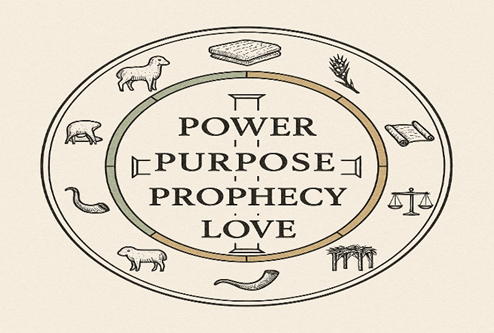
The Feasts of the Lord: Power, Purpose, Prophecy, and Love
Unlike Christmas and Easter, these feasts are not built on folklore, tradition, or borrowed pagan imagery. They are built on power, purpose, prophecy, and love. Each one is an exact replica of God’s dealings with man. Each one is fulfilled in Christ. Each one is a perpetual reminder of the gospel in God’s own language.
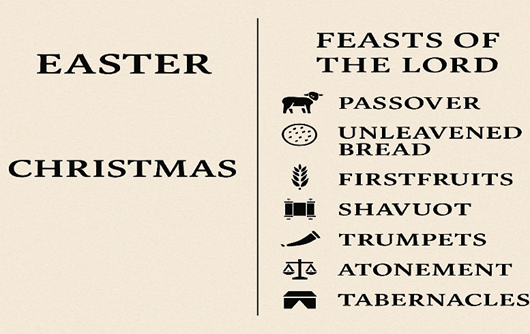
They reveal power: the power of God to save, deliver, redeem, and restore. Passover shows the power of the Lamb. Unleavened Bread shows the power of cleansing. Firstfruits shows the power of resurrection. Pentecost shows the power of the Spirit. Trumpets shows the power of awakening. Atonement shows the power of forgiveness. Tabernacles shows the power of God dwelling with His people.
They reveal purpose: God does not move randomly. The feasts show that salvation is not a moment but a story. It is not an isolated event but a carefully ordered plan. They teach us who God is and how He works.
They reveal prophecy: Christ fulfilled the spring feasts in His first coming with exact precision. He died on Passover (John 19:14; 1 Corinthians 5:7). He was in the grave during Unleavened Bread (Luke 23:54–56). He rose on Firstfruits (Leviticus 23:10–11; 1 Corinthians 15:20). He poured out the Spirit on Pentecost (Acts 2:1–4). The fall feasts point forward with the same precision. The trumpet of His return is described in 1 Thessalonians 4:16. The day of atonement and national repentance is shown in Zechariah 12:10. The tabernacle of God with men is mentioned in Revelation 21:3.
And they reveal love. The feasts are not cold rituals. They are God’s way of saying, “I want you to remember what I’ve done. Think about what I’m doing now. Consider what I will do in the future.” They are the story of Jesus written into time so that when He came, no one would miss Him. Jesus didn’t just fulfill the feasts—He lived them. He died on Passover, rested in the grave during Unleavened Bread, rose on Firstfruits, and sent the Spirit on Pentecost. He will return in the season of Trumpets, cleanse and judge at Atonement, and dwell with us at Tabernacles.
These are not Jewish traditions. They are the fingerprints of God.
When God commanded these feasts as “perpetual” (Exodus 12:14; Leviticus 23:14; Leviticus 23:21; Leviticus 23:31; Leviticus 23:41), He wasn’t preserving a cultural identity. He was preserving the gospel. He was preserving the story of His Son.
If the Church Filled Its Calendar With God’s Feasts, It Wouldn’t Need Filler Seasons to Pretend It’s Alive
But imagine if the church calendar wasn’t built around man‑made festivals at all. Imagine if it was built around the feasts of the Lord. These are the appointments God Himself established. This is the rhythm He wrote into creation. It is the story He embedded into time. If the church filled its year with the feasts of the Lord, it wouldn’t need to manufacture spiritual excitement. It wouldn’t need to create artificial seasons to feel alive. It wouldn’t need to borrow pagan imagery, rename it, and pretend it’s holy. It wouldn’t need to cling to Christmas and Easter like life support.
Because the feasts of the Lord don’t just fill a calendar—they tell the entire gospel from Genesis to Revelation. Not just the birth of Jesus. Not just the resurrection of Jesus. It includes the whole story: The Lamb was slain from the foundation of the world. The blood saves. There is deliverance from bondage. The burial of the old life happens. The resurrection of the new occurs. The Spirit is poured out. The trumpet announces His return. The day of atonement is when every wrong is made right. The tabernacle of God dwells with man forever.
A calendar built by God, not by bishops. A rhythm established by Scripture, not by councils. A story fulfilled by Christ, not by tradition.
When the church embraces the feasts of the Lord, it doesn’t need to pretend to be alive. It becomes alive. It becomes rooted. It becomes anchored. It becomes biblical. It becomes prophetic. It becomes Christ‑centered in a way Christmas and Easter never could. The feasts don’t just celebrate moments—they reveal the entire mission.
The Church Doesn’t Need Easter—It Needs to Return to What God Established
The early church didn’t need Christmas or Easter to feel alive. They had Christ. They had the Spirit. They had the mission. They had the fellowship of the saints. They had the breaking of bread. They had the apostles’ teaching. They had prayer. They had power.
We have two festivals and a lot of noise.
The modern church clings to Christmas and Easter. Without these traditions, it would have to face the truth: it has forgotten how to be the church.


You must be logged in to post a comment.