
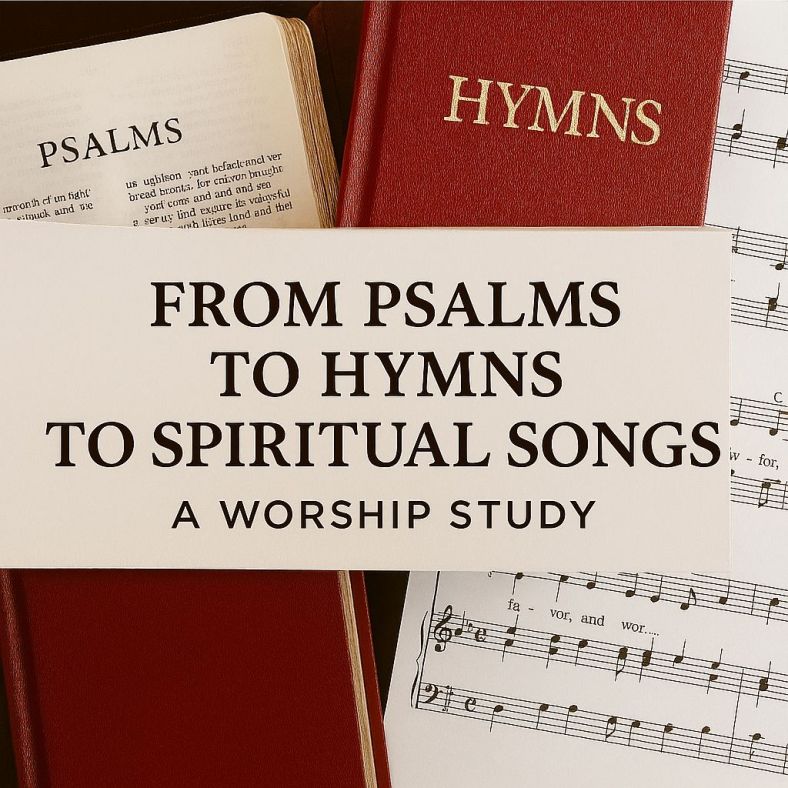
🎶 From Psalms to Hymns to Spiritual Songs: Rediscovering the Full Voice of Worship
There’s a rhythm in the Spirit that many of us miss—not because we’re tone-deaf, but because we’ve grown accustomed to singing in only one key. Paul’s words in Colossians 3:16 and Ephesians 5:19 aren’t just poetic—they’re prophetic. He’s inviting the Church into a threefold harmony: psalms, hymns, and spiritual songs.
But what does that sound like in real life?
📖 The Psalmist’s Cry: Worship That Anchors
David didn’t write songs to impress anyone. He wrote them to survive. In caves, on battlefields, in royal courts and lonely nights, his psalms were raw, reverent, and real. When he sang, “Why are you cast down, O my soul?” (Psalm 42:5), he wasn’t performing—he was pleading.
Psalms are the worship of the anchored heart. They remind us that God is not afraid of our questions, our laments, or our longings. They teach us to worship with Scripture as our vocabulary and honesty as our posture.
In today’s worship culture, we need to recover this. Not just quoting psalms—but singing them. Letting the Word shape our sound.
🕊️ The Hymn-Writers’ Declaration: Worship That Teaches
Fast forward to Paul and Silas in prison. Shackled, bruised, and unjustly accused, what did they do? “About midnight Paul and Silas were praying and singing hymns to God…” (Acts 16:25). Not psalms. Hymns.
Why hymns? Because hymns declare what we believe when everything else is shaking. They’re theological anchors in emotional storms. Whether penned by Luther, Watts, or Fanny Crosby, hymns carry the weight of doctrine wrapped in melody.
Hymns are the worship of the instructed heart. They teach us to sing truth—not just feel it. And in a world drowning in opinions, we need songs that remind us who God is, not just how we feel.
🔥 The Spirit’s Whisper: Worship That Responds
Then there’s the upper room. No hymnals. No setlists. Just wind, fire, and spontaneous utterance. The early Church didn’t just sing about God—they sang with Him. Spiritual songs are the overflow of divine encounter. They’re the worship of the responsive heart.
Think of Mary, pregnant with promise, breaking into spontaneous praise: “My soul magnifies the Lord…” (Luke 1:46). Or the Church in Corinth, where Paul encouraged Spirit-led singing alongside prophecy and teaching (1 Corinthians 14:15).
Spiritual songs are risky. They’re unscripted. But they’re also intimate. And if we silence them, we may miss the now-word of God.
🎯 So What’s the Point?
This isn’t a progression from old to new. It’s not a regression from structured to spontaneous. It’s a divine triad—a full-bodied worship expression. Psalms root us. Hymns instruct us. Spiritual songs release us.
When we lean too heavily on one, we lose the richness of the whole:
Psalms without spiritual songs become liturgical but lifeless.
Hymns without psalms become doctrinal but disconnected.
Spiritual songs without hymns become emotional but unanchored.
💬 A Personal Reflection
I remember a season when all I could sing were psalms. Life was heavy, and I needed the Word to carry me. Then came a time when hymns became my declaration—truth over turmoil. And now, I find myself drawn to spiritual songs—those moments when the Spirit sings through me what I didn’t even know I needed to say.
Worship isn’t just music. It’s movement. And God invites us to sing in every season, with every sound.
🙌 Let’s Sing the Full Song
Let the Word dwell richly. Let the truth ring loudly. Let the Spirit flow freely.
Whether you’re in a cave like David, a prison like Paul, or an upper room like the early Church—there’s a song for you.
Sing the psalm. Declare the hymn. Release the spiritual song.
This has been a View From the Nest. Please Like share and subscribe. Thank you.

You must be logged in to post a comment.