When a Nation Resists Its Own Healing


As America enters Her 250th year of existence, let’s take a moment to pause. We should think about the State of the Union before the President’s address to the Nation in a few days.

There are seasons in a nation’s life. The symptoms of decay rise so clearly to the surface. Even the untrained eye can see them. Corruption becomes normalized. Dishonesty becomes expected. Debt becomes a way of life. Institutions become self-preserving rather than people-serving. Truth becomes inconvenient, and justice becomes negotiable. These are not modern problems. They are ancient ones. Solomon captured it with piercing simplicity when he wrote, “There is nothing new under the sun.” (Ecclesiastes 1:9)

What once was will be again, because human nature has not changed. And the spiritual laws that govern nations have not changed either. If we want to understand the moment we are living in, we must return to the Scriptures. We should not seek political commentary there. Instead, we should aim to find spiritual diagnosis.

The story of Jehoshaphat flows directly from the covenant promise of 2 Chronicles 7:14. It provides a lens to see our own national condition with clarity and sobriety.


The Symptoms of a Nation in Decline

Before Jehoshaphat ever stepped into leadership, Judah was already sick. The symptoms were visible everywhere. Judges accepted bribes. Leaders protected their own interests rather than the people’s. Alliances were forged out of fear rather than faith. The culture tolerated dishonesty because it had grown accustomed to it. The system rewarded corruption because corruption had become the system.

Scripture describes this kind of national decay with painful accuracy:

“Your princes are rebels and companions of thieves. Everyone loves a bribe and runs after gifts; they do not bring justice to the fatherless, and the widow’s cause does not come to them.” (Isaiah 1:23)

A nation does not collapse because of one leader. A nation collapses because of a culture that prefers darkness to light.

Jesus said, “People loved darkness rather than light because their deeds were evil.” (John 3:19) When darkness becomes comfortable, truth becomes offensive.


The System Beneath the Symptoms

Corruption is never random. It is architectural. It is built into the bones of a nation when righteousness is neglected. By the time Jehoshaphat arrived, Judah’s institutions had become self-protecting organisms. They rewarded partiality, concealed dishonesty, and punished anyone who threatened the status quo.

This is the same pattern the prophets confronted:

“Shall I acquit the man with wicked scales and with a bag of deceitful weights?” (Micah 6:11)

“Hear this, you who trample the needy… saying, ‘When will the new moon be over, that we may sell grain… making the ephah small and the shekel great and dealing deceitfully with false balances?’” (Amos 8:4–5)

When a system becomes corrupt, it does not merely harm the weak. It eventually devours the very people who built it.


God Sends a Reformer, Not a Committee

Into this environment, God raised up Jehoshaphat—not as a politician, not as a celebrity, but as a reformer. His assignment was not to preserve the system but to purify it. He appointed honest judges, confronted corruption, restored accountability, and called the nation back to God.

Scripture records his charge to the judges:

“Consider what you do, for you judge not for man but for the LORD. He is with you in giving judgment.” (2 Chronicles 19:6)

Jehoshaphat understood something many forget: Reform is not a political act. Reform is a spiritual intervention.


The Resistance to Reform

But not everyone welcomed the light. Those who benefited from the corruption resisted the reform. Those who prospered under dishonesty opposed accountability. Those who feared losing influence fought the very changes that would have healed the nation.

This is the tragedy of every generation. People cry out for healing. However, when God sends the healer, they resist Him.

Jesus lamented this same pattern:

“O Jerusalem, Jerusalem… how often would I have gathered your children together as a hen gathers her brood under her wings, and you were not willing!” (Matthew 23:37)

A nation cannot be healed if it refuses the hand that heals it.


Miriam’s Warning: Do Not Resist the Vessel God Chooses

Miriam’s story stands as a sobering warning. She did not reject God. She rejected the vessel God chose. She questioned Moses’ authority, challenged his assignment, and believed she had equal standing in the mission. But God responded swiftly:

“Why then were you not afraid to speak against My servant Moses?” (Numbers 12:8)

Her leprosy was not punishment. It was revelation—a visible picture of an invisible rebellion.

When you resist the person God selects to bring deliverance, you are not fighting a man. You are fighting God. And when you fight God, you bring judgment upon your own head.


The Consequence of National Resistance

Jehoshaphat’s reforms were a mercy—a chance for Judah to return to righteousness before judgment fell. But Scripture is clear: when a nation refuses to repent, refuses to humble itself, refuses to turn, judgment becomes inevitable.

Not because God desires destruction, but because corruption collapses under its own weight.

“Pride goes before destruction, and a haughty spirit before a fall.” (Proverbs 16:18)

“Righteousness exalts a nation, but sin is a reproach to any people.” (Proverbs 14:34)

A nation that resists reform is a nation choosing its own ruin.


The Cure That Flows From the Throne

The remedy for national decay has never been political. It has always been spiritual. God told Solomon exactly how a nation is healed:

“If My people, who are called by My name, will humble themselves and pray and seek My face and turn from their wicked ways, then I will hear from heaven, and will forgive their sin and will heal their land.” (2 Chronicles 7:14)

Healing begins with humility. Restoration begins with repentance. Deliverance begins with alignment.

And God’s healing always flows through human instruments. He raises a Moses, a Samuel, a Jehoshaphat, a Nehemiah—and when the people resist the vessel, they resist the healing.


A Prayer for a Nation in Need of Mercy

Father, we humble ourselves before You. We confess our national pride, our corruption, our injustice, and our dishonesty. We acknowledge that we have often resisted the very instruments You sent to heal us. We have misread our moment and preferred comfort over correction.

But today we turn. We seek Your face. We bow our hearts. We repent of our wicked ways. Hear from heaven, O Lord. Forgive our sin. Heal our land.

Raise up reformers in our generation. Give us discernment to recognize Your movement. Give us courage to align with Your purposes. And give us humility to follow the vessels You have chosen.

Heal our land, O God—not by might, nor by power, but by Your Spirit. In Jesus’ name, Amen.
A WARNING AGAINST APOSTASY


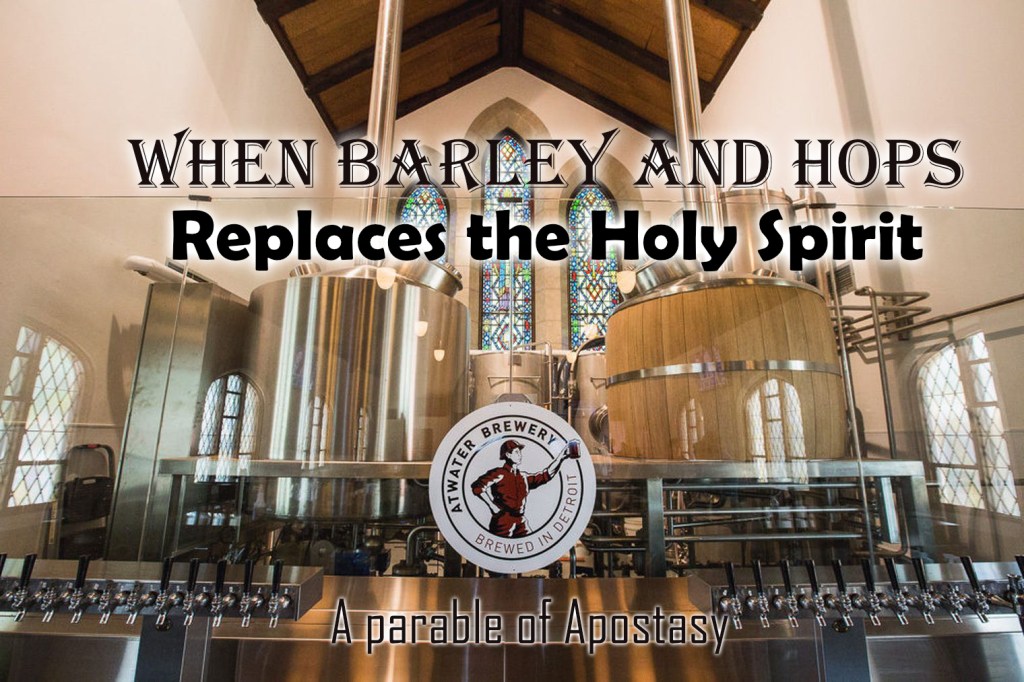
When Barley and Hops Replace the Holy Spirit: A Living Parable of Apostasy

“For if, after they have escaped the defilements of the world through the knowledge of our Lord and Savior Jesus Christ, they are again entangled in them and overcome, the last state has become worse for them than the first. For it would have been better for them never to have known the way of righteousness than after knowing it to turn back from the holy commandment delivered to them.” – 2 Peter 2:20-21

In Pittsburgh’s Lawrenceville neighborhood stands a prophetic warning made of brick and mortar: The Church Brew Works. What was once St. John the Baptist Roman Catholic Church was built in 1902. It served immigrant souls seeking God in a new land. Now, it serves Pious Monk Dunkel where prayers once rose like incense. This isn’t just adaptive reuse. It’s a living parable of what happens when vessels swept clean by the blood of the Lamb evict their Lord.

Consider the spiritual progression: A sinner encounters Christ. The blood washes them clean—REDEEMED. The Holy Spirit takes residence. But then comes the fatal choice: rejecting His Lordship for programs over presence, relevance over reverence. In that willful vacancy, seven worse spirits rush in.

St. John the Baptist Church knew this progression intimately. For 91 years, the Eucharist transformed bread and wine into holy mystery. Immigrants found more than community—they found Christ. But as industry fled Pittsburgh and congregations dwindled, the church chose survival over Spirit. In 1993, the Diocese officially deconsecrated the building. Three years later, copper brewing tanks stand precisely where the altar once stood.

The sobering truth: This “resurrected” space serves 300% more bodies daily than it ever did as a church. But which spirits are they serving? The brewery offers “Celestial Gold” and “Pipe Organ Pale Ale”—mocking the sacred with clever marketing. They’ve literally replaced the Holy Spirit with distilled spirits, the blood of the covenant with barley and hops.

Jesus warned us precisely about this in Matthew 12:43-45: “When an unclean spirit goes out of a man, he goes through dry places, seeking rest, and finds none. Then he says, ‘I will return to my house from which I came.’ And when he comes, he finds it empty, swept, and put in order. Then he goes and takes with him seven other spirits more wicked than himself, and they enter and dwell there; and the last state of that man is worse than the first.”

But Peter’s warning cuts deeper—this isn’t about never knowing Christ. These churches KNEW Him. They were washed in His blood, filled with His Spirit, entrusted with His mysteries. Their apostasy is infinitely worse than ignorance. As Peter declares, better to have never known the way of righteousness than to turn back from the holy commandment.

Some will argue this church merely traded one form of spiritual emptiness for another—replacing religious ritual with recreational ritual. But even symbolic faith is closer to truth than celebrating its absence. When any church—Catholic, Protestant, Orthodox—that once invoked Christ’s name now invokes ‘Celestial Gold’ lager, it strays far from its original purpose. When any altar becomes a brewery, it loses its sanctity. When any sanctuary chooses mammon over even the memory of the sacred, the last state is worse than the first. The building that once reached toward heaven, however imperfectly, now celebrates its earth-bound stupor.

The building remembers its redemption while hosting its own possession. The stained glass still filters light, but onto patrons seeking buzz instead of blessing. The remnant sees this for what it is: not progress but prophecy fulfilled. When institutions that once housed the Holy Spirit choose barley and hops instead, they don’t become neutral spaces—they become anti-sanctuaries.

This is the sober warning to every congregation: Which spirits are you choosing to serve? The Holy Spirit still seeks vessels who won’t trade His presence for the world’s applause. But once you’ve known His glory and chosen vacancy instead, the last state is indeed worse than the first. The Church Brew Works stands as testimony—where the Blood once redeemed, blood alcohol content now rules. Let those with eyes to see, see. Let those with ears to hear, hear.

This has been “A View From the Nest” and that is the way I see it! What say you?

Watchman Report: Live from the Court of Public Spectacle


Allen Frederick

Filed by: The Watchman

Last Saturday, cities across the nation echoed with the resolute voices of thousands gathered at the “No Kings” rallies. These protests, fueled by a deep dissatisfaction with the current government, marked a pivotal moment of public outcry and spiritual unrest. As the crowds marched and chanted, the air was thick with tension and anticipation, setting the stage for a drama that transcends politics and touches the very heart of our cultural and spiritual identity. Tonight, we begin our report by looking back at these rallies and the powerful message they sent across the land. This whole scene is reminiscent of a similar scene that took place more than 2000 years ago. The similarities are striking! Let’s take a trip down memory lane.

REPORTING LIVE FROM THE NO KINGS RALLY

Good evening, listeners. This is your anchor coming to you live with a special report unfolding at the crossroads of faith and culture. Tonight, we witness a drama as old as time itself—the Passion, replayed not on a distant stage, but in the very streets and courts of our world today. The crowd is restless, voices rise in fervor, and the stakes could not be higher. Stay tuned as we bring you the unfolding story, the key players, and the truth that refuses to be silenced.


Opening Broadcast

This is the Watchman, reporting live from the arena of ideological warfare.
The crowd is surging. The chants are coordinated. The signs are sharp.
But beneath the slogans and spectacle, the ancient drama unfolds again.

The Passion is replaying—not in Jerusalem, but in every city square.
The players are familiar. The tactics unchanged.
The target? Still Truth.
The verdict? Still pending.


First Quarter: The Stirring of the Crowd

The governing authorities have taken the field—not to calm, but to agitate.
They’ve deployed their playbook:

  • Stir unrest
  • Isolate the righteous
  • Judge-shop for friendly venues

The crowd responds on cue.
Chants erupt like drumlines:

“No kings!”
“Give us Barabbas!”
“Crucify conviction!”

The volume is deafening.
But the loudest voice doesn’t get the last word.


Second Quarter: The Royal Court of Righteousness Takes the Stand

Each ideological mascot steps forward, cloaked in moral certainty:

  • The Advocate of Accommodation demands tolerance—on his terms.
    He’s not here to listen. He’s here to legislate your repentance.
  • The Priest of Preference rejects divine order.
    He quotes Caesar, not Scripture.
    His altar is built on feelings, not truth.
  • The Protest Scribe unfurls his scroll.
    It’s long. It’s loud. It’s lawless.
    He wants justice—but only for his tribe.
  • The Judge of Identity declares, “I am who I say I am.”
    But Truth replies, “I Am who I Am—and you are not Me.”
  • The Herald of Hurt limps forward.
    Her wounds are real—but her weapon is resentment.
    She demands healing without surrender.

Halftime: The Judges Wash Their Hands

Just like Pilate, today’s judges are shopping for friendly courts.
They want rulings that affirm the crowd, not the Constitution.
They misapply the law to preserve their own peace.
They fear the mob more than they fear God.

“Shall I crucify your King?”
“We have no king but Caesar.”


Third Quarter: The Spectacle Builds

The crowd grows louder.
The costumes more theatrical.
The media amplifies the illusion of strength.

But the Watchman sees:

  • The spectacle is smoke.
  • The unity is Babel.
  • The power is borrowed.

They chant for chaos over peace.
They crown comfort over conviction.
They crucify Truth—and call it progress.


Fourth Quarter: The Rising

They think they’ve won.
They think the tomb is sealed.
They think the Lamb is silenced.

But Truth is not dead.
Truth is not buried.
Truth is rising.

“He was oppressed and afflicted, yet He did not open His mouth.” — Isaiah 53:7
“You will know the truth, and the truth will set you free.” — John 8:32
“Woe to those who call evil good and good evil.” — Isaiah 5:20


Final Call from the Booth

This is the Watchman, signing off.
Crowds chant.
Judges fold.
Scribes scribble.

But the Lamb still reigns!
And the final whistle belongs to Him.

“You have judged the Son of Man by your standards.
But He will judge you by His.”

WATCHMAN’S REPORT The Martyrdom of Charlie Kirk and the Rising Spirit of Antichrist


I. A Sobering Moment in Our Time

On September 10, 2025, Charlie Kirk—conservative activist, founder of Turning Point USA, and outspoken Christian—was fatally shot while speaking at Utah Valley University. His death sent shockwaves through the church, the conservative movement, and the hearts of many young believers who saw in him a bold voice for biblical truth in a culture increasingly hostile to righteousness.

Kirk was not a perfect man, nor did he claim to be. But he was a man who dared to speak truth in love, confronting cultural decay, defending biblical values, and empowering a generation of young Christians to stand firm in their convictions. His assassination, still under investigation, appears to be politically and spiritually charged—a flashpoint in the war between light and darkness.

Like Stephen in Acts 7, Charlie Kirk stood boldly before hostile crowds, proclaiming truth without compromise. And like Stephen, he paid the ultimate price. His death echoes the ancient cry: “Lord, do not hold this sin against them.” (Acts 7:60)


II. The Pattern Repeats

Jesus warned us plainly: “You will be hated by all for My name’s sake” (Matthew 10:22). The same spirit that cried “Crucify Him!” in Jerusalem now cries “Cancel him!” in our streets, campuses, and media. The same crowd that chose Barabbas over the sinless Son of God now cheers for chaos, rebellion, and moral inversion.

Charlie Kirk’s death is not just political violence—it is prophetic confirmation. The spirit of antichrist is not coming; it is here. It mocks holiness, persecutes truth-tellers, and seeks to silence the prophetic voice. It is a spirit that hates fathers, despises order, and exalts confusion. And it is increasingly emboldened.

As in the days of Elijah, when Jezebel sought to kill the prophets and silence the voice of God (1 Kings 19:2), so now the spirit of antichrist seeks to intimidate and eliminate those who speak truth. But just as God preserved a remnant then (1 Kings 19:18), He will preserve one now.


III. The Church Must Awaken

This is not a time for passive lament. It is a time for prophetic clarity and spiritual resolve. The children of God must recognize that we are not called to blend in—we are called to stand out. We are not called to appease culture—we are called to confront it.

Let us not forget: the Apostles were beaten, imprisoned, and executed for preaching Christ. Today, believers are mocked, censored, and even killed for doing the same. The persecution may look different, but the root is the same: the world hates the light because it exposes its darkness (John 3:19–20).

Like Daniel in Babylon, we must refuse to bow to cultural idols (Daniel 3:18). Like Esther, we must speak up “for such a time as this” (Esther 4:14). Like Paul, we must be ready to suffer for the sake of the gospel (2 Timothy 2:3).


IV. What Must We Do?

Here are Spirit-led responses for this hour:

  • Strengthen the Remnant: Equip believers—especially young ones—with biblical literacy, apologetics, and spiritual resilience. Let Charlie’s legacy provoke a generation to speak boldly and live faithfully.
  • Expose the Spirit of Antichrist: Teach discernment. Name the ideologies that oppose Christ—whether in media, education, or politics. Don’t just rebuke darkness; illuminate it with truth.
  • Reclaim the Public Square: Like Kirk, we must re-enter the arenas of debate, education, and culture—not with rage, but with reason, conviction, and compassion. The gospel is not fragile. It belongs in every sphere.
  • Pray and Prophesy: Intercede for our nation. Declare revival. Call the church back to the altar. The blood of the martyrs still speaks—and it calls us to action.
  • Honor the Martyrs: Let us not sanitize their sacrifice. Charlie Kirk’s death must not be reduced to a political statistic. It is a spiritual wake-up call. Let us honor him by continuing the work he began.

V. Final Exhortation

The world may hate us. The spirit of antichrist may rage. But we are not without hope. We are not without power. And we are not without assignment.

“Do not be surprised, brothers, that the world hates you.” (1 John 3:13) “But take heart; I have overcome the world.” (John 16:33)

Let the watchmen cry aloud. Let the church arise. Let the truth be spoken—no matter the cost.

As Isaiah declared, “Arise, shine, for your light has come, and the glory of the Lord rises upon you.” (Isaiah 60:1)

Let us be that light. Let us be that voice. Let us be that remnant—faithful until the end.

VI. Honor Roll of Martyrdom

The blood of the martyrs still speaks.

“Therefore, since we are surrounded by so great a cloud of witnesses, let us also lay aside every weight, and sin which clings so closely, and let us run with endurance the race that is set before us.” (Hebrews 12:1)

  • Stephen — stoned for proclaiming Christ, saw heaven open as he forgave his killers.
  • The Apostles — crucified, beheaded, exiled; each sealed their testimony with blood.
  • The Prophets — mocked, hunted, silenced for calling Israel back to covenant.
  • Joan of Arc — burned at the stake, condemned by religious and political powers alike.
  • Dietrich Bonhoeffer — executed for resisting Nazi tyranny and defending gospel truth.
  • Martin Luther King Jr. — assassinated for preaching justice, reconciliation, and nonviolence.
  • Charlie Kirk — slain for speaking truth in love, confronting cultural rebellion with conviction.

Worship Is Our Warfare: Reclaiming Praise with Purpose


Worship is more than a song. It is a weapon we wield.


In a world noisy with distraction and heavy with unseen battles, worship remains one of the most powerful weapons God has placed in our hands. Not a soundtrack for Sunday. Not an emotional indulgence. But a deliberate, Spirit-anchored declaration that God is God — and we are His.

📖 More Than a Melody — A Battle Cry

Throughout Scripture, we see worship wielded like a sword:

King Jehoshaphat sent singers ahead of soldiers (2 Chronicles 20:21–22), and God Himself set ambushes.

Paul and Silas sang in chains (Acts 16:25–26), and the foundations of the prison trembled.

The psalmist spoke of praises paired with a double-edged sword (Psalm 149:6–9), symbolic of divine authority.

These weren’t acts of passive praise. They were bold movements of faith that invited divine disruption.

🎺 Jericho Jazz & the Wall-Fall Waltz

Now imagine the folks in Jericho watching this parade of priests and trumpeters circle their city. Day after day, they see the same scene: a mariachi band of misfits marching in silence, save for the occasional trumpet blast.

At first, they might have laughed, pointing and jeering from the safety of their walls. But as the days wore on, perhaps their laughter turned to unease. What kind of army fights with music? What kind of strategy is this?

And then, on the seventh day, the music swelled, the people shouted, and the walls that had stood for generations crumbled like sandcastles under a tidal wave.

This wasn’t just a battle won; it was a divine declaration. Worship wasn’t their weapon — it was their witness.

🌊 Noah and the Ark: A Parallel of Faith

The story of Jericho harkens back to Noah, who built the Ark of safety while his neighbors mocked him, believing he had lost his mind. Just as Noah’s neighbors trusted in their own understanding and dismissed the warnings, the people of Jericho trusted in their man-made fortress, believing their walls were impenetrable.

But when the Shout came, their sense of security crumbled along with their walls. They were unprepared because their trust was misplaced.

Thus is the power of praise. Worship centered on God’s might and not on our own creations is our weapon; it is our warfare.

🙌 Worship with Intent, Not Emotion

Vibrant worship is heartfelt, yes — but it is also directed. It honors God not merely in volume or vibe, but in posture:

A posture of surrender, where we relinquish control.

A posture of dependency, where we declare, “You alone are my shield” (Psalm 3:3).

A posture of remembrance, where we reinforce our identity as conquerors in Christ (Romans 8:37).

Lip service may sound sweet to ears, but it does not shake kingdoms. True worship is not a performance — it’s a positioning.

🕊️ Where Praise Dwells, God Defends

When our praise rises, God defends.

Psalm 22:3 reminds us that God inhabits the praises of His people. This means that when we worship, we invite His presence into our battles.

Consider the walls of Jericho. They didn’t fall because of brute force or military strategy. They fell because God responded to the faith-filled worship of His people.

In the same way, our worship today can dismantle strongholds — not just physical ones, but spiritual ones.

Reflect & Respond

What walls are you facing? Take a moment to identify the barriers in your life that seem insurmountable.

Where is your trust? Are you relying on your own strength, or are you placing your faith in God’s power?

How can you worship intentionally? Consider ways to make your worship more than a melody — a deliberate act of faith.

As you reflect, remember that worship is not just a song; it’s a stance. It’s not just an expression; it’s an invitation for God to move.

So lift your voice, raise your hands, and let your praise rise. The walls won’t stand a chance.

Let’s Hear Your Voice

Testimony of God’s deliverance, shout your praise, sound your trumpet of triumph, and join us in marching together as we worship the King of Kings. Share your thoughts and comments — we’d love to hear from you!

This has been a View From the Nest. Be sure to like and share! Until next time, be blessed!