What Foundation Are You Building On?


The Question Every Disciple Must Face

Every life is built on a foundation, whether we acknowledge it or not. Jesus made this clear when He said,

“Whoever hears these sayings of Mine and does them, I will liken him unto a wise man who built his house upon a rock”
(Matthew 7:24–25)

The storm did not reveal their intentions; it revealed their foundations. Both men heard the words of Christ, but only one obeyed them. The difference was not sincerity, emotion, or religious activity. The difference was obedience to the words of the Lord.

Paul echoes this truth when he writes,

“For no other foundation can anyone lay than that which is laid, which is Jesus Christ”
(1 Corinthians 3:11)

He warns believers to “take heed how you build” (1 Corinthians 3:10). This is because the Day will test every man’s work with fire. Wood, hay, and stubble burn quickly, but gold, silver, and precious stones endure. The question is not whether you are building, but what you are building with—and what you are building on.


Sincerity Is Not a Foundation

Many Christians today are sincere, but sincerity is not a foundation. Sincerity can be sincerely misplaced. Israel was sincere when Paul said they had “a zeal for God, but not according to knowledge” (Romans 10:2). They were passionate, but they were passionately wrong because they substituted their own righteousness for the righteousness of God.

Jesus confronted the Pharisees for the same reason:

“You make void the commandment of God by your tradition” (Mark 7:13)

They did not reject God outright; they simply elevated human teaching until it overshadowed divine instruction. This same pattern repeats in the modern church. People cling to rituals, holidays, denominational doctrines, and inherited practices, believing that by keeping these traditions they are honoring God. Yet when asked what the Lord requires of them, many have no answer, because they were never taught to ask.


When Tradition Replaces Truth

Many believers were taught to follow the church calendar, but not the voice of the Shepherd. They were taught to keep the traditions of men, but not the commandments of God. They were taught to carry out religious acts, but not to repent, believe, and be led by the Spirit.

Replacement holidays like Christmas and Easter are only the most visible examples. They are sentimental, familiar, and deeply ingrained, but they are not the foundation God laid. They are cultural observances elevated to the status of holy days. Meanwhile, the appointed times of the Lord are dismissed as “Jewish” or irrelevant. These times were written by His own hand, fulfilled by His Son, and witnessed by His Spirit.

Yet the New Testament speaks of Passover, Pentecost, Unleavened Bread, Firstfruits, and Tabernacles with reverence, not dismissal. These feasts carry God’s fingerprints. They are covered with the blood of Jesus. They need no wreaths, ornaments, or external trappings to feel holy. Their holiness is inherent because their Author is holy.

But the problem goes deeper than holidays. Churches have elevated ritual washings, denominational formulas, and man‑made requirements. They value these above the weightier matters of repentance, faith, and the leading of the Spirit. People are taught to trust in the act rather than the transformation. They believe in the ritual rather than the repentance. Their faith lies more in the formula rather than the faith.

Scripture says plainly:

“As many as are led by the Spirit of God, they are the sons of God” (Romans 8:14)

And again:

“If anyone does not have the Spirit of Christ, he is none of His” (Romans 8:9)

Yet many have been taught to trust in outward forms while neglecting the inward witness of the Spirit.


The Foundation God Requires

A true foundation begins with repentance, continues faithfully, and is sealed by the Spirit. It is shaped by obedience to the words of Jesus, not by the expectations of culture. It is strengthened by the fear of the Lord, not by the comfort of familiarity. It is aligned with the Father’s will, not with the calendar of man.

Micah asks the question plainly:

“What does the LORD require of you but to do justly, to love mercy, and to walk humbly with your God?” (Micah 6:8)

Jesus answers it even more directly:

“My sheep hear My voice, and I know them, and they follow Me” (John 10:27)

The foundation God requires is not built on tradition, ritual, or sentiment. It is built on Christ, His Word, and His Spirit. Anything else is sand.


The Coming Test

The storm is coming, the fire is coming, and the Day is coming when every man’s work will be revealed. Jesus warned that many will say to Him, “Lord, Lord… and list their religious activities, but He will answer,

“I never knew you” (Matthew 7:22–23)

Not because they were evil, but because they built on activity instead of obedience.

Only what is built on the Rock will stand. Only what is built on Christ, His Word, and His Spirit will endure. Everything else—no matter how sincere, sentimental, or traditional—will collapse when the winds rise.


How to Test Your Foundation

Scripture never leaves us without a remedy. The Lord not only commands us to build on the right foundation—He tells us how to examine it.

Paul urges believers to “examine yourselves, whether you be in the faith; prove your own selves” (2 Corinthians 13:5). This examination is not optional, because the testing of our foundation is not optional. The storm will come. The fire will come. The Day will come. Wisdom examines the foundation before the shaking arrives.

The first test is obedience to the words of Jesus.

“Why do you call Me, ‘Lord, Lord,’ and do not do the things which I say?” (Luke 6:46)

Our foundation is unstable if tradition, culture, or denominational teaching shape our lives more than the commands of Christ. This is because it is cracked.

The second test is repentance.
John the Baptist prepared the way of the Lord by crying, “Bring forth fruits worthy of repentance” (Luke 3:8). Repentance is not a ritual; it is a turning of the heart. If repentance is absent, the foundation is weak.

The third test is the witness of the Spirit.

“The Spirit Himself bears witness with our spirit that we are the children of God”
(Romans 8:16)

If the Spirit is not leading, convicting, guiding, and confirming, then the foundation is not Christ but self.

The fourth test is alignment with the Word.

“Sanctify them by Your truth; Your word is truth”
(John 17:17)

If our beliefs can’t be traced to Scripture in context, they can’t support the weight of discipleship.


Wisdom or Folly

Jesus ends His teaching on foundations with a warning and an invitation. The wise man hears and obeys. The foolish man hears and ignores. The difference is not in what they heard, but in what they did with what they heard.

Ignoring the condition of your foundation is folly. Checking it is wisdom. The storm will expose every hidden weakness, every unexamined assumption, every tradition elevated above truth. But the one who builds on Christ, His Word, and His Spirit will stand when everything else falls.

The question remains for every disciple:

What foundation are you building on—and will it stand when the testing comes?

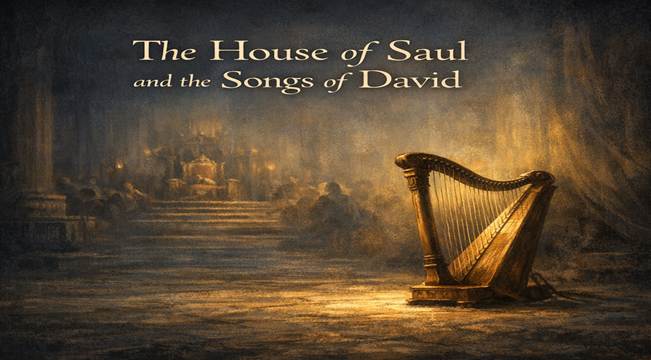
The House of Saul and the Songs of David


A prophetic editorial for a noisy age

A sobering pattern in Scripture keeps resurfacing in the modern worship debates. This is especially true when scandals erupt. During these times, voices rise to condemn entire ministries. It is the pattern of Saul’s house. It is impressive, polished, and anointed in the eyes of the people. It is also the pattern of David, the shepherd‑psalmist whose songs carried healing into a broken court.

Why This Conversation Matters Now

In recent years, well‑known ministries such as Bethel, Hillsong, and Elevation have faced intense public scrutiny. Some of that scrutiny has been justified, some exaggerated, and some weaponized. What began as accountability has, in many circles, turned into a movement. This movement seeks to discredit not only the leaders who failed. It also discredits the worship, the songs, and the sincere believers who served faithfully within those houses. This article is not written to defend institutions. It is written to defend the Davids—those who ministered with purity in places where Saul’s fell. It also aims to remind the church that while God judges leaders, He also preserves worship. This is not a theoretical argument. It is a response to a spiritual battle raging right now.

The People’s King and the Shepherd’s Song

Saul embodied everything Israel believed a leader should be. “A choice young man and a goodly: there was not among the children of Israel a goodlier person than he” (1 Samuel 9:2). Yet beneath the appearance, something was breaking. His disobedience became rebellion, for “rebellion is as the sin of witchcraft, and stubbornness is as iniquity and idolatry” (1 Samuel 15:23).

Into that compromised house, God sent a boy with a harp. Scripture says, “David took a harp and played… so Saul was refreshed, and was well, and the evil spirit departed from him” (1 Samuel 16:23). While Saul unraveled, David worshiped. While Saul threw spears—“Saul cast the spear; for he said, I will smite David even to the wall” (1 Samuel 18:11)—David refused to return them.

David ministered instead of weaponizing his gift.

The Modern Sauls and the Modern Davids

Today, the failures of large ministries often become the feeding ground of self‑appointed critics. They gather like the Pharisee in Jesus’ parable, who prayed, “God, I thank thee that I am not as other men are” (Luke 18:11). They forget that Saul was anointed too. God placed him on the throne. David served faithfully in a spiritually sick environment.

David’s songs were born in a broken house, not a perfect one. His worship rose from places like, “The Lord is my shepherd; I shall not want” (Psalm 23:1) and “Create in me a clean heart, O God” (Psalm 51:10). To attack every worship song because of the failures of a leader is to confuse Saul with David. It is to condemn the harpist because the king lost his way.

The Sin of the Sword‑Bearer

There is a dangerous arrogance in believing that God needs human outrage to accomplish His justice. David understood that judgment belongs to God alone. When Saul hunted him, David said, “I will not put forth mine hand against my lord; for he is the Lord’s anointed” (1 Samuel 24:10).

There is another moment in Scripture that exposes this same spirit. When the mob came to seize Jesus, Peter drew his sword and struck the servant of the high priest, cutting off his ear. But Jesus immediately rebuked him: “Put up thy sword into the sheath” (John 18:10–11). Peter believed he was defending the truth. He believed he was protecting the Kingdom. But in his zeal, he wounded the very one Jesus intended to reach—and Jesus healed what Peter’s sword had damaged. Many today are repeating Peter’s mistake, cutting off ears in the name of righteousness and silencing the very people God is still pursuing.

Paul echoes the same truth: “Vengeance is mine; I will repay, saith the Lord” (Romans 12:19).

Because David refused to take God’s job, God gave David the kingdom. “So all the elders of Israel came… and they anointed David king over Israel” (2 Samuel 5:3).

The Scandals Are Real—But So Is the Pattern

Yes, the sins of modern Sauls are being exposed. Yes, God is humbling what needs to be humbled. “To every thing there is a season… a time to break down, and a time to build up” (Ecclesiastes 3:1,3). But in the midst of that shaking, there are Davids—songwriters, worship leaders, musicians—who served faithfully in those houses. And God is still near to them, for “the Lord is nigh unto them that are of a broken heart” (Psalm 34:18).

To crucify them because Saul fell is to repeat the error of the Pharisee who mistook indignation for righteousness. Jesus warned, “Judge not, that ye be not judged” (Matthew 7:1).

Let God be God.

A Final Admonition

Unless we are sinless, it is not wise to cast stones or spears at another whom God may be preparing to raise up. Jesus said, “He that is without sin among you, let him first cast a stone” (John 8:7). And James reminds us, “There is one lawgiver, who is able to save and to destroy: who art thou that judgest another?” (James 4:12).

The call of this moment is not to sharpen swords but to sheath them. Not to condemn but to discern. Not to destroy but to wait. Not to exalt ourselves but to humble ourselves. “Let all bitterness… be put away from you” (Ephesians 4:31) and “in lowliness of mind let each esteem other better than themselves” (Philippians 2:3).

The God who removed Saul is the same God who raised David. “Promotion cometh neither from the east, nor from the west… but God is the judge” (Psalm 75:6‑7). And Christ Himself “committed himself to Him that judgeth righteously” (1 Peter 2:23).

The Final Word

In an age of noise, outrage, and digital stones, the church must remember the lesson Jesus taught: “Blessed are the meek: for they shall inherit the earth” (Matthew 5:5). And again, “He that humbleth himself shall be exalted” (Luke 18:14).

Let the Sauls fall if God wills it.
Let the Davids rise when God appoints it.
Let the songs continue to minister.
Let the swords remain sheathed.
Let God be God.

“Trust in the Lord with all thine heart… and He shall direct thy paths” (Proverbs 3:5‑6).
“All things work together for good to them that love God” (Romans 8:28).