The Fog That Follows Us
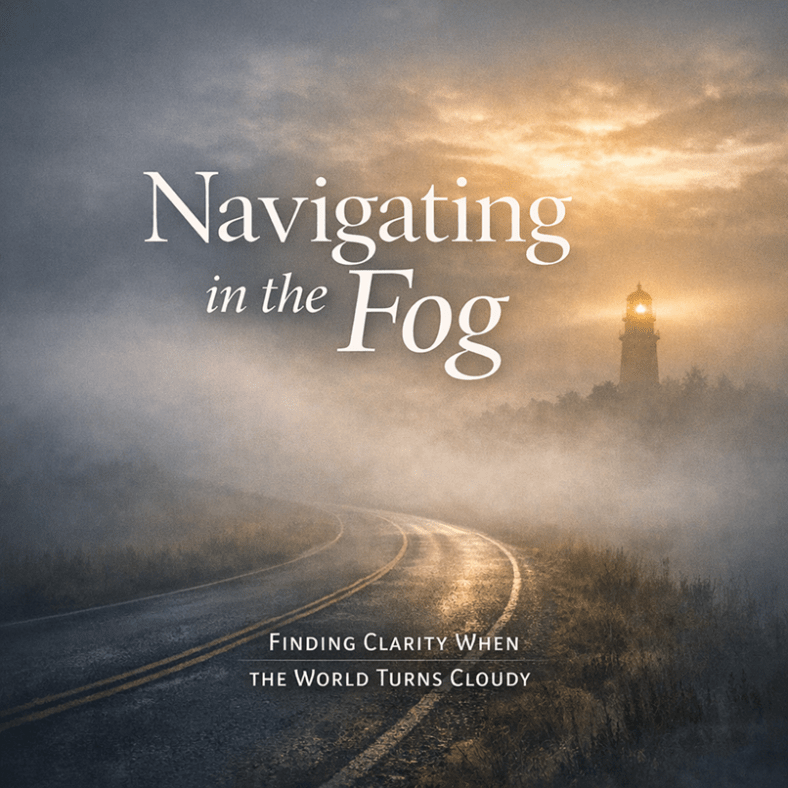
Driving home through dense fog tonight, the world shrank to a few feet of visibility. Familiar roads felt foreign. Landmarks vanished. The horizon dissolved into a gray wall. And as the mist thickened, I realized how closely this mirrors the spiritual climate believers face every day. We live in a world saturated with noise, misinformation, emotional manipulation, and a constant haze of competing voices. The fog is not accidental. It is a tactic.
Scripture warns us that confusion is a weapon of the enemy, not a condition of the Kingdom. “For God is not the author of confusion, but of peace, as in all churches of the saints.” (1 Corinthians 14:33). When the atmosphere grows cloudy, it is never the Lord who has obscured the way.
Fog Lights for the Faithful
On the road, high beams only make fog worse. They bounce off the haze and blind you. But fog lights sit low, cutting beneath the mist, illuminating the next few feet with clarity. That is exactly how the Word of God functions in a world full of spiritual haze.
The psalmist declares, “Thy word is a lamp unto my feet, and a light unto my path.” (Psalm 119:105). A lamp for the feet is not a spotlight for the horizon. It does not reveal the entire journey. It reveals the next faithful step. When the world is filled with lies, distortions, and half‑truths, the Scriptures give clarity that nothing else can match. They cut through the haze.
Jesus Himself prayed, “Sanctify them through Thy truth: Thy word is truth.” (John 17:17). Truth is not merely an idea; it is illumination. It is the light that exposes the path when everything else is obscured.
Trusting the Light, Not Our Sight
Fog distorts everything — distance, direction, depth, even the shape of what stands right in front of you. In those moments, you can’t trust your eyes. You trust the light. Spiritually, this is where faith becomes more than a concept. This is where obedience becomes more than a virtue. This is where trust becomes more than a sentiment.
Scripture speaks directly to this moment: “Trust in the Lord with all thine heart; and lean not unto thine own understanding. In all thy ways acknowledge Him, and He shall direct thy paths.” (Proverbs 3:5–6). When visibility is low, understanding becomes unreliable. But the One who sees the end from the beginning never loses sight of the road.
Paul reminds us that our walk is not dependent on what we see: “For we walk by faith, not by sight.” (2 Corinthians 5:7). Fog does not hinder God’s vision. It only reveals the limits of ours.
Jesus: The Fog Light and the Lighthouse
Fog lights guide your next step. A lighthouse guides your direction. Jesus is both.
He declares, “I am the light of the world: he that followeth Me shall not walk in darkness, but shall have the light of life.” (John 8:12). He is the immediate clarity for today and the fixed point that never moves. He stands above the haze. His voice cuts through the noise. He guides His people with unfailing constancy.
The prophet Isaiah echoes this promise: “And thine ears shall hear a word behind thee, saying, This is the way, walk ye in it.” (Isaiah 30:21). Even when the fog is thick, the Shepherd’s voice remains unmistakable.
Hearing Becomes Sharper in the Fog
When sight is compromised, hearing becomes more important. The hum of the engine becomes more pronounced. The rhythm of the tires is more noticeable. The quiet voice of the GPS stands out. Spiritually, fog has the same effect. It heightens our dependence on the Shepherd’s voice.
Jesus said, “My sheep hear My voice, and I know them, and they follow Me.” (John 10:27). Fog does not silence the Shepherd. It silences the distractions that kept us from listening.
David understood this deeply: “When my spirit was overwhelmed within me, then Thou knewest my path.” (Psalm 142:3). Overwhelm does not confuse God. It draws Him closer.
The Light That Cannot Be Overcome
The world, though wrapped in haze, the people of God walk in a light the darkness can’t extinguish. John opens his Gospel with this triumphant declaration: “And the light shineth in darkness; and the darkness comprehended it not.” (John 1:5). Darkness has never once succeeded in overcoming the Light.
Even when the fog is thick, even when the path is unclear, the believer always has guidance. Even when the voices are many and the truth seems hidden, guidance is never absent. The Word is our fog light. Jesus is our lighthouse. The Spirit is our compass. And the Father is the One who knows the road even when we can’t see it.
Walking Forward With Confidence
The world may feel hazy. The path ahead might seem uncertain. Voices around you can be loud and contradictory. Take heart. You do not need to see the whole road. You need to see the next step. You need the lamp at your feet. You need the Light of the World who stands above the fog and guides His people with unfailing clarity.
The psalmist captures this assurance beautifully: “The Lord shall guide thee continually.” (Isaiah 58:11). Not occasionally. Not when the skies are clear. Continually.
Fog does not weaken faith. Fog reveals where faith actually rests.
A Closing Benediction
Father, in a world thick with fog, voices multiply. Truth is often obscured. We look to You—the Light that no darkness can overcome. We thank You for the lamp of Your Word. It has a steady glow that cuts through confusion and reveals the next faithful step. We thank You for Jesus, the Light of the World, who guides our feet and anchors our hearts. And we thank You for the Holy Spirit, who whispers direction when our sight is dim.
Lord, teach us to trust Your light more than our limited vision. Teach us to walk by faith when understanding fails. Teach us to listen for Your voice above the noise. And teach us to rest in the promise that “The Lord shall guide thee continually.” (Isaiah 58:11).
May Your people walk with confidence, not because the road is clear, but because the Guide is faithful. May Your truth cut through every haze. May Your presence steady every trembling heart. And may Your light shine through us into a world desperate for clarity.
In the name of Jesus—the Light that shines in the darkness—we pray. Amen.
A Call to Action
If the fog has been thick around you, take one step today: Open the Word. Turn on the fog light. Let Scripture illuminate the next few feet of your path.
Begin with the promise: “Thy word is a lamp unto my feet, and a light unto my path.” (Psalm 119:105).
Read it. Pray it. Walk in it.

You must be logged in to post a comment.