WATCHMAN’S REPORT The Martyrdom of Charlie Kirk and the Rising Spirit of Antichrist


I. A Sobering Moment in Our Time

On September 10, 2025, Charlie Kirk—conservative activist, founder of Turning Point USA, and outspoken Christian—was fatally shot while speaking at Utah Valley University. His death sent shockwaves through the church, the conservative movement, and the hearts of many young believers who saw in him a bold voice for biblical truth in a culture increasingly hostile to righteousness.

Kirk was not a perfect man, nor did he claim to be. But he was a man who dared to speak truth in love, confronting cultural decay, defending biblical values, and empowering a generation of young Christians to stand firm in their convictions. His assassination, still under investigation, appears to be politically and spiritually charged—a flashpoint in the war between light and darkness.

Like Stephen in Acts 7, Charlie Kirk stood boldly before hostile crowds, proclaiming truth without compromise. And like Stephen, he paid the ultimate price. His death echoes the ancient cry: “Lord, do not hold this sin against them.” (Acts 7:60)


II. The Pattern Repeats

Jesus warned us plainly: “You will be hated by all for My name’s sake” (Matthew 10:22). The same spirit that cried “Crucify Him!” in Jerusalem now cries “Cancel him!” in our streets, campuses, and media. The same crowd that chose Barabbas over the sinless Son of God now cheers for chaos, rebellion, and moral inversion.

Charlie Kirk’s death is not just political violence—it is prophetic confirmation. The spirit of antichrist is not coming; it is here. It mocks holiness, persecutes truth-tellers, and seeks to silence the prophetic voice. It is a spirit that hates fathers, despises order, and exalts confusion. And it is increasingly emboldened.

As in the days of Elijah, when Jezebel sought to kill the prophets and silence the voice of God (1 Kings 19:2), so now the spirit of antichrist seeks to intimidate and eliminate those who speak truth. But just as God preserved a remnant then (1 Kings 19:18), He will preserve one now.


III. The Church Must Awaken

This is not a time for passive lament. It is a time for prophetic clarity and spiritual resolve. The children of God must recognize that we are not called to blend in—we are called to stand out. We are not called to appease culture—we are called to confront it.

Let us not forget: the Apostles were beaten, imprisoned, and executed for preaching Christ. Today, believers are mocked, censored, and even killed for doing the same. The persecution may look different, but the root is the same: the world hates the light because it exposes its darkness (John 3:19–20).

Like Daniel in Babylon, we must refuse to bow to cultural idols (Daniel 3:18). Like Esther, we must speak up “for such a time as this” (Esther 4:14). Like Paul, we must be ready to suffer for the sake of the gospel (2 Timothy 2:3).


IV. What Must We Do?

Here are Spirit-led responses for this hour:

  • Strengthen the Remnant: Equip believers—especially young ones—with biblical literacy, apologetics, and spiritual resilience. Let Charlie’s legacy provoke a generation to speak boldly and live faithfully.
  • Expose the Spirit of Antichrist: Teach discernment. Name the ideologies that oppose Christ—whether in media, education, or politics. Don’t just rebuke darkness; illuminate it with truth.
  • Reclaim the Public Square: Like Kirk, we must re-enter the arenas of debate, education, and culture—not with rage, but with reason, conviction, and compassion. The gospel is not fragile. It belongs in every sphere.
  • Pray and Prophesy: Intercede for our nation. Declare revival. Call the church back to the altar. The blood of the martyrs still speaks—and it calls us to action.
  • Honor the Martyrs: Let us not sanitize their sacrifice. Charlie Kirk’s death must not be reduced to a political statistic. It is a spiritual wake-up call. Let us honor him by continuing the work he began.

V. Final Exhortation

The world may hate us. The spirit of antichrist may rage. But we are not without hope. We are not without power. And we are not without assignment.

“Do not be surprised, brothers, that the world hates you.” (1 John 3:13) “But take heart; I have overcome the world.” (John 16:33)

Let the watchmen cry aloud. Let the church arise. Let the truth be spoken—no matter the cost.

As Isaiah declared, “Arise, shine, for your light has come, and the glory of the Lord rises upon you.” (Isaiah 60:1)

Let us be that light. Let us be that voice. Let us be that remnant—faithful until the end.

VI. Honor Roll of Martyrdom

The blood of the martyrs still speaks.

“Therefore, since we are surrounded by so great a cloud of witnesses, let us also lay aside every weight, and sin which clings so closely, and let us run with endurance the race that is set before us.” (Hebrews 12:1)

  • Stephen — stoned for proclaiming Christ, saw heaven open as he forgave his killers.
  • The Apostles — crucified, beheaded, exiled; each sealed their testimony with blood.
  • The Prophets — mocked, hunted, silenced for calling Israel back to covenant.
  • Joan of Arc — burned at the stake, condemned by religious and political powers alike.
  • Dietrich Bonhoeffer — executed for resisting Nazi tyranny and defending gospel truth.
  • Martin Luther King Jr. — assassinated for preaching justice, reconciliation, and nonviolence.
  • Charlie Kirk — slain for speaking truth in love, confronting cultural rebellion with conviction.

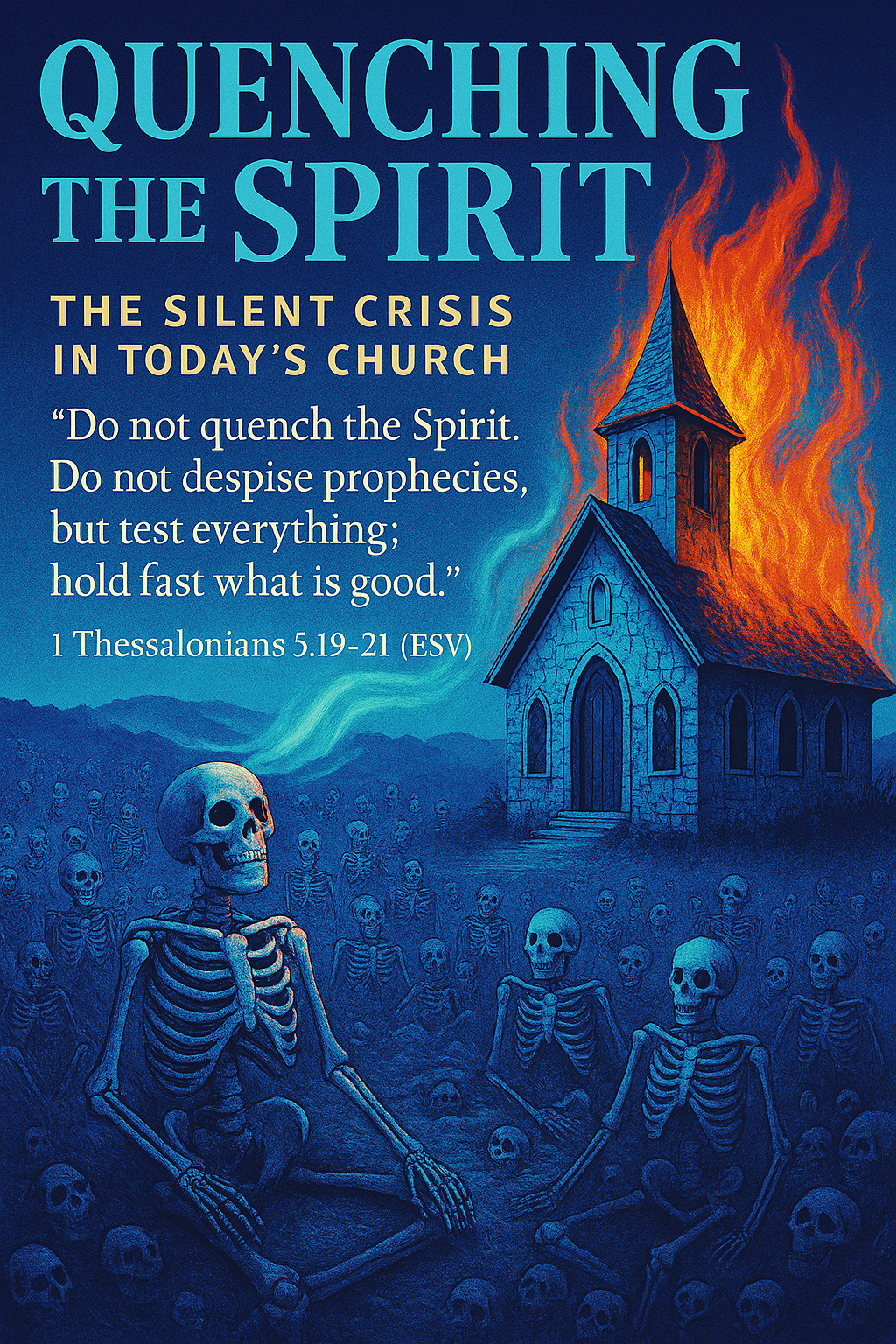
Quenching the Spirit: The Silent Crisis in Today’s Church


Random Ramblings from the Resident Raptor

“Do not quench the Spirit. Do not despise prophecies, but test everything; hold fast what is good.”
1 Thessalonians 5:19-21 (ESV)

The Apostle Paul’s warning is a cry to the modern church: Do not quench the Spirit! Yet, countless churches have unknowingly become fire suppressants, designing services that leave no room for the movement of God. The Spirit is choked, the prophetic voice silenced, the wind of revival stilled. What remains is an empty structure—a skeletal framework of religion that remembers the past but does not live it (2 Timothy 3:5).

But the crisis we face today is not new—it has been woven through biblical history. If we would just listen, if we would look, Scripture already shows us the cost of silencing the breath of God.


The Valley of Dry Bones: The Calling and the Resistance

“The hand of the Lord was on me, and he brought me out by the Spirit of the Lord and set me in the middle of a valley; it was full of bones.”
Ezekiel 37:1

Revival always begins with the hand of God upon someone—a chosen vessel, set apart for a divine task. Ezekiel was not placed in the valley by accident; God positioned him intentionally in the midst of death, decay, and desolation. He was sent not just to observe, but to speak, to call forth breath, and to declare life where death reigned.

Yet in the physical vision, the bones were completely lifeless, all flesh had been removed—they had no resistance, no voice, no ability to reject the call of God. When Ezekiel prophesied, they responded immediately; they could not fight back because they were truly dead (Ezekiel 37:7-10).

But in spiritual reality, the modern church is not fully dead—it still has some life on its bones, it still walks in the flesh enough to resist the call of God. Instead of surrendering to revival, instead of rising to the prophetic word, many churches fight against the placement of God’s chosen, resist the voices He has sent, and silence the Word instead of receiving it.

The spirit may be willing but the flesh is weak. (Matthew 26:41)

The Thessalonians were warned against this very act:
“Do not quench the Spirit. Do not despise prophecies, but test everything; hold fast what is good.”
1 Thessalonians 5:19-21

Paul foresaw what would happen if the church turned against its own awakening. A church that rejects prophecy, silences the Spirit, and fights against divine placement is suffocating itself. It is not fully dead—but it is dying.

This is precisely what Jesus rebuked in the Pharisees:
“Woe to you, teachers of the law and Pharisees, you hypocrites! You are like whitewashed tombs, which look beautiful on the outside but on the inside are full of the bones of the dead and everything unclean.”
Matthew 23:27

Their outward form appeared righteous, yet inside they were lifeless—spiritually dead, spreading corruption instead of revival. And worse, they didn’t just remain in their own deception—they multiplied death, leading others deeper into spiritual ruin:

“Woe to you, scribes and Pharisees, hypocrites! For you travel land and sea to win one convert, and when he becomes one, you make him twice as much a child of hell as yourselves.”
Matthew 23:15

These spiritless leaders were not reviving people—they were burying them. They were not calling forth breath—they were silencing it. The Pharisees were not just dead bones themselves—they were creating a modern valley of dry bones, filled with disciples of death instead of disciples of Christ.


Elijah and the Fire Suppressants: When the Altar Became Empty

“How long will you waver between two opinions? If the Lord is God, follow him; but if Baal is God, follow him.”
1 Kings 18:21

Elijah stood atop Mount Carmel, confronting not just the false prophets, but the people who had accepted the deception. Israel had grown spiritually dull, hosting empty worship services that had no impact, no presence, no awareness of God’s absence. They clapped, they sang, they danced, but they did not realize they were spiritually dead.

The prophets of Baal cried out, danced, and slashed themselves, believing that volume and movement would summon fire. But there was none (1 Kings 18:26-29). Their worship was loud but powerless, dramatic but empty, passionate but void of the Spirit.

The prophets of Baal were not chosen, not sent, not anointed. They set themselves up as spokesmen for God without His presence. And what did they produce? Emptiness. Delusion. False manifestations.

This is the modern deception—the belief that noise equals anointing, that repetition equals revival, that emotion equals encounter, that you can conjure up the Spirit by performance in the flesh.

Elijah did not shout, did not dance, did not perform. He simply arranged things decently and in order (1 Corinthians 14:40), then he stepped back and let God move. He knew he was not the one responsible for bringing about a move of God, all he had to do was make the preparatioins.

He rebuilt the altar, stacked the stones, laid the wood, and drenched the sacrifice in water—making it impossible for human effort to ignite the fire.

Elijah prayed:
“Answer me, Lord, so that these people will know that You are God.”
1 Kings 18:37

And the fire of the Lord fell.
Because it wasn’t performance—it was purity.
Not charisma—consecration.

The lesson is clear: Revival does not come through human effort, emotionalism, or performance, it comes through surrender, obedience, and divine intervention. For the Word teaches us that flesh and blood cannot inherit  the Kingdom of God. (1 Corinthians 15:50)

But one final warning must not be ignored—when God’s fire falls, it does not just bring revival, it brings judgment. Those who stand in deception, who embrace false worship, who reject the Spirit’s movement will not be refined, they will be consumed.

“For our God is a consuming fire.”
Hebrews 12:29

“Examine yourselves to see whether you are in the faith; test yourselves.”
2 Corinthians 13:5

When God shows up, will you be revived or destroyed? Will His fire purify you or consume you?


The Call: Will We Let the Bones Remain Dry?

Can these bones live?
Can the altar be rebuilt?
Can the fire fall once more?

YES. But only if we remove the fire suppressants. Only if we refuse to quench the Spirit. Only if we call for the breath of God.

“Prophesy to the breath; prophesy, son of man, and say to it, ‘This is what the Sovereign Lord says: Come, breath, from the four winds and breathe into these slain, that they may live.’”
Ezekiel 37:9

The church must no longer resist. The wind is waiting. The fire is ready. The bones must rise.

This final warning must not be overlooked—when God’s fire falls, it does not just bring revival, it brings judgment. Those who stand in deception, who embrace false worship, who reject the Spirit’s movement will not be refined—they will be consumed.

This truth is woven throughout Scripture:

  • Leviticus 10:1-2 – Nadab and Abihu, sons of Aaron, offered unauthorized fire before the Lord, and fire came out from the presence of the Lord and consumed them.
  • 1 Kings 18:38-40 – When God’s fire fell on Elijah’s altar, it proved His supremacy, and the false prophets of Baal were slaughtered.
  • 2 Chronicles 7:1 – At the dedication of Solomon’s temple, fire came down from heaven, consuming the sacrifices, and the glory of the Lord filled the temple.
  • Hebrews 12:29“For our God is a consuming fire.”

This is the final warning, examine your heart. When God shows up, will you be revived or destroyed? Will His fire purify you or consume you?

The modern church must wake up, it cannot host empty worship, it cannot embrace false teaching, it cannot reject the Spirit and expect to stand when the fire falls.

History Repeats: The Church’s Cycles of Suppression and Revival

Whenever the Spirit was quenched, revival was needed to restore God’s presence:

  • The Dark Ages (500-1500 AD) – A time marked by institutional control over faith and a lack of spiritual power.
  • The Protestant Reformation (16th century) – A return to biblical truth, but often reliant on intellectualism over Spirit-led movement.
  • The Great Awakenings (18th-19th centuries) – Revivals birthed through fervent prayer, preaching, and power encounters.
  • The Pentecostal and Charismatic Movements (20th century) – A rediscovery of spiritual gifts and the fire of God.
  • Modern Protestantism – Many churches today maintain a form of godliness but deny its power (2 Timothy 3:5).

Every time the Spirit was quenched, God raised up a remnant hungry for His presence. That remnant must rise again today.

This has been A View From the Nest: And that is the way I see it! What say you?