
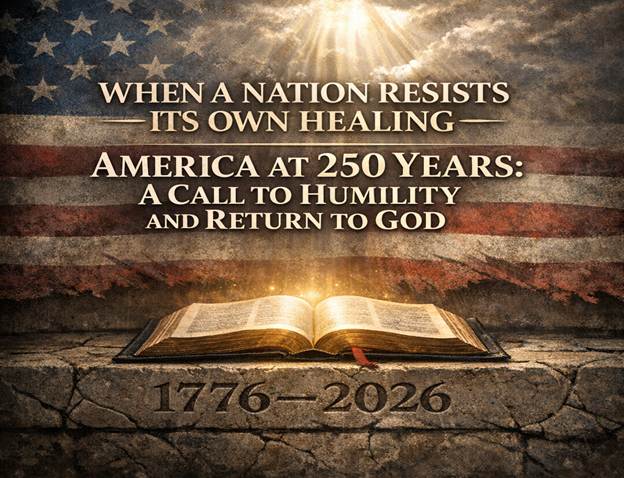
As America enters Her 250th year of existence, let’s take a moment to pause. We should think about the State of the Union before the President’s address to the Nation in a few days.
There are seasons in a nation’s life. The symptoms of decay rise so clearly to the surface. Even the untrained eye can see them. Corruption becomes normalized. Dishonesty becomes expected. Debt becomes a way of life. Institutions become self-preserving rather than people-serving. Truth becomes inconvenient, and justice becomes negotiable. These are not modern problems. They are ancient ones. Solomon captured it with piercing simplicity when he wrote, “There is nothing new under the sun.” (Ecclesiastes 1:9)
What once was will be again, because human nature has not changed. And the spiritual laws that govern nations have not changed either. If we want to understand the moment we are living in, we must return to the Scriptures. We should not seek political commentary there. Instead, we should aim to find spiritual diagnosis.
The story of Jehoshaphat flows directly from the covenant promise of 2 Chronicles 7:14. It provides a lens to see our own national condition with clarity and sobriety.
The Symptoms of a Nation in Decline
Before Jehoshaphat ever stepped into leadership, Judah was already sick. The symptoms were visible everywhere. Judges accepted bribes. Leaders protected their own interests rather than the people’s. Alliances were forged out of fear rather than faith. The culture tolerated dishonesty because it had grown accustomed to it. The system rewarded corruption because corruption had become the system.
Scripture describes this kind of national decay with painful accuracy:
“Your princes are rebels and companions of thieves. Everyone loves a bribe and runs after gifts; they do not bring justice to the fatherless, and the widow’s cause does not come to them.” (Isaiah 1:23)
A nation does not collapse because of one leader. A nation collapses because of a culture that prefers darkness to light.
Jesus said, “People loved darkness rather than light because their deeds were evil.” (John 3:19) When darkness becomes comfortable, truth becomes offensive.
The System Beneath the Symptoms
Corruption is never random. It is architectural. It is built into the bones of a nation when righteousness is neglected. By the time Jehoshaphat arrived, Judah’s institutions had become self-protecting organisms. They rewarded partiality, concealed dishonesty, and punished anyone who threatened the status quo.
This is the same pattern the prophets confronted:
“Shall I acquit the man with wicked scales and with a bag of deceitful weights?” (Micah 6:11)
“Hear this, you who trample the needy… saying, ‘When will the new moon be over, that we may sell grain… making the ephah small and the shekel great and dealing deceitfully with false balances?’” (Amos 8:4–5)
When a system becomes corrupt, it does not merely harm the weak. It eventually devours the very people who built it.
God Sends a Reformer, Not a Committee
Into this environment, God raised up Jehoshaphat—not as a politician, not as a celebrity, but as a reformer. His assignment was not to preserve the system but to purify it. He appointed honest judges, confronted corruption, restored accountability, and called the nation back to God.
Scripture records his charge to the judges:
“Consider what you do, for you judge not for man but for the LORD. He is with you in giving judgment.” (2 Chronicles 19:6)
Jehoshaphat understood something many forget: Reform is not a political act. Reform is a spiritual intervention.
The Resistance to Reform
But not everyone welcomed the light. Those who benefited from the corruption resisted the reform. Those who prospered under dishonesty opposed accountability. Those who feared losing influence fought the very changes that would have healed the nation.
This is the tragedy of every generation. People cry out for healing. However, when God sends the healer, they resist Him.
Jesus lamented this same pattern:
“O Jerusalem, Jerusalem… how often would I have gathered your children together as a hen gathers her brood under her wings, and you were not willing!” (Matthew 23:37)
A nation cannot be healed if it refuses the hand that heals it.
Miriam’s Warning: Do Not Resist the Vessel God Chooses
Miriam’s story stands as a sobering warning. She did not reject God. She rejected the vessel God chose. She questioned Moses’ authority, challenged his assignment, and believed she had equal standing in the mission. But God responded swiftly:
“Why then were you not afraid to speak against My servant Moses?” (Numbers 12:8)
Her leprosy was not punishment. It was revelation—a visible picture of an invisible rebellion.
When you resist the person God selects to bring deliverance, you are not fighting a man. You are fighting God. And when you fight God, you bring judgment upon your own head.
The Consequence of National Resistance
Jehoshaphat’s reforms were a mercy—a chance for Judah to return to righteousness before judgment fell. But Scripture is clear: when a nation refuses to repent, refuses to humble itself, refuses to turn, judgment becomes inevitable.
Not because God desires destruction, but because corruption collapses under its own weight.
“Pride goes before destruction, and a haughty spirit before a fall.” (Proverbs 16:18)
“Righteousness exalts a nation, but sin is a reproach to any people.” (Proverbs 14:34)
A nation that resists reform is a nation choosing its own ruin.
The Cure That Flows From the Throne
The remedy for national decay has never been political. It has always been spiritual. God told Solomon exactly how a nation is healed:
“If My people, who are called by My name, will humble themselves and pray and seek My face and turn from their wicked ways, then I will hear from heaven, and will forgive their sin and will heal their land.” (2 Chronicles 7:14)
Healing begins with humility. Restoration begins with repentance. Deliverance begins with alignment.
And God’s healing always flows through human instruments. He raises a Moses, a Samuel, a Jehoshaphat, a Nehemiah—and when the people resist the vessel, they resist the healing.
A Prayer for a Nation in Need of Mercy
Father, we humble ourselves before You. We confess our national pride, our corruption, our injustice, and our dishonesty. We acknowledge that we have often resisted the very instruments You sent to heal us. We have misread our moment and preferred comfort over correction.
But today we turn. We seek Your face. We bow our hearts. We repent of our wicked ways. Hear from heaven, O Lord. Forgive our sin. Heal our land.
Raise up reformers in our generation. Give us discernment to recognize Your movement. Give us courage to align with Your purposes. And give us humility to follow the vessels You have chosen.
Heal our land, O God—not by might, nor by power, but by Your Spirit. In Jesus’ name, Amen.

You must be logged in to post a comment.