
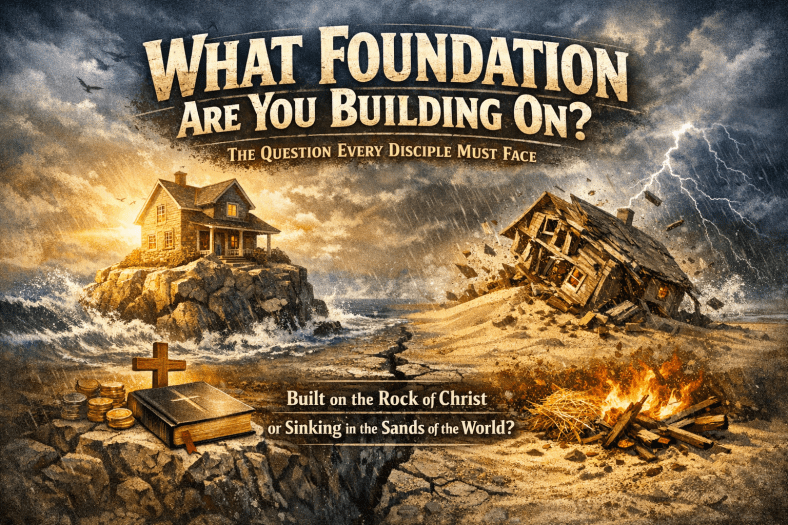
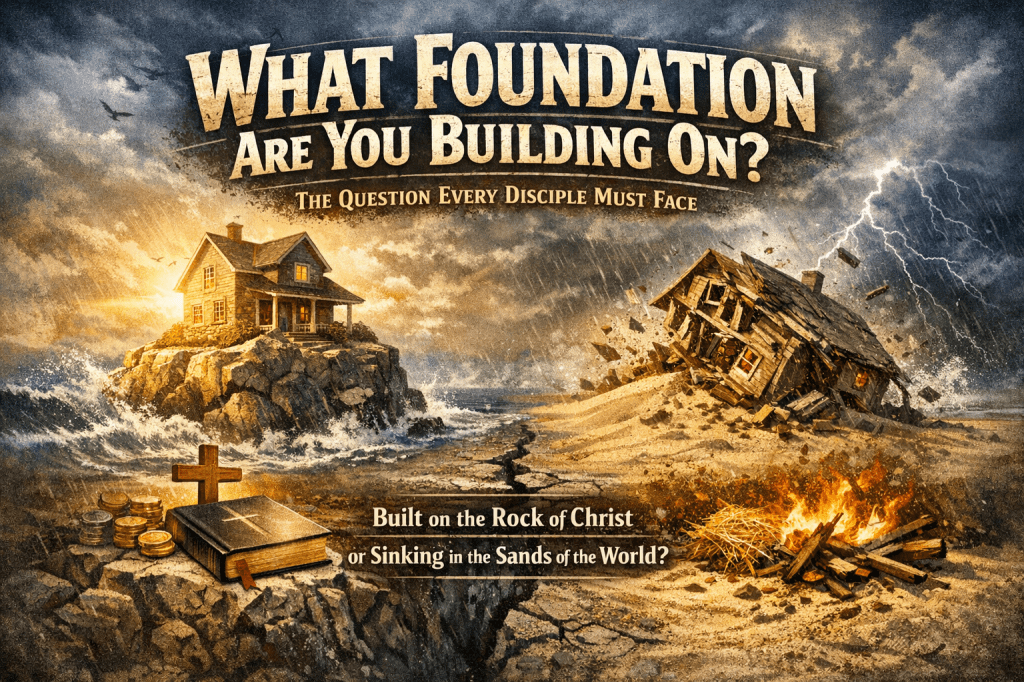
The Question Every Disciple Must Face
Every life is built on a foundation, whether we acknowledge it or not. Jesus made this clear when He said,
“Whoever hears these sayings of Mine and does them, I will liken him unto a wise man who built his house upon a rock”
(Matthew 7:24–25)
The storm did not reveal their intentions; it revealed their foundations. Both men heard the words of Christ, but only one obeyed them. The difference was not sincerity, emotion, or religious activity. The difference was obedience to the words of the Lord.
Paul echoes this truth when he writes,
“For no other foundation can anyone lay than that which is laid, which is Jesus Christ”
(1 Corinthians 3:11)
He warns believers to “take heed how you build” (1 Corinthians 3:10). This is because the Day will test every man’s work with fire. Wood, hay, and stubble burn quickly, but gold, silver, and precious stones endure. The question is not whether you are building, but what you are building with—and what you are building on.
Sincerity Is Not a Foundation
Many Christians today are sincere, but sincerity is not a foundation. Sincerity can be sincerely misplaced. Israel was sincere when Paul said they had “a zeal for God, but not according to knowledge” (Romans 10:2). They were passionate, but they were passionately wrong because they substituted their own righteousness for the righteousness of God.
Jesus confronted the Pharisees for the same reason:
“You make void the commandment of God by your tradition” (Mark 7:13)
They did not reject God outright; they simply elevated human teaching until it overshadowed divine instruction. This same pattern repeats in the modern church. People cling to rituals, holidays, denominational doctrines, and inherited practices, believing that by keeping these traditions they are honoring God. Yet when asked what the Lord requires of them, many have no answer, because they were never taught to ask.
When Tradition Replaces Truth
Many believers were taught to follow the church calendar, but not the voice of the Shepherd. They were taught to keep the traditions of men, but not the commandments of God. They were taught to carry out religious acts, but not to repent, believe, and be led by the Spirit.
Replacement holidays like Christmas and Easter are only the most visible examples. They are sentimental, familiar, and deeply ingrained, but they are not the foundation God laid. They are cultural observances elevated to the status of holy days. Meanwhile, the appointed times of the Lord are dismissed as “Jewish” or irrelevant. These times were written by His own hand, fulfilled by His Son, and witnessed by His Spirit.
Yet the New Testament speaks of Passover, Pentecost, Unleavened Bread, Firstfruits, and Tabernacles with reverence, not dismissal. These feasts carry God’s fingerprints. They are covered with the blood of Jesus. They need no wreaths, ornaments, or external trappings to feel holy. Their holiness is inherent because their Author is holy.
But the problem goes deeper than holidays. Churches have elevated ritual washings, denominational formulas, and man‑made requirements. They value these above the weightier matters of repentance, faith, and the leading of the Spirit. People are taught to trust in the act rather than the transformation. They believe in the ritual rather than the repentance. Their faith lies more in the formula rather than the faith.
Scripture says plainly:
“As many as are led by the Spirit of God, they are the sons of God” (Romans 8:14)
And again:
“If anyone does not have the Spirit of Christ, he is none of His” (Romans 8:9)
Yet many have been taught to trust in outward forms while neglecting the inward witness of the Spirit.
The Foundation God Requires
A true foundation begins with repentance, continues faithfully, and is sealed by the Spirit. It is shaped by obedience to the words of Jesus, not by the expectations of culture. It is strengthened by the fear of the Lord, not by the comfort of familiarity. It is aligned with the Father’s will, not with the calendar of man.
Micah asks the question plainly:
“What does the LORD require of you but to do justly, to love mercy, and to walk humbly with your God?” (Micah 6:8)
Jesus answers it even more directly:
“My sheep hear My voice, and I know them, and they follow Me” (John 10:27)
The foundation God requires is not built on tradition, ritual, or sentiment. It is built on Christ, His Word, and His Spirit. Anything else is sand.
The Coming Test
The storm is coming, the fire is coming, and the Day is coming when every man’s work will be revealed. Jesus warned that many will say to Him, “Lord, Lord…” and list their religious activities, but He will answer,
“I never knew you” (Matthew 7:22–23)
Not because they were evil, but because they built on activity instead of obedience.
Only what is built on the Rock will stand. Only what is built on Christ, His Word, and His Spirit will endure. Everything else—no matter how sincere, sentimental, or traditional—will collapse when the winds rise.
How to Test Your Foundation
Scripture never leaves us without a remedy. The Lord not only commands us to build on the right foundation—He tells us how to examine it.
Paul urges believers to “examine yourselves, whether you be in the faith; prove your own selves” (2 Corinthians 13:5). This examination is not optional, because the testing of our foundation is not optional. The storm will come. The fire will come. The Day will come. Wisdom examines the foundation before the shaking arrives.
The first test is obedience to the words of Jesus.
“Why do you call Me, ‘Lord, Lord,’ and do not do the things which I say?” (Luke 6:46)
Our foundation is unstable if tradition, culture, or denominational teaching shape our lives more than the commands of Christ. This is because it is cracked.
The second test is repentance.
John the Baptist prepared the way of the Lord by crying, “Bring forth fruits worthy of repentance” (Luke 3:8). Repentance is not a ritual; it is a turning of the heart. If repentance is absent, the foundation is weak.
The third test is the witness of the Spirit.
“The Spirit Himself bears witness with our spirit that we are the children of God”
(Romans 8:16)
If the Spirit is not leading, convicting, guiding, and confirming, then the foundation is not Christ but self.
The fourth test is alignment with the Word.
“Sanctify them by Your truth; Your word is truth”
(John 17:17)
If our beliefs can’t be traced to Scripture in context, they can’t support the weight of discipleship.
Wisdom or Folly
Jesus ends His teaching on foundations with a warning and an invitation. The wise man hears and obeys. The foolish man hears and ignores. The difference is not in what they heard, but in what they did with what they heard.
Ignoring the condition of your foundation is folly. Checking it is wisdom. The storm will expose every hidden weakness, every unexamined assumption, every tradition elevated above truth. But the one who builds on Christ, His Word, and His Spirit will stand when everything else falls.
The question remains for every disciple:
What foundation are you building on—and will it stand when the testing comes?

You must be logged in to post a comment.