The church has been lulled into cycles of repetition, borrowing pagan customs and sentimental traditions that obscure the gospel. But the Word of God cuts sharper than any ritual. Here are four truths that stand immovable, each one a pillar of the greatest story ever told.
Christ was born once.
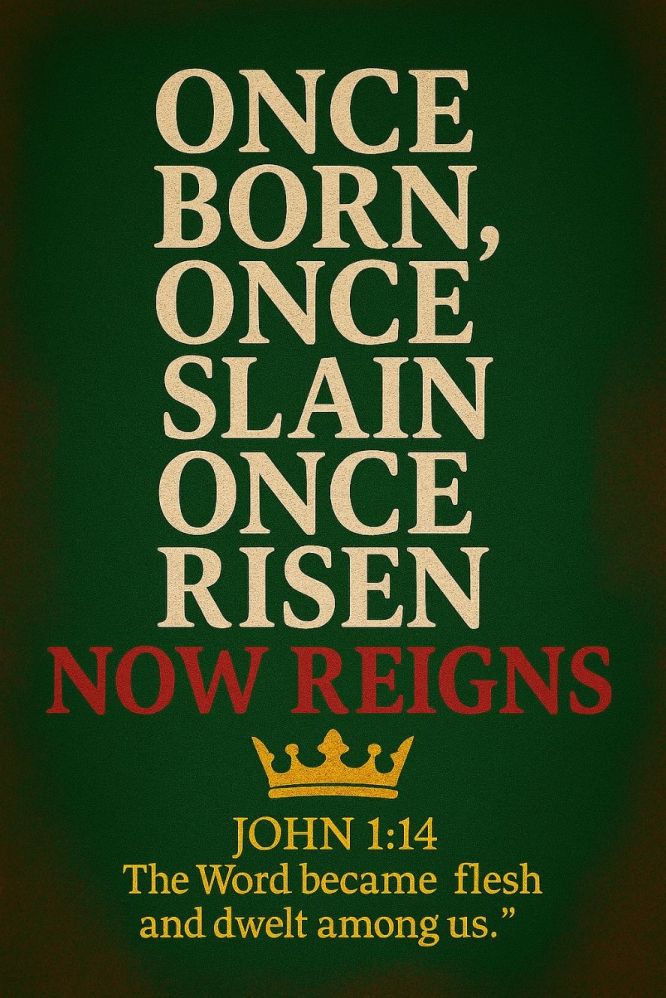
The incarnation was not a seasonal myth or a cycle to be replayed every December. “The Word became flesh and dwelt among us” (John 1:14). That moment in Bethlehem was the opening act of redemption, the eternal God stepping into human frailty. He came once, and that was enough. To rehearse His birth as if it were an annual event is to reduce the incarnation to pagan repetition.
Christ died once.
The cross was not symbolic theater—it was the decisive sacrifice. “Christ died for sins once for all, the righteous for the unrighteous, to bring you to God” (1 Peter 3:18). Pagan gods die endlessly in cycles, but Christ’s death was final. It satisfied the wrath of God, fulfilled prophecy, and broke the curse. There is no need for repetition; the penalty has been paid in full.
Christ rose once.
The resurrection is the hinge of history. “He was raised on the third day according to the Scriptures” (1 Corinthians 15:4). Unlike Baal or Sol Invictus, Christ does not rise each year with the sun. He rose once, never to die again. His empty tomb is the triumph that validates our faith and secures eternal life. This is not seasonal hope—it is eternal reality.
Christ forever reign.
The story does not end at the tomb. “He must reign until He has put all His enemies under His feet” (1 Corinthians 15:25). His ascension enthroned Him, and His reign is ongoing. He is not a Babe to be revisited each December—He is the King who rules now and will return in glory. The finale is not nostalgia but the appearing of Christ in power.
Admonition
Stop rehearsing pagan cycles. Stop lighting candles for what has already been fulfilled. Preach the gospel: once born, once slain, once risen, now reigns—soon to return.
“Do not move the ancient boundary which your fathers have set.” — Proverbs 22:28
This isn’t just about property lines—it’s a divine warning against tampering with God-ordained order. In today’s climate, we’re witnessing a literal and metaphorical redrawing of boundaries: voting districts, theological definitions, even moral absolutes. The question is—who benefits when lines are blurred?
🗳️ The Political Parallel: Gerrymandering and Power Games
📜 A Brief History of Gerrymandering
Coined in 1812 when Massachusetts Gov. Elbridge Gerry approved a district shaped like a salamander—thus, “Gerry-mander.”
It’s the art of redrawing electoral maps to favor one party, often resulting in bizarre, contorted districts.
Both parties have used it: Republicans in Texas, Democrats in Illinois and New York. The goal? Lock in power, dilute opposition.
🧠 Modern Tactics
Advanced algorithms now allow surgical precision—splitting communities, packing or cracking voter blocs.
Texas’s current effort, backed by Trump, aims to gain five more GOP seats by slicing up Democratic strongholds like Austin.
Democrats have responded with walkouts and threats to redraw their own maps in blue states.
🧩 Racial Gerrymandering: Illegal in Principle, Practiced in Reality
While racial gerrymandering is explicitly prohibited under the Voting Rights Act, both parties have exploited racial demographics. They use these demographics to secure political advantage. The tactic? Carve up districts based on racial voting patterns, especially in predominantly Black communities known to lean Democratic.
🧠 Strategic Targeting
In states like Illinois and New York, Democrat-led legislatures have drawn maps that concentrate Black voters into specific districts to guarantee safe seats.
This “packing” strategy ensures electoral dominance while diluting minority influence in surrounding areas.
⚖️ Legal Challenge: New York’s Congressional Map Overturned
In 2022, a New York appellate court ruled that Democrats had unconstitutionally gerrymandered their congressional map to discourage competition and favor their party.
The court cited expert analysis showing the map gave Democrats a strong majority in 22 of 26 districts, despite only representing 22% of registered voters statewide.
“There is no sheriff in town saying this is not helping everyone.” — Kareem Crayton, Brennan Center for Justice
🧮 Census Manipulation and Foreign Influence
🧨 Counting Noncitizens: A Distortion of Representation
The U.S. Census counts all residents, including noncitizens and undocumented immigrants.
This inflates population numbers in states with large foreign-born populations, disproportionately benefiting Democrat-leaning states in congressional apportionment.
Some estimates suggest Democrats gained up to 24 seats due to this inclusion, though the exact number is debated.
🧭 Biblical Reflection
In ancient Israel, lots were cast to divide tribal territories (Joshua 18:10)—a form of voting under divine oversight.
But God’s system was not equal in size, nor did it include foreigners in the inheritance. It was based on covenant, lineage, and divine purpose.
Today’s census-driven redistricting includes noncitizens, giving them outsized influence in shaping laws they may not be subject to.
📜 Scriptural Context: God’s Boundaries and Tribal Territories
🧱 Why Was the Warning Given?
Proverbs 22:28 warns against moving ancient boundary stones—symbols of inheritance, justice, and divine order.
🧭 Who Was It Given To?
The Israelites, as a safeguard against exploitation and chaos. It echoes commands in Deuteronomy and reflects God’s concern for fairness and legacy.
🧬 God: The Original Boundary-Setter
In Joshua, God divided the land among the twelve tribes by casting lots.
Each tribe received territory based on family lineage and divine promise.
These boundaries were sacred—not political tools, but covenantal markers.
“To your descendants I have given this land…” — Genesis 15:18
🧱 Traditions, Customs, and Cohesion
Ancient boundaries also represent traditions, customs, and familiar cohesion. When these are forcibly adjusted—whether through political manipulation or cultural redefinition—chaos, not peace, is the result.
Biblical customs preserved societal harmony and spiritual identity.
Modern disruptions—from redefining family to erasing national borders—undermine the very fabric of community.
The Church must rise with discernment, clarity, and courage—refusing to let the enemy redraw what God has already decreed. The boundaries are ancient, sacred, and non-negotiable.
“If the foundations are destroyed, what can the righteous do?” — Psalm 11:3


You must be logged in to post a comment.