
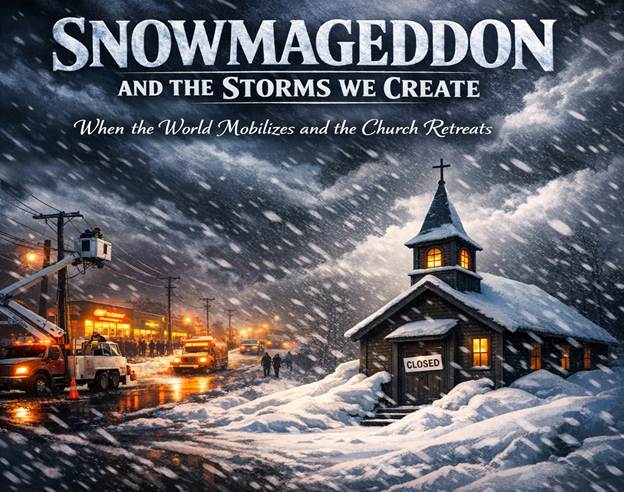
The forecasts grow louder. The graphics turn dramatic. The region braces for what the news has christened Snowmageddon. This is a storm wrapped in apocalyptic language. It comes complete with countdown clocks, urgent tickers, and warnings that feel more cinematic than meteorological. The world prepares with a kind of frantic determination. Meanwhile, something else unfolds quietly in the background. It is almost unnoticed unless you are paying attention.
Electric linemen are already staged in their trucks, engines idling, ready to restore power the moment the first line snaps. Road crews sit in warm garages beside mountains of salt, waiting for the call to roll out into the night. Grocery stores are stripped bare as shoppers fill carts with enough food to survive a siege. Everyone is mobilizing. Everyone is preparing. Everyone is stepping into their role with a sense of duty and resolve.
And then, amid all this activity, comes the announcement from the one place that claims to carry the unshakable Kingdom:
“All services are canceled due to inclement weather.”
The contrast is hard to ignore. The world gears up. The church shuts down.
This is not about recklessness or ignoring safety. It is about the symbolism—the quiet confession embedded in the decision. When the world anticipates hardship, it mobilizes. When the church anticipates hardship, it retreats. And that retreat reveals something deeper than a scheduling adjustment. It reveals a posture.
Scripture never once suggests that worship is a Sunday-only activity, nor does it tie devotion to favorable weather. The command is simple and ancient: “Six days you shall labor and do all your work, but the seventh is a Sabbath to the LORD your God.” (Exodus 20:9–10) The rhythm is work and rest, not convenience and cancellation. If the work of the Kingdom is the saving of souls, it also includes the strengthening of the saints. It involves the breaking of bread and the prayers of the people. Then that work is not suspended by snowflakes.
The early church understood this instinctively. They gathered in homes, courtyards, borrowed rooms, and hidden places. They met in caves and catacombs. They prayed in prison cells. They broke bread wherever they could find a table. They did not have buildings to close, so they could not close the church. Their worship was not weather-permitting. Their devotion was not seasonal. Their gatherings were not fragile.
Jesus Himself warned us about the danger of a faith that collapses under pressure. “Everyone who hears these words of Mine and does them is like a wise man who built his house on the rock.” (Matthew 7:24) The storm came, the winds blew, the floods rose—and the house stood because its foundation was not circumstantial. But the house built on sand fell, “and great was its fall.” (Matthew 7:27)
A storm does not create weakness. A storm reveals it.
And perhaps that is what Snowmageddon exposes—not the fragility of our infrastructure, but the fragility of our ecclesiology. A church that closes at the first sign of difficulty has confused the building with the body. A church that cancels worship because the weather is inconvenient has forgotten. It has forgotten that worship is not an event but a life. A church that retreats while the world mobilizes is a church that has lost sight of its calling.
Jesus said, “The harvest is plentiful, but the laborers are few.” (Matthew 9:37) He did not add, “unless it snows.” He did not say, “unless the roads are slick.” He did not suggest that the work of the Kingdom pauses when the forecast is unfavorable. Souls do not stop needing salvation because the temperature drops. Hearts do not stop needing hope because the wind picks up. Darkness does not delay its work because the roads are icy.
If anything, storms heighten the need for light.
The world prepares for the storm because it knows what storms can do. The church should prepare for the storm because it knows what storms reveal.
And maybe that is the quiet message hidden inside this winter’s theatrics. If a snowstorm can cancel our worship, perhaps what we call worship was never the thing God asked for. If a weather system can scatter the saints, perhaps the gathering was never rooted in the Spirit. If the church retreats while the world mobilizes, maybe we have forgotten that the Kingdom work is still work. The One who called us did not limit His commission to clear skies.
“Be steadfast, immovable, always abounding in the work of the Lord.” (1 Corinthians 15:58)
Storm or no storm, the Kingdom does not close. Storm or no storm, the mission does not pause. Storm or no storm, the church is still the church.
And maybe Snowmageddon is not the storm we should fear. Maybe the greater storm is the quiet one. It shows how easily we retreat when the world needs us most.


You must be logged in to post a comment.