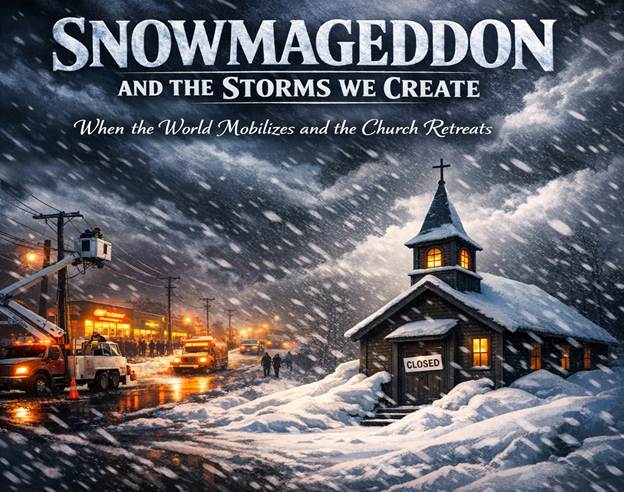
The forecasts grow louder. The graphics turn dramatic. The region braces for what the news has christened Snowmageddon. This is a storm wrapped in apocalyptic language. It comes complete with countdown clocks, urgent tickers, and warnings that feel more cinematic than meteorological. The world prepares with a kind of frantic determination. Meanwhile, something else unfolds quietly in the background. It is almost unnoticed unless you are paying attention.
Electric linemen are already staged in their trucks, engines idling, ready to restore power the moment the first line snaps. Road crews sit in warm garages beside mountains of salt, waiting for the call to roll out into the night. Grocery stores are stripped bare as shoppers fill carts with enough food to survive a siege. Everyone is mobilizing. Everyone is preparing. Everyone is stepping into their role with a sense of duty and resolve.
And then, amid all this activity, comes the announcement from the one place that claims to carry the unshakable Kingdom:
“All services are canceled due to inclement weather.”
The contrast is hard to ignore. The world gears up. The church shuts down.
This is not about recklessness or ignoring safety. It is about the symbolism—the quiet confession embedded in the decision. When the world anticipates hardship, it mobilizes. When the church anticipates hardship, it retreats. And that retreat reveals something deeper than a scheduling adjustment. It reveals a posture.
Scripture never once suggests that worship is a Sunday-only activity, nor does it tie devotion to favorable weather. The command is simple and ancient: “Six days you shall labor and do all your work, but the seventh is a Sabbath to the LORD your God.”(Exodus 20:9–10) The rhythm is work and rest, not convenience and cancellation. If the work of the Kingdom is the saving of souls, it also includes the strengthening of the saints. It involves the breaking of bread and the prayers of the people. Then that work is not suspended by snowflakes.
The early church understood this instinctively. They gathered in homes, courtyards, borrowed rooms, and hidden places. They met in caves and catacombs. They prayed in prison cells. They broke bread wherever they could find a table. They did not have buildings to close, so they could not close the church. Their worship was not weather-permitting. Their devotion was not seasonal. Their gatherings were not fragile.
Jesus Himself warned us about the danger of a faith that collapses under pressure. “Everyone who hears these words of Mine and does them is like a wise man who built his house on the rock.”(Matthew 7:24) The storm came, the winds blew, the floods rose—and the house stood because its foundation was not circumstantial. But the house built on sand fell, “and great was its fall.”(Matthew 7:27)
A storm does not create weakness. A storm reveals it.
And perhaps that is what Snowmageddon exposes—not the fragility of our infrastructure, but the fragility of our ecclesiology. A church that closes at the first sign of difficulty has confused the building with the body. A church that cancels worship because the weather is inconvenient has forgotten. It has forgotten that worship is not an event but a life. A church that retreats while the world mobilizes is a church that has lost sight of its calling.
Jesus said, “The harvest is plentiful, but the laborers are few.”(Matthew 9:37) He did not add, “unless it snows.” He did not say, “unless the roads are slick.” He did not suggest that the work of the Kingdom pauses when the forecast is unfavorable. Souls do not stop needing salvation because the temperature drops. Hearts do not stop needing hope because the wind picks up. Darkness does not delay its work because the roads are icy.
If anything, storms heighten the need for light.
The world prepares for the storm because it knows what storms can do. The church should prepare for the storm because it knows what storms reveal.
And maybe that is the quiet message hidden inside this winter’s theatrics. If a snowstorm can cancel our worship, perhaps what we call worship was never the thing God asked for. If a weather system can scatter the saints, perhaps the gathering was never rooted in the Spirit. If the church retreats while the world mobilizes, maybe we have forgotten that the Kingdom work is still work. The One who called us did not limit His commission to clear skies.
“Be steadfast, immovable, always abounding in the work of the Lord.”(1 Corinthians 15:58)
Storm or no storm, the Kingdom does not close. Storm or no storm, the mission does not pause. Storm or no storm, the church is still the church.
And maybe Snowmageddon is not the storm we should fear. Maybe the greater storm is the quiet one. It shows how easily we retreat when the world needs us most.
“When the Church Becomes a Non-Prophet Organization”
🔥 The Silent Reformation: When the Gifts Go Missing
The Church today faces one of its most sobering realities. There is a quiet elimination of the very leadership gifts the Holy Spirit gave to equip and mature the Body. In many congregations, only the role of Pastor/Teacher remains visible. Even that role is often reduced to a weekly sermon and administrative oversight. The Evangelist was once a fiery voice calling the lost to repentance. Now, they are more often rebranded as a “missionary.” They are tucked away in foreign fields rather than stirring hearts at home.
But what of the Apostle? The Prophet? These foundational gifts (Ephesians 4:11–13) are not just absent—they are often unwelcome. Mainline churches have institutionalized themselves into a form of godliness in many cases. They deny the power and structure that God originally ordained.
This isn’t just a leadership issue—it’s a spiritual crisis. When the Church becomes a “non-prophet organization,” it loses its ability to:
Hear and declare the word of the Lord (Prophet)
Pioneer new territory and establish Kingdom order (Apostle)
Stir the hearts of the lost (Evangelist)
Shepherd and teach with clarity and compassion (Pastor/Teacher)
The result? A body that is undernourished, under-equipped, and often unaware of its true calling.
👤 Apostles as Fathers of the Faith
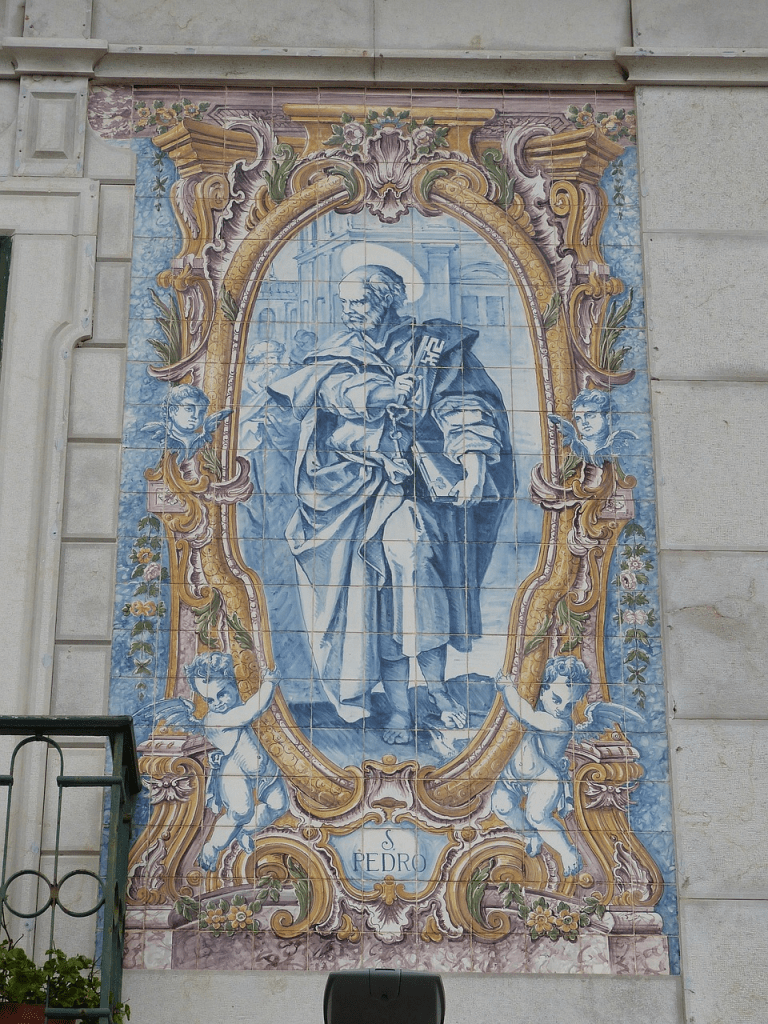
Apostle Peter
The early Church Fathers were direct disciples of the apostles. They were seen not just as theologians but as spiritual patriarchs. They preserved doctrine, corrected error, and nurtured the Church into maturity. Clement of Rome, for example, emphasized apostolic succession as a way to preserve the integrity of the faith. This idea of spiritual fatherhood was foundational to early Christian identity and governance.
Your framing of apostles as “fathers of the faith” aligns with this tradition. Apostles weren’t just pioneers. They were builders, correctors, and nurturers. They resembled a father raising children into maturity. Consider 1 Corinthians 4:15: “Though you have countless guides in Christ, you do not have many fathers…”
Fatherhood as a Lost Art in America
Modern sociologists and psychologists have echoed your concern about the decline of fatherhood in American culture:
Ray Williams describes America as becoming a “fatherless society,” with massive social consequences including poverty, crime, and emotional instability.
Psychology Today notes that the archetype of the father—as protector, moral guide, and stabilizer—has been eroded or distorted in modern narratives.
Don Unger, in Men Can, explores how the image and role of fathers have shifted, often being undervalued or misunderstood in both family and cultural life.
🔗 The Church and the Culture Mirror Each Other
The erosion of fatherhood in society is not just a sociological issue—it’s a spiritual one. The Church, by sidelining the apostolic and prophetic offices, has modeled a form of leadership that lacks fatherhood, correction, and generational vision. This absence has echoed into the culture, where natural fatherhood is now seen as optional, replaceable, or even irrelevant.
When the Church no longer raises up spiritual fathers, the result is a generation of believers who:
Struggle with spiritual identity
Resist correction and accountability
Lack maturity and direction
Chase trends instead of truth
This mirrors the broader cultural fallout of fatherlessness—emotional instability, rebellion, and a hunger for affirmation in all the wrong places.
The Crisis of Fatherhood: In the Church and the Culture
Explaining the need for these missing offices established by God shows a real lack of understanding on the part of the Reformation Church movement, which basically eliminated the Holy Spirit and gifts entirely. The Reformation Church movement, in its zeal to correct abuses, often swung the pendulum too far, sidelining the very gifts and offices that were meant to empower and mature the Body.
Restoring these offices isn’t just about leadership—it’s about reclaiming the Church’s identity and mission. Without apostles, prophets, evangelists, and Spirit-empowered pastors and teachers, the Church risks becoming a hollow institution rather than a living, breathing organism.
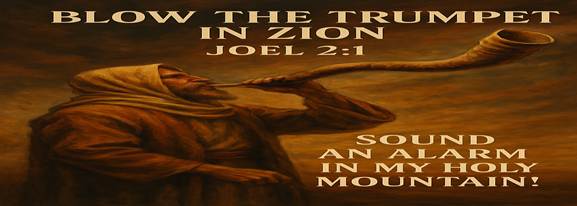
The trumpet sounds for a return to the fullness of God’s design—a Church that hears His voice, pioneers new territory, stirs the lost, and shepherds with compassion and clarity.
📖 Scriptural Support for Fatherhood
The Bible provides a wealth of guidance on the importance of fatherhood, both spiritual and natural:
Malachi 4:6: “He will turn the hearts of the fathers to their children, and the hearts of the children to their fathers; or else I will come and strike the land with total destruction.” This verse underscores the critical role of fathers in restoring relationships and preventing societal decay.
Ephesians 6:4: “Fathers, do not provoke your children to anger, but bring them up in the discipline and instruction of the Lord.” This highlights the father’s role in nurturing and guiding their children spiritually.
Proverbs 22:6: “Train up a child in the way he should go; even when he is old he will not depart from it.” This emphasizes the long-term impact of a father’s guidance.
1 Corinthians 4:15: “Though you have countless guides in Christ, you do not have many fathers. For I became your father in Christ Jesus through the gospel.” This verse reflects the spiritual fatherhood role that apostles and church leaders are called to fulfill.
By integrating these scriptures, the Church can reclaim its role as a spiritual family, with fathers—both natural and spiritual—leading the way in nurturing, correcting, and guiding the next generation.
🔮 The Misunderstood Prophet: Truth in a Time of Tension
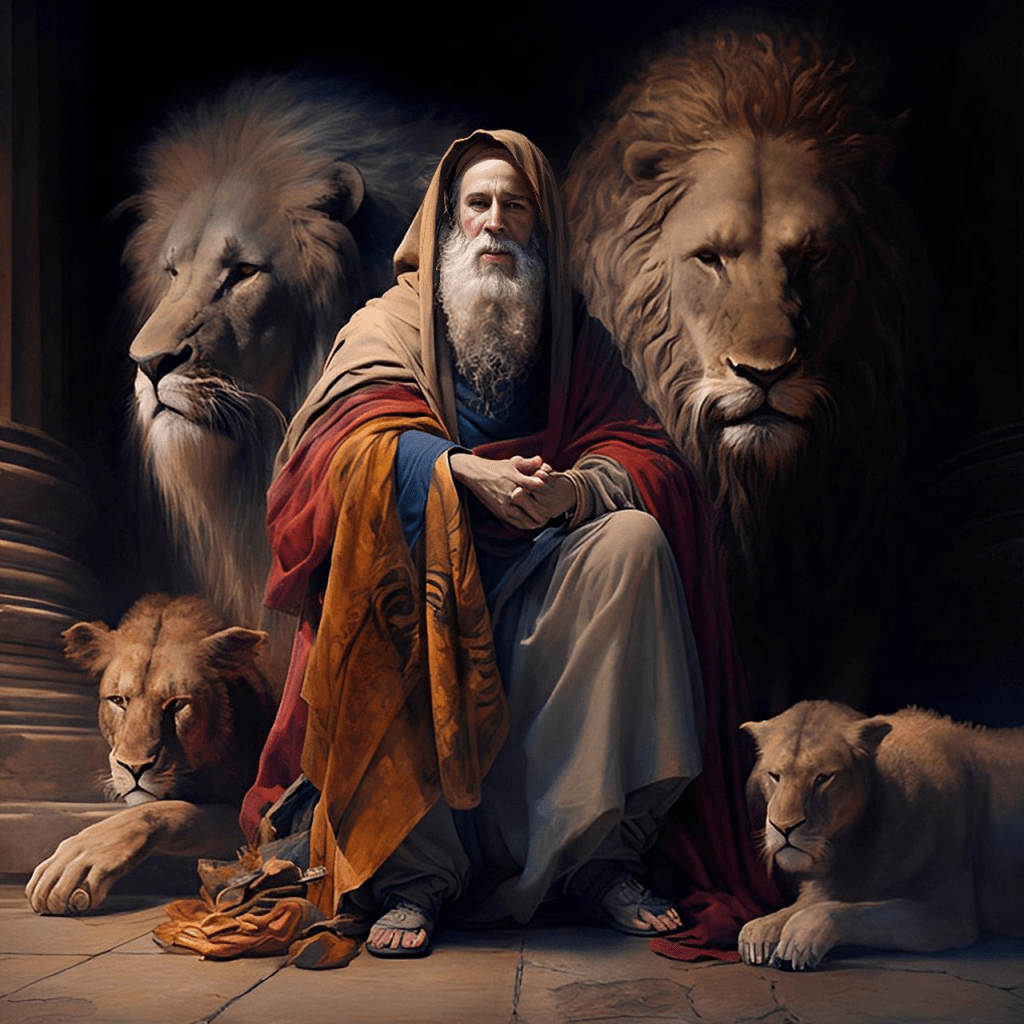
Prophet Daniel in the lion’s den
The prophetic office has always been controversial—because prophets don’t just comfort, they confront. They don’t just predict, they pierce. In a culture (and Church) that often prefers affirmation over accountability, the prophet’s voice is frequently silenced, sanitized, or sidelined.
🧱 What the Prophet Is Not:
Not a fortune-teller or spiritual entertainer
Not a self-appointed critic with a microphone
Not merely someone who “feels things deeply”
🔥 What the Prophet Is:
A mouthpiece for God’s heart and mind (Jeremiah 1:9)
A watchman who warns of danger (Ezekiel 33:7)
A plumb line for truth and holiness (Amos 7:7–8)
A builder who equips and strengthens the Church (1 Corinthians 14:3)
🚫 Why the Church Resists Prophets:
Prophets disrupt comfort zones
They expose hidden sin and institutional compromise
They challenge the status quo and call for repentance
They often speak what others are afraid to say
📖 Scriptural Anchors:
Jeremiah 1:10 – “See, I have set you this day over nations and over kingdoms, to pluck up and to break down, to destroy and to overthrow, to build and to plant.”
1 Thessalonians 5:20–21 – “Do not despise prophecies, but test everything; hold fast what is good.”
Amos 3:7 – “Surely the Sovereign Lord does nothing without revealing his plan to his servants the prophets.”
Ephesians 2:20 – “Built on the foundation of the apostles and prophets, Christ Jesus himself being the cornerstone.”
Turning the Church Back into a “For Prophet” Organization
To restore the prophetic office is to restore the Church’s relevance and reverence. A Church that embraces the prophetic voice becomes:
A beacon of truth in a time of deception
A source of hope in a world of despair
A catalyst for repentance and revival
A community that hears and responds to the voice of God
The trumpet sounds for a return to the fullness of God’s design—a Church that hears His voice, pioneers new territory, stirs the lost, and shepherds with compassion and clarity. Let us not despise the prophetic gift but embrace it, test it, and hold fast to what is good.
🌱 The Evangelist: Sowers in the Vineyard
The role of the Evangelist is indispensable in the life of the Church. Without those who sow seeds of the Gospel, there can be no harvest. Evangelists are the planters in the vineyard, tirelessly working to bring the message of salvation to the lost.
📖 Scriptural Foundations:
Matthew 9:37–38: “Then he said to his disciples, ‘The harvest is plentiful, but the laborers are few; therefore pray earnestly to the Lord of the harvest to send out laborers into his harvest.’”
Romans 10:14–15: “How, then, can they call on the one they have not believed in? And how can they believe in the one of whom they have not heard? And how can they hear without someone preaching to them? And how can anyone preach unless they are sent? As it is written: ‘How beautiful are the feet of those who bring good news!’”
2 Timothy 4:5: “But you, keep your head in all situations, endure hardship, do the work of an evangelist, discharge all the duties of your ministry.”
🌍 The Evangelist’s Mission:
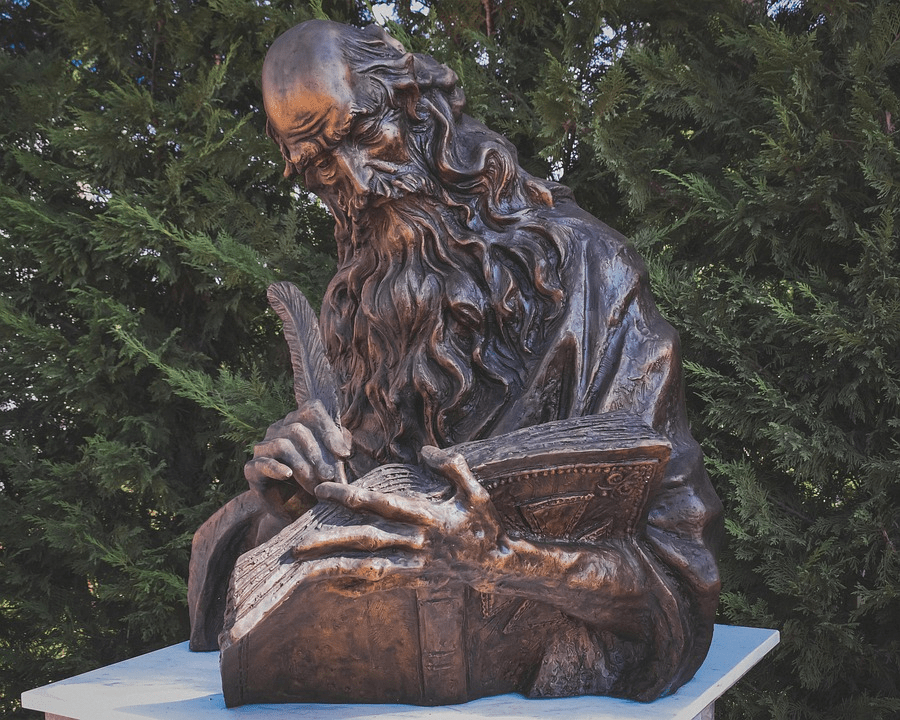
Evangelist John the Revelator
Evangelists are not just preachers—they are heralds of the Kingdom, bringing the good news to every corner of the earth. Their mission is to:
Proclaim the Gospel with clarity and conviction
Call sinners to repentance and faith in Christ
Equip the Church to share the Gospel
Pioneer new ministries and outreach efforts
🚨 The Church’s Neglect:
Many churches have sidelined the role of the Evangelist, relegating it to foreign missions or occasional revival meetings. This neglect has led to a lack of evangelistic fervor within local congregations, resulting in stagnation and decline.
🌟 Restoring the Evangelistic Gift:
To restore the Church’s vitality, we must reemphasize the importance of the Evangelist. This includes:
Recognizing and affirming those with the gift of evangelism
Providing training and resources for effective Gospel outreach
Creating opportunities for evangelistic ministry within the local church
Celebrating the fruit of evangelistic efforts
The Evangelist is a God-ordained gift to the Church, essential for its growth and health. Let us not ignore this vital role but embrace it with the urgency and passion it deserves.
🌟 The Overlooked Gifts: A Call to Action
Beyond the Evangelist, there are many other spiritual gifts that are often ignored or underutilized in the Church today. These gifts, given by the Holy Spirit, are meant to build up the Body of Christ and advance the Kingdom of God.
📖 Scriptural Basis:
1 Corinthians 12:4–7: “There are different kinds of gifts, but the same Spirit distributes them. There are different kinds of service, but the same Lord. There are different kinds of working, but in all of them and in everyone it is the same God at work. Now to each one the manifestation of the Spirit is given for the common good.”
Ephesians 4:11–13: “So Christ himself gave the apostles, the prophets, the evangelists, the pastors and teachers, to equip his people for works of service, so that the body of Christ may be built up until we all reach unity in the faith and in the knowledge of the Son of God and become mature, attaining to the whole measure of the fullness of Christ.”
🌈 A Diversity of Gifts:
The Holy Spirit has given a wide variety of gifts to the Church, including:
Teaching: The ability to explain and apply God’s Word effectively
Healing: A gift of faith and prayer to bring physical and spiritual healing
Administration: The ability to organize and lead with wisdom and efficiency
Hospitality: A heart to welcome and care for others
Discernment: The ability to distinguish between truth and error
🚀 A Call to Action:
The Church must:
Identify and nurture these gifts within its members
Create opportunities for these gifts to be exercised
Celebrate the diversity of gifts as a reflection of God’s creativity and purpose
By embracing the full spectrum of spiritual gifts, the Church can become the vibrant, Spirit-filled community God intended it to be. Let us not quench the Spirit but fan into flame the gifts He has given for the common good.
🌟 The Pastor/Teacher: Builders of Maturity
The role of the Pastor/Teacher is foundational to the Church’s mission of equipping believers and fostering spiritual growth. These leaders are not merely caretakers—they are builders, charged with developing disciples who can carry forward the work of the Kingdom.
📖 Scriptural Foundations:
Ephesians 4:11–13: “So Christ himself gave the apostles, the prophets, the evangelists, the pastors and teachers, to equip his people for works of service, so that the body of Christ may be built up until we all reach unity in the faith and in the knowledge of the Son of God and become mature, attaining to the whole measure of the fullness of Christ.”
Hebrews 5:12–14: “In fact, though by this time you ought to be teachers, you need someone to teach you the elementary truths of God’s word all over again. You need milk, not solid food! Anyone who lives on milk, being still an infant, is not acquainted with the teaching about righteousness. But solid food is for the mature, who by constant use have trained themselves to distinguish good from evil.”
2 Timothy 2:2: “And the things you have heard me say in the presence of many witnesses entrust to reliable people who will also be qualified to teach others.”
🌱 The Pastor/Teacher’s Mission:
Pastors and teachers are called to:
Equip believers with a deep understanding of God’s Word
Foster spiritual maturity and discernment
Develop new leaders and disciples from within the congregation
Create a culture of growth and multiplication
🚨 The Church’s Challenge:
A vibrant church is one that continually raises up leaders from within, rather than relying on external replacements for pastors and teachers. This requires intentional investment in discipleship and leadership development.
🌟 Restoring the Pastor/Teacher Role:
To restore the Church’s vitality, we must reemphasize the importance of the Pastor/Teacher. This includes:
Recognizing and affirming those with the gift of teaching and shepherding
Providing training and resources for effective discipleship
Creating opportunities for leadership development within the local church
Celebrating the fruit of spiritual growth and maturity
The Pastor/Teacher is a God-ordained gift to the Church, essential for its growth and health. Let us not ignore this vital role but embrace it with the urgency and passion it deserves.
🎁 Wrapping It All Together
The Church is called to be a living, breathing organism—a vibrant community that reflects the fullness of God’s design. This means embracing the diversity of gifts, restoring the offices of apostle, prophet, evangelist, pastor, and teacher, and nurturing the spiritual family with fathers and mothers who guide, correct, and inspire.
Let us rise to the challenge of becoming a “for prophet” organization once again. Let us hear the trumpet sound and respond with faith, courage, and action. The harvest is plentiful, the gifts are abundant, and the Spirit is ready to empower us for the work ahead.
May we be a Church that hears His voice, pioneers new territory, stirs the lost, and shepherds with compassion and clarity. The time is now. The call is clear. Let us answer with all our hearts.
“You are the light of the world. A city on a hill cannot be hidden. Neither do people light a lamp and put it under a bowl. Instead they put it on its stand, and it gives light to everyone in the house. In the same way, let your light shine before men, that they may see your good deeds and praise your Father in heaven. Matthew 5:14-16 (NIV)
Like the church in Thyatira that tolerated immorality in its midst, the evangelical church today has grown all too accepting of sin. The church is ducking the vital moral issues of our age. Rather than influencing our culture by being Gospel salt and light, the church has itself become influenced by the permissive culture in which we live.
The holy, blood-bought church of the Lord Jesus Christ is far more accommodating of sin than ever before. In many churches across America, homosexuals, adulterers and sexually active youth can sit in the church pew and rarely be confronted by the convicting Word of God.
Men and women who habitually and consistently practice sin should experience the convicting work of the Holy Spirit. There are far too many churches that tolerate members who deliberately pursue a sinful lifestyle in an open and unrepentant manner. Unfortunately, when that occurs—and it does all too often—the purity and holiness of the Bride of Christ is sullied, and the witness of the church in a corrupt culture is compromised.
I do not believe this is simply a culture war, or a battle between conservative and liberal elements of our society. It is much more than a drift away from the moral underpinnings that helped found and guide our nation for centuries.
This is a full-scale assault against Christianity and the followers of Christ. When prayer is banned from the public square, when our President fails to defend biblically defined marriage, and he openly and zealously advocates for gay rights; when legislators rush to overrule existing laws to promote gay marriage; when schools and courts consistently suppress religious freedoms; we know we are locked in a war against the Christian faith, not culture.
We are certain that we are of God,
but all the world is in the power of the Evil One.
The worldly systems of politics, courts, entertainment and education have almost entirely been stripped of the influence of Christian precepts and principles.
For too long Christian leaders have discouraged believers from entering into the arena of ideas. They have taught that we are to be separate from the world to such an extent that we see very little Christian influence in societal institutions. Too many Christians have remained inactive in political issues as well as societal issues, they choose instead to congregate with like-minded individuals, and do not take the call of Jesus to heart to go into all the world to teach them and disciple them, turning their darkness into light. What we see is a separated group which fears an engagement in societal matters, they are more like a bless me club, but fail miserably on the command to fight against evil and make disciples of all nations and as such bring a blessing to all nations, and people, and tongues.
Where is the evangelistic zeal of the Apostles who dared to defy lawmakers and stood in the public arena proclaiming the good news of Jesus Christ and with that proclamation denounced the ways of the Pharisees and Publicans. They had a Holy, righteous fire burning within their bosoms to confront evil with a heartfelt desire to see the whole world saved from the bondage of sin.
This is a critical hour for the church. The world is seeking for answers. The oppressed everywhere are crying out for help and deliverance. We cannot duck our responsibilities as Christ’s representatives to a lost and dying world. We must take a bold stand for the truth in every arena of our lives, deal ruthlessly with sin in our own heart and be men and women of uncompromising holiness. We need to be the ‘salt and light’ of the world and not hide under a bushel of fear somewhere waiting until Jesus returns.
Now is the time to “be watchful, stand firm in the faith, act like men, be strong” (1 Corinthians 16:13).
Martin Niemöller was a German church leader who stood with Dietrich Bonhoeffer against Hitler’s control of the church before and during WWII. That resistance, which landed Niemöller in the Dachau concentration camp and resulted in Bonhoeffer’s execution two weeks before the end of the war, contrasted with others in the church who cowered before the evil of the Third Reich. Many credit Niemöller with these words:
“First they came for the Communists, but I was not a Communist so I did not speak out. Then they came for the Socialists and the Trade Unionists, but I was neither, so I did not speak out. Then they came for the Jews, but I was not a Jew so I did not speak out. And when they came for me, there was no one left to speak out for me.”
Secularists, humanists, atheists and all the other enemies of truth are very bold and brazen about declaring what they believe. They roar around like lions seeking whomever they can devour with their lies and deceptions. We, who have the power of God working within and through us, should be just as bold if not more so. The opposition spares no expense, and wastes no time in making sure their messages are heard. But when the world is seeking a Word from the Lord, we hear the silence of the lambs. Nary a peep is heard, hardly a word is said, let alone proclaimed with power and confidence.
The word tells us that greater is He who is in us that he that is in the world. If God be for us who can be against us? In the words of Martin Luther the great reformer of old who penned the majestic hymn “A Mighty Fortress is Our God” we read these words:
And though this world,
with devils filled,
should threaten to undo us,
We will not fear,
for God hath willed
His truth to triumph through us.
The Prince of Darkness grim,
we tremble not for him;
His rage we can endure,
for lo, his doom is sure;
One little word shall fell him.
We have been entrusted with the truth of God’s word, we are empowered by the Spirit of the Living God, and we are equipped with the sword of the Spirit, which is the word of God, and yet we cower in fear because of the persecution that is sure to come because of Christ. We are to boldly go into all the world, and that includes the world’s institutions, to preach and teach and make them disciples of Christ. We are to take the truth of God’s world and challenge the wisdom of this age, and proclaim the release of the captives and sight to the blind.
Christ challenged His first disciples to go change the world, and they did. We are expected to do the same thing. Are we?
This is a view from the nest. What say you?
But those who are waiting for the Lord will have new strength; they will get wings like eagles: running, they will not be tired, and walking, they will have no weariness.Isaiah 40:31 (BBE)
Along for the journey
This has been A View from the Nest. The statements, comments, or opinions expressed are solely that of the author and do not represent the views or opinions of the host of this site or any affiliates thereof. Any questions or comments should be directed to myself and not to the host or hosts of this site.
Behold, we go up to Jerusalem; and the Son of man shall be delivered unto the chief priests and the scribes; and they shall condemn him to death, and shall deliver him unto the Gentiles: and they shall mock him, and shall spit upon him, and shall scourge him, and shall kill him; and after three days he shall rise again. Mark 10:33-34 (ASV)
NOW THAT IS GOOD NEWS! FOR IT’S A TRUTH, YOU CAN NOT KEEP A GOD MAN DOWN!






You must be logged in to post a comment.