
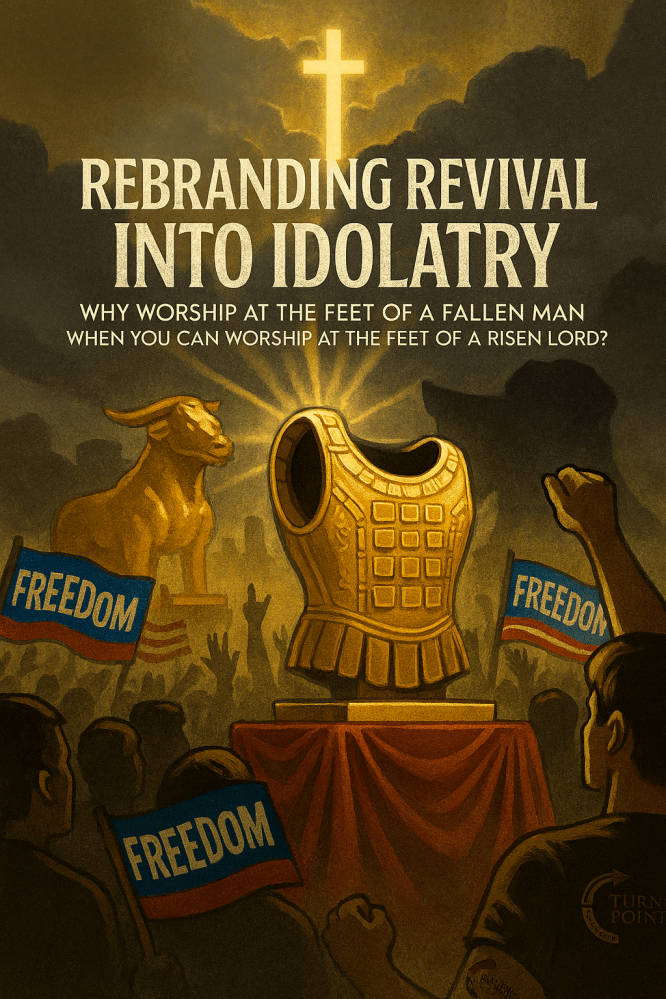
Why Worship at the Feet of a Fallen Man When We Can Worship at the Feet of a Risen Lord?
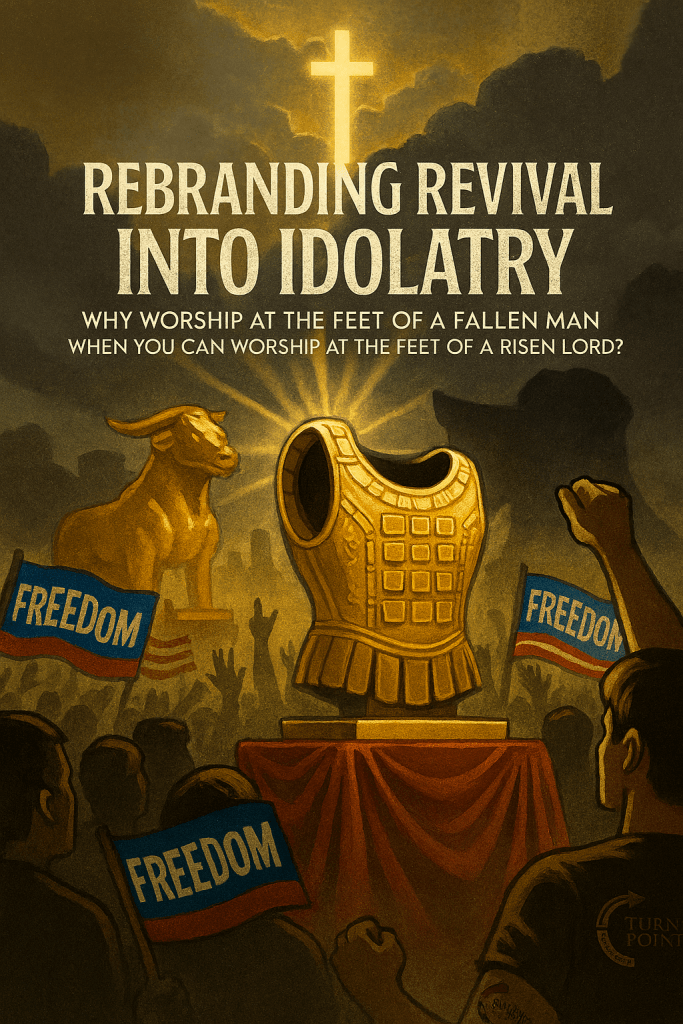
In the weeks since Charlie Kirk’s assassination, the nation has seen a surge of energy. News reports describe stadiums filled with mourners who have become activists. “FREEDOM” tee-shirts are flying off shelves. Turning Point tattoos are being etched into skin. The movement is swelling with momentum. Some hail it as revival. Others see it as a political awakening.
But momentum is not the same as revival. And history—biblical history—warns us that what begins as a move of God can sour into a monument to man.
Gideon in the Winepress
When we first meet Gideon in Judges 6, he is threshing wheat in a winepress, hiding from Midianite raiders. Hardly a revolutionary. Yet God calls him “mighty warrior” and raises him up to deliver Israel.
But God made it clear: the victory would not belong to Gideon. He whittled Gideon’s army down to 300 men so that no one could boast, “My own hand has saved me” (Judges 7:2). The triumph over Midian was not Gideon’s brilliance, not the zeal of his men, but the power of God alone.
Charlie Kirk, in many ways, became a Gideon figure for this generation. He had unassuming beginnings and a small band of devoted followers. He achieved a victory that seemed impossible against the tide of cultural opposition. His courage inspired many. But just as in Gideon’s day, the danger comes after the battle.
Rebranding Revival into Idolatry
After his victory, Gideon asked for gold from the spoils of war and “made an ephod of it and put it in his city, in Ophrah. And all Israel prostituted themselves by worshiping it there, and it became a snare to Gideon and his family” (Judges 8:27).
Here’s the problem:
- The ephod was a sacred priestly garment, commanded by God in Exodus 28 to be worn only by the high priest of Levi.
- It bore the names of Israel’s tribes and was used with the Urim and Thummim to discern God’s will (Exodus 28:29–30).
- Gideon was not a priest. He was from Manasseh (Judges 6:15). He had no authority to assume priestly garments.
By making an ephod, Gideon stepped outside his calling. And the people, instead of objecting, embraced it. They shifted their devotion from the God who delivered them to the symbol of victory. The ephod became a counterfeit center of worship.
And here is where the prophetic punch lands: Why worship at the feet of a fallen man when you can worship at the feet of a risen Lord?
Gold: Glory Turned to Graven
Gold was used to overlay the Ark of the Covenant, to adorn the tabernacle, and to craft the priestly garments. It symbolized God’s holiness and majesty. But when taken out of context—when melted down and molded by human hands—it became the golden calf (Exodus 32), a grotesque parody of divine worship.
Gideon’s ephod, fashioned from gold taken as spoils, echoes that same drift. What began as a symbol of victory became a snare. The people bowed not to God, but to the glitter of conquest.
Even Judas, in the shadow of the cross, traded the Son of God for thirty pieces of silver—precious metal once again used to betray glory.
Gold, when untethered from reverence, becomes the metal of misdirection.
Our Modern Ephods
Today, the parallels are sobering. Tee‑shirts, tattoos, slogans, and symbols are rising as rallying points. They are not evil in themselves. But they risk becoming ephods—objects of misplaced devotion that subtly shift the focus from the risen Christ to a fallen man, from the Deliverer to the movement.
The drift begins when no one raises the alarm. When the church accepts the symbol without questioning whether it has replaced the Savior. When we rally around the banner instead of the cross.
The Call Back to the Cross
Scripture is clear:
- “And I, when I am lifted up from the earth, will draw all people to myself” (John 12:32).
- “There is no other name under heaven given among men by which we must be saved” (Acts 4:12).
- “He must increase, but I must decrease” (John 3:30).
It wasn’t Gideon. It wasn’t the 300. It wasn’t the ephod.
It was God.
And so it must be with us. Organizing for better government is not wrong. Honoring courage is not wrong. But rallying around a name other than Jesus Christ is always wrong.
Final Word
The ephod warns us: symbols can become snares.
The cross reminds us: salvation is not in the symbol but in the Savior.
So let us ditch the ephods of our age and cling to the risen Lord. For it was never Gideon, never Charlie, never Turning Point—it was, and always will be, God.
Why worship at the feet of a fallen man when you can worship at the feet of a risen Lord?
This has been “A VIEW FROM THE NEST.” And that is the way I see it. What say you?


You must be logged in to post a comment.