
Take It Slow in the Snow


A Winter Road. A Spiritual Lesson. A Faithful Captain.
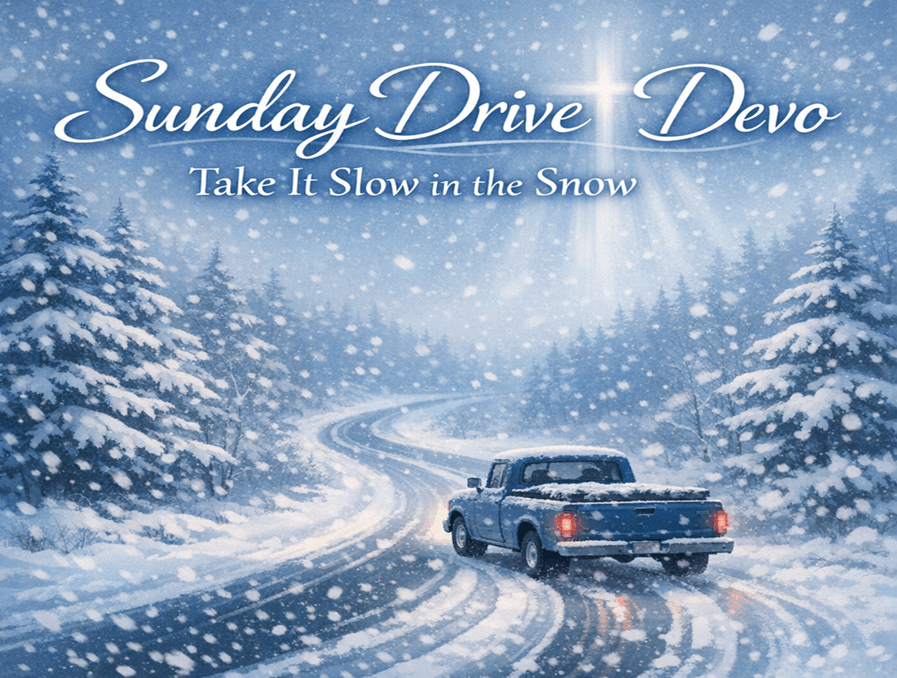
Opening

The weather outside may be frightful, and the roads may be anything but delightful. Snow piles up, visibility drops, and ice hides beneath the surface waiting to surprise the unprepared. On days like this, the wise stay home. But if you must venture out, safety is job one.

Take it slow in the snow.
Because where there is snow… there is almost always ice.

1. The Four‑Wheel Drive Myth

A lot of folks hit the winter roads thinking four‑wheel drive makes them invincible. But every seasoned driver knows the truth:

All tires slide on ice.
Four‑wheel drive helps you get moving — it does nothing to help you stop.

And sometimes?
Four‑wheel drive just gets you into trouble faster.

Spiritually, pride works the same way.

1 Corinthians 10:12 — “Let him who thinks he stands take heed lest he fall.”

Overconfidence is black ice for the soul.

2. Weight: The Hidden Stability

Years behind the wheel taught me something most people don’t understand:

An empty truck bed is unstable.
A loaded truck settles down.

Weight increases traction.
Weight presses the tires into the road.
Weight gives you control.

Spiritually, the same is true.

Psalm 119:11 — “Your word I have hidden in my heart, that I might not sin against You.”

A believer with Scripture inside them has spiritual downforce.
An empty soul slides.
A weighted soul stands.

3. Traction: Obedience Under Pressure

Dualies give you more rubber on the road — but only when there’s weight pressing them down.

Empty dualies?
They float on snow.
They lose grip.
They slide sideways.

But load that truck…
and those dualies bite into the surface and hold steady.

Obedience works the same way.

James 1:22 — “Be doers of the word, and not hearers only.”

Traction isn’t about speed — it’s about grip.
It’s about consistency.
It’s about doing what God said even when conditions are slick.

4. Modern Parables from the Road

Parable 1 — The Invisible Ice

Black ice looks like pavement.
Temptation looks like opportunity.

Proverbs 14:12 — “There is a way that seems right to a man, but its end is the way of death.”

Parable 2 — The Slow Driver Who Arrives

The one who slows down in the storm is the one who makes it home.

Isaiah 30:15 — “In returning and rest you shall be saved; in quietness and confidence shall be your strength.”

5. The Road as an Altar — First Person Revelation

I’ve spent a lot of years behind the wheel.
Long roads. Long nights. Long storms.
And if there’s one thing driving has taught me, it’s this:

Experience helps… but experience alone won’t save you.

I’ve learned to feel the road through the steering wheel.
I’ve learned how a truck talks when the bed is empty,
and how it settles down when it’s carrying weight.
I’ve learned the difference between snow and ice,
between a slide I can correct
and a slide that’s already decided for me.

But even with all that experience,
I’ve had moments where the road reminded me:
You don’t know what you don’t know.

And that’s exactly what happened on the Sea of Galilee.

The disciples weren’t rookies.
They were experienced fishermen — men who grew up on that water.
They knew the winds.
They knew the currents.
They knew the storms that came out of nowhere.

But one night, a storm hit that was bigger than their experience.

Mark 4:37 — “And a great windstorm arose, and the waves beat into the boat…”

These seasoned men panicked.
Why?
Because experience can teach you a lot —
but it can’t teach you everything.

Experience can make you skilled —
but it can’t make you sovereign.

Experience can help you navigate storms —
but it can’t calm them.

Only Jesus can do that.

Mark 4:39 — “Then He arose and rebuked the wind, and said to the sea, ‘Peace, be still!’”

And someone always brings up Paul’s shipwreck as a rebuttal —
“See? Even a man of God can go down in a storm.”

But look closer.

The ship wrecked…
but the people didn’t.

Acts 27:22 — “There will be no loss of life among you, but only of the ship.”

Why?
Because a man of God was on board.
Because God had a purpose for Paul that no storm could cancel.
Because Jesus wasn’t just along for the ride —
He was the Captain of the outcome.

And that’s the lesson I’ve learned on the road:

I can have experience.
I can have skill.
I can have traction and weight and wisdom.
But if I try to navigate a storm on experience alone,
I’m headed for a wreck.

But if Jesus is in the cab with me —
better yet, if He’s the One holding the wheel —
then even if the truck slides,
even if the road gets rough,
even if the storm gets violent…

I’m going to make it.

Not because I’m a great driver.
But because He’s a faithful Captain.

Psalm 121:8 — “The LORD shall preserve your going out and your coming in…”

Final Reflection

And before I close this out, let me say one more thing — something personal, something true, something I carry with gratitude every single day:

I’ve survived over three million miles behind the wheel.
Accident‑free.
Incident‑free.
Storms, snow, ice, long nights, empty roads, and crowded highways —
and I’m still here.

Not because I’m the best driver.
Not because I always made the right call.
Not because experience never failed me.

I’m here because Jesus piloted my ship.

Three million miles…
and not one of them driven alone.

Thank You, Jesus.

Closing

If you have nowhere to go today, let it snow.
Rest. Be still.

But if God calls you forward, take it slow in the snow.
Move with wisdom.
Move with awareness.
Move with Him.

Because the One who guides you through the storm
is the same One who clears the road ahead.

Proverbs 3:6 — “In all your ways acknowledge Him, and He shall direct your paths”

Doing the Right Thing


Scripture tells us: Someone may say, “I’m allowed to do anything,” but not everything is helpful. I’m allowed to do anything, but not everything encourages growth. People should be concerned about others and not just about themselves. 1 Corinthians 10:23-24 (GW)

In other words. In a Free society we are free to do lots of things, but there are things which are not wise to do. We are free to do these things, but not all things are for the common good or work to betterment of society.

Benjamin Franklin, statesman and signer of our Declaration of Independence, said: “Only a virtuous people are capable of freedom. As nations become corrupt and vicious, they have more need of masters.” John Adams, another signer, echoed a similar statement: “Our Constitution was made only for a moral and religious people. It is wholly inadequate to the government of any other.”

Legality alone cannot be the guide for moral people. The moral question is, is it the ‘right’ thing to do? Keep in mind that slavery was legal; apartheid was legal; the Nazi’s Nuremberg Laws were legal; and the Stalinist and Maoist purges were legal.

Are today’s Americans virtuous and moral, or have we made immorality and corruption legal? Let’s think about it a little shall we?

Suppose I saw an elderly woman pain­fully huddled on a heating grate in the dead of winter. I credit Walter E. Williams for this analogy. She’s hungry and in need of shelter and medical attention. To help the woman, I walk up to you using intimidation and threats and demand that you give me $200. Having taken your money, I then purchase food, shelter and medical assistance for the woman.

Would I be guilty of a crime? A moral person would answer yes because I was stealing from my neighbor. Most Americans would agree that it would be theft regardless of what I did with the money.

Now comes the hard part.

Using Walter E. Williams’ analogy again.

What if instead of personally taking your money to assist the woman, I got together with other Americans and asked Congress to use Internal Revenue Service agents to take your money? In other words, does an act that’s clearly immoral and illegal when done privately become moral when it is done legally and collectively? To put it another way, does legality establish morality?

I believe that assisting one’s fellow man in need by reaching into one’s own pocket is praiseworthy and laudable. In fact scripture teaches the same thing. Remember the parable of the Good Samaritan:

“A man went from Jerusalem to Jericho. On the way robbers stripped him, beat him, and left him for dead. “By chance, a priest was traveling along that road. When he saw the man, he went around him and continued on his way. Then a Levite came to that place. When he saw the man, he, too, went around him and continued on his way. “But a Samaritan, as he was traveling along, came across the man. When the Samaritan saw him, he felt sorry for the man, went to him, and cleaned and bandaged his wounds. Then he put him on his own animal, brought him to an inn, and took care of him. The next day the Samaritan took out two silver coins and gave them to the innkeeper. He told the innkeeper, ‘Take care of him. If you spend more than that, I’ll pay you on my return trip.’ “Of these three men, who do you think was a neighbor to the man who was attacked by robbers?” Luke 10:30-36 (GW)

This man took from his own resources to help the man in need. The first part of this story reminds me more of the government thugs who beat down businessmen on their way into town to do business and leave them by the side of the road as road kill. The poor business man was minding his own business, had profit in his pocket, and these thugs and robbers beat him down and took it from him leaving him to fend for himself. What this fellow needed was some compassion and someone to look on him to tend to his wounds but instead what he got was more ridicule, insults, and another beat down from the passers-by who wanted to take even more from him.

A good neighbor, or good Samaritan, or better put, a good citizen would have compassion on someone who truly is in need and would reach into their own pocket to provide for this persons needs. This is true charity and this is what the bible refers to as caring for a neighbor. This scripture condemns the ones who ignored the person in need as well as the robbers who beat and stole from the person.

Jesus taught to go and do like the good Samaritan. Reaching into another’s pockets is despicable, dishonest and worthy of condemnation.

Some people call governmental handouts charity, but as far as charity is concerned, James Madison, the acknowledged father of our Constitution, said, “Charity is no part of the legislative duty of the government.” To my knowledge, the Constitution, as penned by Thomas Jefferson has not been amended to include charity as a legislative duty of Congress. Granted our Supreme court has figured out some way to weave the ‘General Welfare’ clause to include whatever congress wants to do in order to take money from one person to give to another. This is not done for charitable purposes but rather to maintain positions of power and control over the population. Making dependents of people is the aim and not tending to make these people better citizens. In order to offer this ‘assistance’ the government must steal the resources of another person thus depriving them of their rights and liberties. And some call this ‘charity’.

“Our current economic crisis, is a direct result of immoral conduct”. This again comes from Walter Williams. It is legal alright but it is immoral none-the-less.

I like how the purveyors of entitlements like to frame the argument that you are greedy and mean-spirited to deny help to the needy while at the same time they ignore their own greed and the mean-spiritedness of their own actions by demanding the property of their neighbor. They do not ask politely, they are not even concerned if the person from whom they are stealing can afford to have their possessions confiscated. Since the recipients of such ‘charity’ are not the ones actually stealing from their neighbor they somehow feel justified in wanting more and more of what belongs to their neighbor. This is called covetousness and is condemned by scripture. Just because something is legal does not mean it is the ‘right thing to do.’ And it is certainly not in the general welfare of society to be stealing from one person just to give to another.

Roughly two-thirds to three-quarters of our federal budget can be described as Congress’ taking the property of one American and giving it to another. Social Security, Medicare and Medicaid account for nearly half of federal spending. Then there are corporate welfare and farm subsidies and thousands of other spending programs, such as food stamps, welfare and education. Yes, education. Education is a welfare program because you are not paying for the education of your own children but rather you are demanding that your neighbor pay for your child’s education. Since the cost of educating your child is spread among your neighbors you do not see the real cost and burden your actions is placing upon society and the burdens you are forcing your neighbors to bear.

According to a 2009 Census Bureau report, nearly 139 million Amer­icans — 46 percent — receive handouts from one or more federal programs, and nearly 50 percent have no federal income tax obligations. In other words roughly 50% of our population are taking something from their neighbor and giving nothing back. They are contributing nothing to the “general welfare” of their neighbors.

In the face of our looming financial calamity, what are we debating about? It’s not about the reduction or elimination of the immoral conduct that’s delivered us to where we are. It’s about how we pay for it — namely, taxing the rich, not realizing that even if Congress imposed a 100% tax on earnings higher than $250,000 per year, it would keep the government running for only 141 days. Ayn Rand, in her novel Atlas Shrugged, reminded us that “when you have made evil the means of survival, do not expect men to remain good.” In other words when you legalize immorality you have people acting immorally and demanding more and more from their neighbors. There are too many thieves and robbers in our society and not enough good Samaritans.

That is the way I see it! What say you?

This has been A View from the Nest. The statements, comments, or opinions expressed are solely that of the author and do not represent the views or opinions of the host of this site or any affiliates thereof. Any questions or comments should be directed to myself and not to the host or hosts of this site.
Enhanced by Zemanta