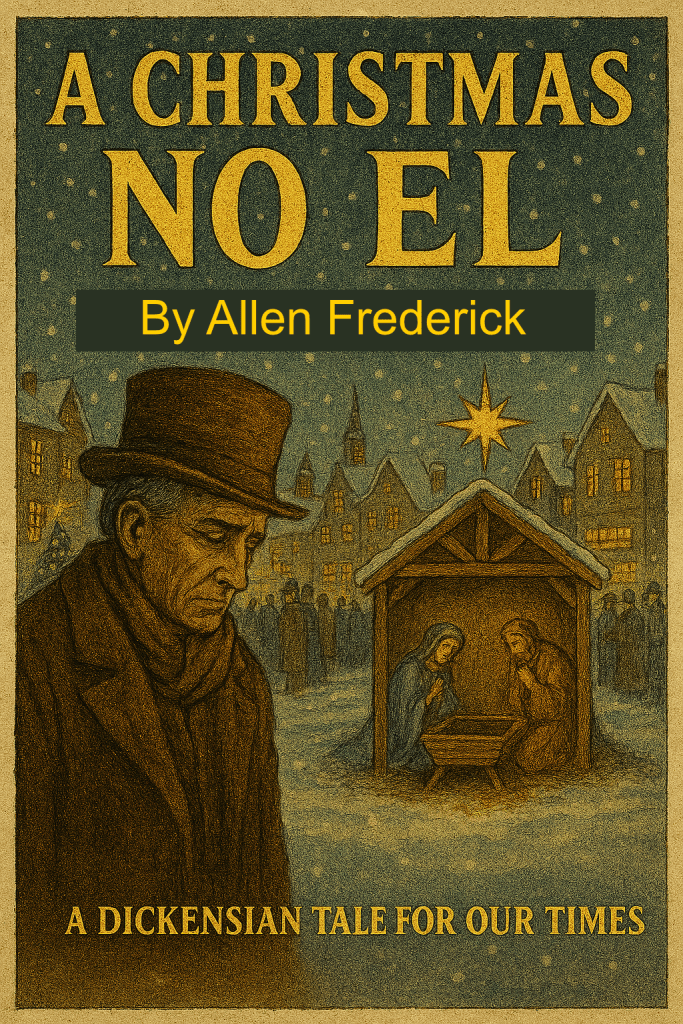
✦ A Christmas No El ✦ A Dickensian Tale for Our Times


Stave One — In Which Christmas Appears Full, Yet Empty

In the bustling town of Fairbridge, where every lamppost glittered and every window glowed, Christmas had arrived with all its customary clamor. The streets rang with carols, the shops overflowed with tinsel and trinkets, and the town square boasted a nativity scene so polished and picturesque that even old Charles Dickens might have paused to admire it.

Yet something was wrong.

For though the shepherds stood in their places, and the wise men knelt in their frozen devotion, the manger — the very heart of the scene — lay empty.

“Another one stolen,” sighed the constable. “Baby Jesus gone missing again. Third one this week.”

And so begins our tale.

Thomas Bright, a weary soul with more questions than answers, had spent the afternoon wandering the aisles of Bargain Barn — a sprawling emporium of markdowns and merriment, its wooden rafters and rustic beams unintentionally echoing the very barn of Bethlehem.

He had seen Christmas trees stacked to the ceiling, lights blinking like frantic stars, inflatable Santas wobbling in perpetual cheer, and enough wrapping paper to swaddle the world twice over. But the Christ child? Nowhere.

“Christmas is everywhere,” Thomas muttered, “and yet Christ is nowhere.”

He returned home and flipped through the cable channels, hoping perhaps to find Him there. But every movie was a love story. Every special was about family, good cheer, or exchanging gifts. There were tales of goodwill and warm feelings, of snowstorms and reconciliations, of miracles that never mentioned the Miracle Maker.

He watched a dozen Christmas stories — and not one contained Christ.

“Even the stories,” he whispered, “have forgotten the Story.”

He turned off the television, sat in silence, and stared out the frosted window. Outside, the town square glowed with pageantry. Inside, his heart ached with absence.

He did not yet know it, but the night had prepared a visitation for him.


Stave Two — The Ghost of Christmas Misplaced

Thomas awoke to a soft rustling at the foot of his bed. There, glowing faintly in the moonlight, stood a small plastic figure — the very Baby Jesus stolen from the town square.

“Fear not,” said the figurine, its voice gentle yet grave. “I am the Christ Child you have misplaced.”

Thomas blinked. “But… you’re just a decoration.”

“Indeed,” replied the Child, “and so you have made Me.”

The room dissolved, and Thomas found himself walking through the town. Everywhere he looked, he saw nativity sets — in yards, in storefronts, in church foyers — each one missing its central figure.

“You have built Me scenes,” said the Child,
“but not space.
You have carved Me statues,
but not room in your hearts.
You have placed Me in plastic,
but not in practice.”

They passed a church where a Christmas pageant was underway. Children in robes recited lines, parents filmed with their phones, and applause filled the sanctuary.

“But where am I?” asked the Child.

Thomas looked. The manger was empty.


Stave Three — The Ghost of No Kings

A trumpet blast split the air, and the scene shifted. Thomas now stood in the midst of a rally — signs waving, voices shouting:

“NO KINGS IN AMERICA!”
“DOWN WITH MONARCHS!”
“WE BOW TO NONE!”

At the center stood a tall, stern figure robed like Herod of old, though dressed in modern attire.

“I am the Spirit of Earthly Power,” he declared. “And I fear any king but myself.”

The crowd roared.

Thomas trembled. “Is this what we’ve become?”

The Spirit nodded. “You celebrate a holiday about a King, yet refuse His rule. You sing of His birth, yet resist His reign. You want a baby in a manger — harmless, silent, sentimental — but not a King who commands allegiance.”

The wise men appeared beside Thomas, their faces solemn.

“We sought Him,” they said. “We traveled far. We bowed low. But you — you search Bargain Barn aisles and wonder why you cannot find Him.”

The shepherds joined them. “We left our flocks. You will not leave your comforts.”

The Spirit of Earthly Power sneered. “You have no kings in America — and so you have none in your hearts.”


Stave Four — The Ghost of Christmas Yet to Come

A cold wind swept through the square, and the world dimmed until only a single figure remained — tall, cloaked, and silent. No face could be seen beneath the hood, yet Thomas felt its gaze pierce him deeper than any words could.

“You…” Thomas whispered. “You must be the Spirit of Christmas Yet to Come.”

The figure did not speak, but lifted a hand — long, pale, and unwavering — and pointed toward the heavens.

The sky split open.

Not with snow.
Not with stars.
But with fire and glory.

Thomas shielded his eyes as a radiant figure descended — not a baby, not a child, but a King. His eyes were like flames, His voice like rushing waters, and on His robe and on His thigh was written:

KING OF KINGS
AND LORD OF LORDS

Thomas trembled. “This… this is Jesus?”

The Spirit nodded.

Gone was the manger.
Gone the swaddling cloths.
Gone the gentle lullaby of Bethlehem.

This was the Christ of Revelation — the One who rides the white horse, the One before whom every knee bows, the One who judges the nations with righteousness.

Thomas watched as crowds fled, not from a baby, but from a King they had ignored. He saw pageants crumble, lights flicker out, and all the glitter of Christmas fade like mist before the sun.

And then he saw something worse:

People searching for the baby in the manger —
but the manger was empty.
The barn was empty.
The world was empty.

Because they had looked down when they should have looked up.

The Spirit’s voice finally broke the silence, low and solemn:

“You search for a child in a crib,
but you must prepare for a King on a throne.”

Thomas fell to his knees. “What must I do?”

The Spirit pointed — not to the sky, but to Thomas’s own chest.

A heart.
A throne.
A choice.

And then the vision vanished.


Stave Five — The Search

Thomas found himself alone in a vast marketplace of Christmas cheer. Lights blinked. Bells jingled. Artificial snow drifted from machines. Everywhere he turned, he saw the trappings of the season — but never the One it claimed to celebrate.

“Where are You?” Thomas cried.

A voice answered behind him.

“I am where I have always been — among the humble, the seeking, the surrendered.”

Thomas turned and saw the Christ Child again — no longer plastic, but radiant with quiet authority.

“You will not find Me in the noise,” He said.
“Nor in the pageantry.
Nor in the glittering aisles of commerce.
I am not lost — but you have wandered.”

Thomas fell to his knees. “Then show me where to look.”


Stave Six — The Christ of Christmas Found

The Child touched Thomas’s shoulder, and suddenly he was back in his room. The dawn of Christmas morning crept through the window.

But something had changed.

Thomas rose, not to unwrap gifts or check his phone, but to kneel. To seek. To surrender.

And as he did, he felt the presence he had been searching for — not in a manger, not in a store, not in a pageant — but in the quiet chambers of a heart finally yielded.

Outside, the town square unveiled a new nativity scene. This time, the manger was not empty. For Christ had been found — not because He returned, but because someone finally looked in the right place. And so the truth of the tale rang out with quiet authority:

Jesus is not searching for a church to attend,
nor a pageant to participate in,
nor a carol to be sung in His honor,
nor any of the trappings we pile around Christmas.
He is searching for a heart to inhabit,
a life to transform,
and a soul to save —
for He is found by the seekers,
seen by the searchers,
and revealed to the hearts that truly look for Him.

Outro — A Call to Seek

If this story stirred something in you, don’t let the search end here. Look beyond the noise, beyond the glitter, and find the true heart of Christmas. Seek, surrender, and let the King find a throne in your heart.

Subscribe for more stories that challenge and inspire.

REIMAGING THE NATIVITY


A poetic retelling of the Christmas story.

The Christmas Light


“And the light goes on shining in the dark; it is not overcome by the dark.”
John 1:5 (BBE)

I was driving east on the Pennsylvania Turnpike late on Christmas Eve, logging mile after mile of deep darkness. The road was quiet. The sky was heavy with low clouds. The only light came from my headlights cutting a narrow path forward.

But as I approached the outskirts of Philadelphia, something unexpected happened. The sky began to brighten — not a little, but dramatically. It looked as if dawn were breaking, yet the clock insisted it was only 1 AM. The closer I drove toward the city, the brighter the sky became. Light bounced off the cloud cover. It reflected off the snow‑covered ground. This transformed the night into something that felt almost like day.

I had never seen anything like it. I even checked the time twice, just to be sure.

Light is like that. It doesn’t need permission. It doesn’t need ideal conditions. It doesn’t even need to be strong. A single source can transform an entire landscape. After more than 200 miles of darkness, one city’s glow changed everything.

And on that Christmas morning, it felt fitting — creation itself offering a reminder.

The Wise Men Followed a Light Too

Epiphany tells the story of travelers from the East. They saw a light in the sky. They knew it meant something. They didn’t understand it fully, but they recognized it as a sign worth following. Their journey took them to Jerusalem. Then they went to Bethlehem. They were guided by scripture and by a star that refused to be ignored.

They were seeking a King.

I wasn’t seeking anything that night — just heading east to be with family. That strange illumination across the sky whispered the same truth the wise men discovered. Jesus is the Light of the world. His light still breaks into the darkness.

Light That Leads Us Home

Jesus said, “He who follows Me shall not walk in darkness, but have the light of life.” (John 8:12)

That’s not poetic language — it’s a promise.

His light reveals the path.
His light exposes what would trip us.
His light brings warmth, clarity, and direction.
His light cannot be overcome.

And one day, His return will blaze across the sky from east to west — unmistakable, unmissable, undeniable.

A Question for the Road

Have you seen the Light?
Not the glow of a city on a snowy night, but the Light that shines into the human heart.

Are you following Him the way the wise men followed the star — with intention, with expectation, with readiness?

Because the same Jesus who came quietly in Bethlehem will come again in glory.

“Those who wait for the Lord will renew their strength;
they will rise up with wings like eagles.”
Isaiah 40:31

Until that day, every step of the journey matters.
Every mile.
Every moment of unexpected illumination.
Every reminder that darkness never gets the final word.

So as you take today’s Sunday drive, let this truth settle in your spirit:

The Light still shines.
The Light still leads.
And the Light is coming again.

Christ’s Love Once for All


Advent lights a final candle and calls it love. But was love for God found in that manger? God’s love most certainly was—He sent His Son into the world, wrapped in flesh, laid in a smelly stall because there was no room inside. That was love incarnate.

Yet even then, it stood in stark contrast to the hearts of men. Cold toward God, busy chasing worthless idols, fearful of authority, hardened by religion. The same voices that ignored Him at His birth would later cry, “Crucify Him! Crucify Him!” (Luke 23:21).

Love is not found in ritual candles or seasonal sentiment. It is found in the cross. “God demonstrates His own love for us in this: while we were still sinners, Christ died for us” (Romans 5:8). That is once‑for‑all love—eternal, unrepeatable, unshakable.

The Advent candle flickers sentimentally, but the cross blazes with eternal love. Love is not seasonal—it is finished.


Prophetic Closing

Do not mistake ritual for reality. God’s love was revealed in a manger, but fulfilled at the cross. The Christ Mass fails to display it, because true love is not a flicker—it is the once‑for‑all sacrifice of Christ. Stop chasing idols and seasonal shadows. Receive the love that was proven once, forever.

From Manger to Marriage: Preparing the Bride, Not the Cradle


God’s Jealous Holiness

The very first commandment thunders: “You shall have no other gods before Me” (Exodus 20:3). This is not a suggestion—it is the foundation of covenant faith. God is a consuming fire (Deuteronomy 4:24), a jealous God who refuses to share His glory with idols (Isaiah 42:8). When His people profane His name by mixing pagan practices with worship, His wrath is stirred. Israel learned this the hard way: when they borrowed from Baal and the nations, He sent them into exile (Jeremiah 7:30–34).

Today, the church risks the same judgment. By elevating Christmas—a festival grafted onto the pagan worship of Sol Invictus, the sun god—we profane His holiness. We call it “the Christmas story,” but nowhere in Scripture are we commanded to honor His birth. The gospel is not about repeating manger scenes; it is about Christ crucified, risen, and returning.

The manger is past; the marriage is coming.


The Days of Noah Revisited

Jesus warned: “As it was in the days of Noah, so shall it be at the coming of the Son of Man” (Matthew 24:37–39). In Noah’s day, people ate, drank, married, bought, and sold—business as usual—until judgment swept them away.

Is it any different now? We have Christmas parties, shopping frenzies, and sentimental carols. There are decorated trees and manger displays. Meanwhile, the church remains oblivious to the urgency of Christ’s return. We are living in the days of Noah again: distracted, unprepared, blind to the storm clouds of judgment.

The manger is past; the marriage is coming.


The Gospel’s Completeness

The Incarnation was necessary because of sin, but it is not the center of the gospel. Scripture declares: “Christ was offered once to bear the sins of many” (Hebrews 9:28). Once born, once crucified, once risen. The manger is history; the cross is complete.

We do not rebirth Him every December. We do not repeat the gospel cycle of “baby Jesus” year after year. The gospel is eternal, not seasonal. Christ is alive, reigning, and coming again.

The manger is past; the marriage is coming.


The Bride vs. the Cradle

  • Christmas Sentiment: Preparing straw, donkeys, sheep, and manger scenes.
  • Kingdom Reality: Preparing garments of righteousness, hearts of repentance, and readiness for the Bridegroom (Revelation 19:7).

The church’s obsession with the cradle blinds it to the call of the Bride. Jesus is not looking for another manger; He is looking for a bride clothed in holiness, ready to receive Him.

The manger is past; the marriage is coming.


Hebrews 6: A Rebuke to Infancy

“Therefore let us leave the elementary doctrine of Christ and go on to maturity, not laying again a foundation of repentance from dead works and of faith toward God…” (Hebrews 6:1–3).

This is the piercing word for our generation. Year after year, the church lays again the same foundation. It presents Jesus as a baby in a manger. It shows Jesus on a cross and Jesus in a tomb. We rehearse the same scenes, decorate the same altars, and sing the same sentimental songs. But we never move on to the deeper things. These include resurrection power, eternal judgment, the indwelling Spirit, and the preparation of the Bride.

God’s Wrath Against Idolatry

The prophets declared that God hates corrupted festivals (Amos 5:21–23). He judged kings who tolerated Baal worship. He destroyed altars that profaned His name.

Christmas is not harmless tradition—it is a borrowed glory, a pagan overlay baptized into the church. God’s wrath is against all ungodliness and idolatry (Romans 1:18). To elevate Christmas as a “high holy day” is to risk His jealousy.


The Prophetic Call

The Spirit is saying: Stop profaning His glory with borrowed festivals.

  • Return to His appointed times—Passover, Pentecost, Tabernacles—the feasts Christ fulfilled and will fulfill.
  • Celebrate the living Christ, not a sentimental tradition.
  • Prepare not for another manger, but for the coming King.
  • Grow up into maturity—leave behind childish cycles and walk in the fullness of Christ.

The manger is past; the marriage is coming.


Closing Admonition

The jealous God is not looking for decorated trees or nostalgic carols. He is looking for a bride clothed in righteousness, ready to meet Him. The manger is past; the marriage is coming. The days of Noah are upon us—business as usual while judgment looms.

The call is urgent: repent, prepare, and watch, for the Bridegroom is at the door. Let us leave behind infancy and tradition, and go on to maturity in Christ.

The manger is past; the marriage is coming.