
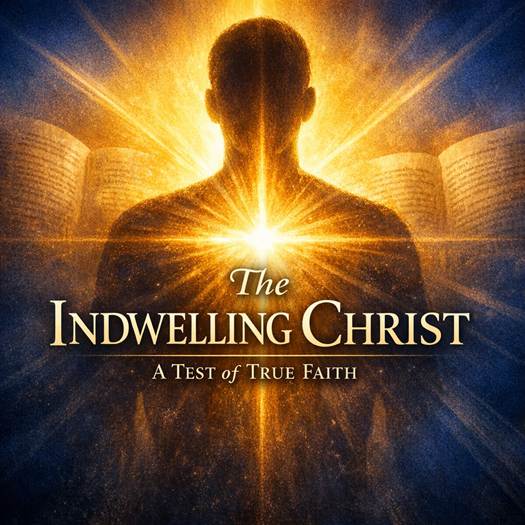
A Call to Honest Examination
Paul’s command in 2 Corinthians 13:5 is not gentle counsel but a summons: “Examine yourselves to see whether you are in the faith; test yourselves.” He does not ask us to recall a moment of sincerity or to lean on a memory of spiritual awakening. He calls us to look honestly at the present reality of our inner life. The question is not whether we once believed, but whether Christ is truly dwelling within us now. Paul presses the point further: “Do you not realize that Christ Jesus is in you—unless, of course, you fail the test?” The test is not about religious activity. It is about indwelling. It is about whether the life of Christ is actually present and active within the believer.
Christ Within: The Only True Evidence
Scripture makes this standard unmistakably clear. Paul writes, “Christ in you, the hope of glory” (Colossians 1:27). If Christ is in us, there is hope. If Christ is not in us, there is no glory at all. John echoes this reality when he says, “He who has the Son has life; he who does not have the Son of God does not have life” (1 John 5:12). Life is not found in religious familiarity but in union with Christ Himself. Paul goes even further in Romans 8:9: “If anyone does not have the Spirit of Christ, he does not belong to Christ.” The dividing line is not church attendance, doctrinal agreement, or moral behavior. The dividing line is the presence or absence of Christ within.
The Danger of Overestimating Ourselves
This is why Paul warns us not to overestimate our spiritual condition. “Do not think of yourself more highly than you ought” (Romans 12:3). We are prone to assume devotion because we participate in religious environments. We sit in church, we sing the songs, we nod at the sermons, and we assume these things testify on our behalf. Yet Jesus confronted the most religious people of His day with devastating clarity: “This people honors Me with their lips, but their heart is far from Me” (Matthew 15:8). External proximity is not internal reality. The Pharisees prayed, fasted, tithed, taught Scripture, and yet Jesus said, “You are like whitewashed tombs… outwardly you appear righteous to men, but within you are full of dead men’s bones” (Matthew 23:27). They failed the test not because they lacked religious activity, but because they lacked the indwelling Christ.
The Voice That Reveals Our Allegiance
Jesus Himself defined the test of true discipleship with piercing simplicity: “My sheep hear My voice, and I know them, and they follow Me” (John 10:27). The evidence of belonging to Christ is not merely hearing Christian voices but hearing His. It is not following Christian culture but following Him. The modern church has trained many believers to outsource their spiritual discernment to pastors, authors, influencers, and institutions. Yet Jesus did not say, “My sheep hear their pastor’s voice.” He said they hear His. And He warned that many who assume they belong to Him will discover otherwise: “Not everyone who says to Me, ‘Lord, Lord,’ will enter the kingdom of heaven, but only he who does the will of My Father” (Matthew 7:21). Words are not proof. Obedience is.
The First Commandment as the True Measure
This is why the first commandment is the true measure of the heart. Jesus said, “You shall love the Lord your God with all your heart, and with all your soul, and with all your mind, and with all your strength” (Mark 12:30). That word all dismantles every rival authority. To love God with all your mind means His Word outranks the voices of media, academia, science, politics, and even our own understanding. Proverbs speaks directly to this: “Trust in the LORD with all your heart and lean not on your own understanding” (Proverbs 3:5). To love Him with all your heart means no affection competes with His. To love Him with all your strength means obedience is not occasional but the natural outflow of devotion. Jesus tied love and obedience together when He said, “If you love Me, you will keep My commandments” (John 14:15). Love without obedience is sentiment. Obedience without love is religion. True discipleship holds both.
Adam, Eve, and Abraham: Two Portraits of the Test
Scripture gives us two vivid portraits of this test. Adam and Eve failed it because they trusted another voice above God’s. The serpent questioned God’s character, and they embraced the lie. The text says, “When the woman saw that the tree was good for food… she took of its fruit and ate” (Genesis 3:6). They trusted their eyes over God’s Word. They leaned on their own understanding instead of His command. Their failure was not about fruit; it was about allegiance. Abraham, by contrast, passed the test because he trusted God’s character even when the command made no sense. When God said, “Take your son, your only son Isaac, whom you love… and offer him there” (Genesis 22:2), Abraham obeyed. Hebrews explains why: “He considered that God was able even to raise him from the dead” (Hebrews 11:19). Abraham trusted God’s voice above his own logic, above his emotions, above the visible circumstances. That is what passing the test looks like.
The Inner Witness of the Spirit
When Paul tells us to examine ourselves, he is calling us into that same clarity. He is asking whether Christ is truly the center of our affections, the anchor of our decisions, the voice that shapes our convictions, and the Lord who governs our steps. John gives us a simple diagnostic: “By this we know that we have come to know Him, if we keep His commandments” (1 John 2:3). Not perfectly, but sincerely. Not flawlessly, but faithfully. The presence of Christ produces repentance, humility, endurance, holiness, and a growing love for truth. The absence of Christ produces apathy, compromise, self‑rule, and selective obedience. Paul’s command is not meant to create fear but honesty. It is not meant to condemn but to reveal. And when Christ truly dwells within us, His Spirit bears witness with our spirit that we are children of God (Romans 8:16).
Christ in You: The Only Hope of Glory
For if Christ is in us, His presence will not remain hidden. His life will press outward. His voice will rise above the noise. His truth will confront our excuses. His holiness will shape our conduct. And His glory will begin to take form within us, even in quiet and unseen ways. But if Christ is not in us—if our faith is merely cultural, inherited, intellectual, or performative—then no amount of religious activity can compensate for His absence. Jesus warned of this with sobering clarity: “Apart from Me you can do nothing” (John 15:5). Without Him, we may appear spiritual, but we will lack the life that only He can give.
Returning to the Center
This is why Paul’s command matters. It calls us back to the center. It calls us to the first love. It calls us to the first commandment. It calls us to the living Christ who does not merely inspire from a distance but dwells within those who belong to Him. The hope of glory is not found in our performance, our knowledge, our traditions, or our religious habits. The hope of glory is Christ in us. And nothing less will do.



You must be logged in to post a comment.